Economic Affairs
Authors
Matthew Boswell
News Type
News
Date
Paragraphs

Governments, markets, and analysts in the United States and around the world frequently find themselves surprised by China’s capabilities in industries central to economic and national security—from artificial intelligence and robotics to pharmaceuticals, advanced manufacturing, and strategic supply chains. Episodes widely described as “DeepSeek moments” reflect more than isolated breakthroughs; they reveal a systematic failure to understand how China builds technological capacity and scales it with speed. At the Stanford Center on China's Economy and Institutions' third annual China Conference, leading academics and policy experts examined both the phenomenon and the repercussions of those assumptions. A common thread emerged: the world’s prevailing frameworks for assessing China’s innovative capacity often underestimate it, and the consequences of that blind spot are growing.

A Sweeping Tech Ambition with Self-Sufficiency at the Core
Barry Naughton, a leading economist of China at UC San Diego, framed the stakes: China’s innovation apparatus, he argued, is not simply a set of R&D programs—it is part of an “across-the-board commitment” to recreate within China’s borders all of the sophisticated inputs required to run a modern economy. The goal, embedded in successive five-year plans, is what China’s policymakers call a “modernized industrial system”: an economy in which technological spillovers are captured domestically rather than leaking out to foreign suppliers and partners.

This ambition carries enormous costs. Fiscal revenues as a share of GDP have fallen by roughly seven percentage points since 2015, Naughton noted, as resources have been channeled into industrial priorities. Local governments—many of them carrying deep deficits—continue to fund showy high-tech parks and innovation consortia in response to signals from Beijing. The result, as Naughton and others put it, is a system producing “impressive achievements alongside an enormous amount of waste.”

The goal is what China’s policymakers call a “modernized industrial system”: an economy in which technological spillovers are captured domestically rather than leaking out to foreign suppliers and partners.

Semiconductors: The Limits of Containment?
The conference returned repeatedly to America’s use of export controls—and whether they are working. The verdict was nuanced. Philip Wong, the Willard R. and Inez Kerr Bell Professor of Electrical Engineering at Stanford, argued that in the semiconductor space the strategy has plainly backfired. By cutting China’s firms off from American chip-making equipment and advanced logic chips, the controls created a large captive domestic market for China’s equipment suppliers who previously had no customers. “It basically enabled the indigenous supply chains to have a wonderful set of customers within China,” Wong said, “and so they were able to climb up the learning curve really quickly, much more quickly than before.” Other speakers suggested that may be a tolerable cost as long as export controls allow the US to reach certain frontier capabilities first—as has been the case with Anthropic’s Mythos model.

Wong pushed back on both alarmism and dismissiveness about China's broader technological rise. China, he argued, has genuine world-class talent and infrastructure across multiple sectors—a peer competitor, not a pretender. "If you are among the best athletes, sometimes you win, sometimes other people win. That happens all the time." To treat any given Chinese breakthrough as proof of American collapse, or to wave it away as a fluke, both miss the point: China is, in his words, "a bona fide good athlete."

Wong’s recommended alternative to export controls was direct: rather than trying to slow a competitor, the United States should focus on “how do we make ourselves run faster.” That sentiment echoed throughout the day, particularly after he noted that the National Science Board had recently been dismissed and that American R&D funding continues to be primarily focused on defense-oriented research. 

Biotech: From Follower to Leading Force
Physician-scientist Chenjian Li, a research fellow at the Hoover Institution, offered striking data on China’s advancement in biotech. In the active pharmaceutical ingredients that form the basis of medicines taken by hundreds of millions of Americans daily, China has achieved near-total global dominance—some categories are 100% Chinese-sourced. “Medicine, be it advanced experimental drugs, high-end prescriptions or just daily over-the-counter pills, are actually much more impactful than weapons of mass destruction,” Li said, “because they affect 80% of the United States and global population.”

At the cutting edge of drug discovery, the picture is more nuanced but equally notable. Chinese biotech startups are increasingly producing competitive "me-too, me-better" drugs that improve on existing treatments, and pushing into "first-in-class" drugs—the crown jewels of pharmaceutical innovation. Major multinational corporations (MNCs) are paying billions to acquire them. The fact that Pfizer, Merck, and Eli Lilly are spending at this scale, Li argued, says something important: “The MNCs buy those new therapeutic assets because they are solid and unique, and because the MNCs don’t think that they can be as fast and as good in those lines.”

Economist Ruixue Jia of UC San Diego connected this pharmaceutical surge to China’s education system, which has spent decades steering enormous numbers of students toward engineering and STEM fields, including biology and life sciences. The founder of one of last year’s biggest biotech deals—a $5.6 billion transaction—fit a pattern Jia’s research keeps finding: educated in China, PhD in Canada, postdoc in the United States, returned to China in 2008. “It’s not just a success story of Chinese education,” she noted. “It’s also a success story of North American education.”

Fragmentation and the AI Race
A central tension runs through the broader debate: what do the world’s two largest economies actually gain or lose from their escalating technological confrontation?

Tsinghua economist Hong Ma argued that, measured by its own goals, the American trade war has largely failed. US import dependence on Chinese value-added has remained roughly constant despite years of tariffs, as goods simply reroute through third countries. Beyond tariffs, he warned of a longer-term cost: fragmentation into two separate innovation ecosystems, neither large enough to fully benefit from the other. The US would lose access to the Chinese market, Chinese engineering feedback, and the scale that sustains rapid innovation. “On both sides,” he said, “this is not the optimal equilibrium.”

Panelists pointed to China’s open-weight AI models as evidence of a different kind of competition playing out below the frontier. China’s models from Alibaba, Moonshot AI, and others are being used across the globe—often simply because they are cheaper and good enough for most applications. In this way, big US labs may be ahead on raw benchmarks, but that advantage does not automatically translate into leading global adoption.

The lesson is not that China cannot innovate, but that state-directed industrial policy produces highly variable results.

Impressive Achievements, Costly Failures
Another useful synthesis came from Scott Kennedy of the Center for Strategic and International Studies. Kennedy’s “bumpy success” framework holds that China’s innovation trajectory is clearly positive—it now ranks tenth globally on the Innovation Index, ahead of Japan in the Asia-Pacific—but deeply uneven across sectors. He described China as a “slow tech dragon”: vast misallocation of resources produces genuine breakthroughs alongside enormous waste, and that waste is a real drag on the broader economy. Commercial aviation was one such example—despite being a signature priority for China’s leadership and the single largest recipient of state investment, the result is, in Kennedy’s words, “an American plane with Chinese paint.” The lesson is not that China cannot innovate, but that state-directed industrial policy produces highly variable results.

That framework—impressive achievements, structural waste, uneven outcomes—runs as a quiet undercurrent through the broader debate. Structural challenges remain: a domestic market that cannot yet absorb the premium prices of cutting-edge drugs; an education system optimized for solving known problems rather than identifying unknown ones; and an economy in which the benefits of technological investment are not yet reaching ordinary households.

The picture that emerges resists easy predictions, but carries a clear message: the old frameworks—China as technological follower, export controls as sufficient means to maintain America’s remaining technological edge, global supply chains as something susceptible to political redirection—often no longer fit the evidence. The task now is building better ones.


Discover more from the 2026 SCCEI China Conference. 


Read More

Rush Doshi speaks behind a podium at the SCCEI China Conference
News

To Counter China's Scale, the U.S. Must Build Allied Scale, Reasons Rush Doshi

Rush Doshi, keynote speaker at the 2026 SCCEI China Conference, laid out an eight-point blueprint for transforming U.S. alliances into an engine of shared economic and industrial capacity.
To Counter China's Scale, the U.S. Must Build Allied Scale, Reasons Rush Doshi
Sean Stein addresses the audience during a keynote speech.
News

The High Cost of Miscalculation: Sean Stein on U.S.-China Trade Fallout

In a keynote address during the 2025 SCCEI China Conference, U.S.-China Business Council President Sean Stein cautioned that strategic miscalculations and trade tensions have left the U.S. economy with lasting setbacks—and few clear gains.
The High Cost of Miscalculation: Sean Stein on U.S.-China Trade Fallout
Elizabeth Economy speaks during a Fireside Chat.
News

Strategic Shifts: Understanding China’s Global Ambitions and U.S.-China Dynamics with Elizabeth Economy

At the 2025 SCCEI China Conference, Elizabeth Economy, Hargrove Senior Fellow at the Hoover Institution, outlined China’s ambitious bid to reshape the global order—and urged the U.S. to respond with vision, not just rivalry, during a Fireside Chat with Professor Hongbin Li, Senior Fellow and SCCEI Faculty Co-Director.
Strategic Shifts: Understanding China’s Global Ambitions and U.S.-China Dynamics with Elizabeth Economy
Hero Image
A panel of men sit at a long table on a stage.
Rod Searcey
All News button
1
Subtitle

SCCEI brought together leading China scholars this spring for its third annual China Conference under the theme “Understanding ‘DeepSeek Moments’ and China’s Innovation Ecosystem.” Conversation centered around the idea that the world’s prevailing frameworks for assessing China’s innovative capacity often underestimate it, and the consequences of that blind spot are growing.

Image
Lantern exhibition in a city park in Dalian, China.
Title
China's Innovative Capacity Is Underestimated — and the Stakes Are Growing
Aria Label
Read China's Innovative Capacity Is Underestimated — and the Stakes Are Growing
Date Label
Display Hero Image Wide (1320px)
No
Authors
Heather Rahimi
News Type
News
Date
Paragraphs

The United States cannot match China's scale alone and pretending otherwise is a strategic mistake. That was the central message Rush Doshi delivered as keynote speaker at the Stanford Center on China's Economy and Institutions' 2026 annual China Conference, where he called on the U.S. to reimagine its alliance system as a platform for building shared capacity across military, economic, and technological domains.

Rush Doshi, the C.V. Starr Senior Fellow for Asia Studies at the Council on Foreign Relations and an assistant professor at Georgetown's Walsh School of Foreign Service, previously served as Deputy Senior Director for China and Taiwan on the National Security Council (2021-24), where, for a portion of his tenure, he was the U.S. government’s lead action officer coordinating the negotiations that launched AUKUS, a trilateral security partnership for the Indo-Pacific region between Australia, the United Kingdom, and the United States. He is also the author of The Long Game: China's Grand Strategy to Displace American Order (Oxford University Press, 2021).

Doshi grounded his address in a historical argument: scale, which Doshi defined as “the ability to generate efficiency and productivity and thereby outcompete rivals,” has been the decisive factor in the rise and fall of great powers. Great Britain's eclipse by larger industrializing rivals in the late nineteenth century, he argued, offers a cautionary parallel for the U.S. today. "Today, that sense of daunting scale belongs to China," Doshi said, "and the United States appears to be in the position that Great Britain was in a century ago."

China's Scale Is Not Abstract
China's economy, measured in purchasing power, is now roughly 30 percent larger than that of the United States, and its share of global manufacturing quintupled in the two decades after joining the WTO, while the U.S. share fell by half. China has two to three times U.S. industrial capacity, 13 times U.S. steel production, and roughly 500 times U.S. shipbuilding capacity. It produces two-thirds of the world's electric vehicles, three-quarters of its batteries, and 90 percent of its solar panels and refined rare earths, and is at the leading edge of six of the ten industries expected to define the next industrial revolution.
That industrial strength is now translating into direct geopolitical leverage. Doshi pointed to China's weaponization of its rare earths dominance in 2025, which effectively forced the U.S. to walk back elements of its own trade and export control policies. "That marked the first time that an export control was used to force open market access," he said. "That's a massive moment in the history of trade.

The Case for Allied Scale
The answer, Doshi argued, is not to retreat into fortress America, a sphere-of-influence arrangement, or a China-led order, but to build what he calls "allied scale." A coalition of the U.S. and its key allies and partners would represent three times China's nominal GDP, twice its defense spending, and one and a half times its share of global manufacturing.

That advantage is entirely theoretical, unlocking its potential, though, is the central task of American statecraft in this century."
Rush Doshi

"That advantage is entirely theoretical," Doshi conceded. "Unlocking its potential, though, is the central task of American statecraft in this century." In practice, that might mean Japan and South Korea investing in American shipbuilding; Taiwan building semiconductor plants in the U.S.; allies co-producing advanced weapons systems; and all parties maintaining a shared tariff or regulatory wall against China's excess industrial capacity. On the economic side, Doshi called for common investment screening, coordinated industrial policy, and an "economic Article 5" ensuring that when China uses economic coercion against one ally, all respond together.

Addressing the Skeptics
Doshi acknowledged "the new pessimism," the view that Trump-era damage to U.S. alliances has made allied scale impossible. The strain is real, he said, but not terminal, for three reasons:

  1. The alternatives are worse. Spheres of influence, unrestrained multipolarity, and a China-led order all leave the U.S. and its partners poorer and less secure. 
  2. Alliances have absorbed serious shocks before and survived. For example, France's withdrawal from NATO's unified command, Nixon's opening to China, the Plaza Accord. 
  3. The underlying logic of interdependence persists. Allied economies are growing more dependent on U.S. markets as China buys less from them, allies are purchasing record numbers of American weapons, and even the Trump administration has not escaped the pull of allied scale, with Vice President Vance publicly calling for a trading bloc among allies to break China's chokehold on critical minerals.
Allied scale can't just be about balancing China, it has to be about building the kind of world that we want to see and live in.
Rush Doshi

Eight Principles to Achieve Allied Scale
Doshi closed with a practical blueprint — eight principles for building allied scale.

  1. Turn the page on the Trump era. Persuade allies that the most damaging recent policies were products of individual leadership rather than durable features of the American political system.

  2. Begin with humility. Start with small, achievable projects: a joint shipbuilding effort, a critical minerals offtake agreement, a co-production line. Build from there.

  3. Build mutually beneficial bargains. Allies invest in America; America invests in allies. All extend each other more preferential terms than they do to non-market economies like China.

  4. Pay attention to domestic politics. “The danger of the ‘Trump Approach’ is alienation and polarization of allied politics that makes diplomacy impossible.” Any allied scale strategy must be first grounded in domestic politics.

  5. Build ad hoc coalitions. Allied scale does not mean doing everything with everyone. It means assembling the right groupings for specific challenges and opportunities.

  6. Bolster credibility through congressional legislation. Executive orders are too easily reversed. Durable commitments to allies require legislative backing that is harder to undo with a change in administration.

  7. Build on existing platforms. Frameworks like the Quad, AUKUS, the U.S.-Japan-South Korea trilateral, and the G7 already exist. Allied scale should strengthen what works, not start from scratch.

  8. Articulate an affirmative vision. "Allied scale can't just be about balancing China," Doshi said. "It has to be about building the kind of world that we want to see and live in."


“That work is hard,” Doshi concluded, but “it's not impossible. And the alternatives are far more concerning than the future that I’m outlining.” Doshi ended his address on a note of optimism: a call to action for the U.S. to reforge our alliances and rebalance the world order to create a better world for not just the U.S., but for nations across the globe.


A full recording of Dr. Rush Doshi’s talk is available on YouTube and below.

Read More

A panel of men sit at a long table on a stage.
News

China's Innovative Capacity Is Underestimated — and the Stakes Are Growing

SCCEI brought together leading China scholars this spring for its third annual China Conference under the theme “Understanding ‘DeepSeek Moments’ and China’s Innovation Ecosystem.” Conversation centered around the idea that the world’s prevailing frameworks for assessing China’s innovative capacity often underestimate it, and the consequences of that blind spot are growing.
China's Innovative Capacity Is Underestimated — and the Stakes Are Growing
Sean Stein addresses the audience during a keynote speech.
News

The High Cost of Miscalculation: Sean Stein on U.S.-China Trade Fallout

In a keynote address during the 2025 SCCEI China Conference, U.S.-China Business Council President Sean Stein cautioned that strategic miscalculations and trade tensions have left the U.S. economy with lasting setbacks—and few clear gains.
The High Cost of Miscalculation: Sean Stein on U.S.-China Trade Fallout
Elizabeth Economy speaks during a Fireside Chat.
News

Strategic Shifts: Understanding China’s Global Ambitions and U.S.-China Dynamics with Elizabeth Economy

At the 2025 SCCEI China Conference, Elizabeth Economy, Hargrove Senior Fellow at the Hoover Institution, outlined China’s ambitious bid to reshape the global order—and urged the U.S. to respond with vision, not just rivalry, during a Fireside Chat with Professor Hongbin Li, Senior Fellow and SCCEI Faculty Co-Director.
Strategic Shifts: Understanding China’s Global Ambitions and U.S.-China Dynamics with Elizabeth Economy
Hero Image
Rush Doshi speaks behind a podium at the SCCEI China Conference
Rod Searcey
All News button
1
Subtitle

Rush Doshi, keynote speaker at the 2026 SCCEI China Conference, laid out an eight-point blueprint for transforming U.S. alliances into an engine of shared economic and industrial capacity.

Date Label
Display Hero Image Wide (1320px)
No
Authors
News Type
News
Date
Paragraphs

While cigarette sales have fallen across much of the world, China has moved in the opposite direction. The trend is driven by the immense power of China's State Tobacco Monopoly Administration, which both regulates and profits from the industry. And as China's economy slows and traditional revenue sources like land sales decline, the government has become more dependent on tobacco revenue. According to Stanford anthropologist Matthew Kohrman, a faculty affiliate with APARC who studies smoking in China, this institutional reality is compounded by social factors. Citizens are turning to nicotine as a "mood modulator" to cope with economic stress, a habit made easier by the weak enforcement of smoking restrictions, Kohrman tells the New York Times. Read the article >

Read More

Hero Image
Portrait photo of Matthew Kohrman and logo of the New York Times with text "In the Media."
All News button
1
Subtitle

China’s tobacco monopoly has become so financially vital to the government that even its powerful leader has failed to curb the country’s smoking habit.

Date Label
Display Hero Image Wide (1320px)
Yes
Authors
Heather Rahimi
News Type
News
Date
Paragraphs

On May 13, 2026, the Stanford Center on China's Economy and Institutions and Stanford University Libraries welcomed Professor Chang-Tai Hsieh (University of Chicago) for the 2026 Dr. Sam-Chung Hsieh Memorial Lecture. In a talk titled The Ghost of Plaza,  Professor Chang-Tai Hsieh offered a frank and nuanced assessment of Taiwan's economic rise and the structural vulnerabilities hiding beneath it.

Taiwan's Unique Position in the AI Era

Professor Hsieh opened by noting that Taiwan's economic trajectory looks like a genuine success story. Its leading role in the semiconductor industry has positioned the nation at the very center of the global AI boom. Yet Hsieh argued that this surface-level success masks a deeper problem: economic policy in Taiwan remains governed by what he called the "Ghost of Plaza.”

The Ghost of Plaza

The specter Hsieh described traces back to the 1985 Plaza Accord, when U.S.-Japan negotiations forced Taiwan to allow its currency to appreciate. In response, Taiwan's policymakers developed a deep institutional fear that the economy is always just one step away from disaster; this persistent fear has shaped policy ever since. Rather than allowing the gains of export success to flow broadly through the economy, Taiwan has systematically suppressed domestic consumption and kept the New Taiwan dollar undervalued to protect its competitive edge.

This policy has produced a trade surplus that reached 20% of GDP in 2025 and may climb to an extraordinary 35% of GDP in 2026. The surpluses have been invested most notably through purchases of U.S. treasury bonds by Taiwan's life insurance industry, parking roughly 90% of its assets in U.S. dollar-denominated instruments. The result is a system carrying enormous hidden financial risk: if the New Taiwan dollar appreciates sharply, a significant portion of Taiwan's life insurance sector faces potential collapse.

Who Bears the Cost?

A central thread of Hsieh's lecture was a pointed question: who has actually benefited from Taiwan's economic boom? His answer was largely: not workers. Labor policy in Taiwan, including widespread use of non-compete agreements, suppressed wages, and constrained mobility between firms, reflects the same logic of sacrifice that underlies macroeconomic policy in Taiwan. 

Hsieh illustrated this with a simple analogy: imagine your income rises significantly, but you are culturally and institutionally pressured to act as though it didn't. That, he argued, is the lived experience of many Taiwanese workers: a social norm of sacrifice rationalized by a sense of perpetual economic insecurity.

Toward an Uncertain Future

Present-day Taiwan may face a potential policy response to growing external pressure: rather than holding surpluses in foreign treasury bonds, Taiwan would channel investment into direct foreign investment, including building manufacturing facilities in the United States. While this may ease political tensions around the trade imbalance, Hsieh cautioned that it does nothing to address inequality at home. Any returns from such investments will flow to firms, not to workers.

Professor Hsieh closed with a call for honest reckoning. Taiwan's economy has achieved something genuinely extraordinary, but its success has been built on a foundation of suppressed wages, financial risk, and a policy psychology rooted in fear rather than confidence. Moving beyond the Ghost of Plaza, he suggested, will require confronting those structures directly, and ensuring that the gains of Taiwan's boom are finally shared more broadly.


Watch the Recorded Event


This lecture was endowed by the family of Dr. Sam-Chung Hsieh (1919–2004), former Governor of Taiwan's Central Bank, in honor of his legacy of economic stewardship and development.

Read More

Kenneth Wilcox headshot
News

Why Joint Ventures So Often Fail in China

Former Silicon Valley Bank CEO Kenneth Wilcox draws on his own experience launching SVB in China to illustrate how Western companies repeatedly fail in China because they rely on mental models built for home — assumptions about business, government, and rule of law that simply don't apply in the Chinese market.
Why Joint Ventures So Often Fail in China
Hanming Fang presents in front of slides in a conference room.
News

What Two Decades of Data Reveal About China’s Industrial Policy

At a SCCEI Seminar economist Hanming Fang presented a sweeping new analysis of how China’s industrial policies have evolved over the past 20 years. Using LLMs, the researchers compiled, codified, and analyzed nearly 3 million documents to build one of the most detailed databases of industrial policymaking in China to date.
What Two Decades of Data Reveal About China’s Industrial Policy
Professor Matteo Maggiori speaks in front of a crowd.
News

Stanford Professor Matteo Maggiori Unpacks the New Geopolitics of Global Trade

Professor Maggiori joined SCCEI and Stanford Libraries to discuss how the U.S. and China apply economic pressure to achieve their political and economic goals, and the economic costs and benefits that this competition is imposing on the world.
Stanford Professor Matteo Maggiori Unpacks the New Geopolitics of Global Trade
Hero Image
Chang-Tai Hsieh speaks during a lecture in a library.
Xinmin Zhao
All News button
1
Subtitle

The Stanford Center on China's Economy and Institutions and Stanford University Libraries welcomed Professor Chang-Tai Hsieh (University of Chicago) for the 2026 Dr. Sam-Chung Hsieh Memorial Lecture on the risks of Taiwan's economic boom.

Date Label
Display Hero Image Wide (1320px)
No
Authors
Heather Rahimi
News Type
News
Date
Paragraphs
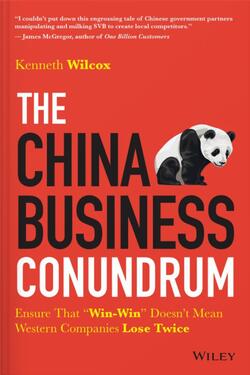
The China Business Conundrum book cover by Kenneth Wilcox.

Headlines about foreign companies establishing a foothold in China only to fail years later no longer surprise anyone. But why does this keep happening? Kenneth Wilcox, former CEO of Silicon Valley Bank (SVB) from 2001 to 2010 and author of The China Business Conundrum: Ensure that Win-Win Doesn't Mean Western Companies Lose Twice, argues that the answer comes down to mental models and preparation.

In a recent lecture hosted by the Stanford Center on China's Economy and Institutions, Wilcox explained that we all develop mental models — internal frameworks that help us interpret and navigate the world around us. We carry these models with us wherever we go, applying them instinctively to new situations and environments. The trouble, Wilcox argues, is that a mental model only holds up if the new environment resembles the one it was built for. And American mental models, more often than not, simply don't hold up in China.

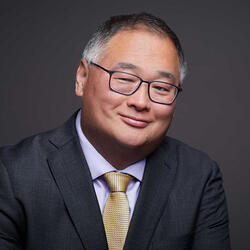
Kenneth Wilcox headshot

Wilcox knows this firsthand. After a decade leading SVB, he and his wife moved to China in 2011 to open a Chinese branch of the bank. Things started smoothly enough — he secured a partnership with Shanghai Pudong Development Bank and obtained the necessary license — but it quickly became clear that the rules he'd spent his career following no longer applied. The license, for instance, permitted him to open the bank but barred him from conducting any business in renminbi, China's national currency, for the first three years. For a bank, this created an obvious problem: how do you pay staff, let alone operate, without access to local currency? The government's solution was a subsidy to cover operating costs during that period, along with an invitation to meet regularly with other banks and business leaders to share SVB's model and approach. After many such meetings, Wilcox's Chinese partners told him they had been so impressed with what they'd learned that they planned to open their own bank modeled on SVB's approach.

This, Wilcox explained, is a pattern that plays out with striking regularity in China. Foreign companies are lured in with the promise of a vast new market and eager local partners. They are then entangled in regulations and bureaucracy, kept afloat with subsidies while they wait for permission to operate more freely — all while their technology and intellectual property are quietly absorbed. Eventually, the foreign company is left with little choice but to close up and leave. Some companies see it happening but look the other way. Others don't recognize it until it's too late. Many never fully understand why they failed at all.

Wilcox traced all of this back to the limitations of mental models. American businesses tend to arrive in China assuming the environment will function more or less like home: keep your head down, stay out of politics, focus on the business, and you'll be fine. But that assumption doesn't hold in China, where the government and the Communist Party exert control over virtually every aspect of commercial life. The most powerful players routinely hold simultaneous roles — party member, bank executive, government official — all at once. It is precisely these unexamined assumptions, Wilcox concluded, that set so many Western ventures up to fail before they've even begun.

Read More

Yiqing Xu and Hongbin Li sit on a stage during a SCCEI event.
News

China's Test-based Education System is a Mirror of Society

Hongbin Li and Ruixue Jia joined Yiqing Xu for a fireside chat on their newly published book, "The Highest Exam: How the Gaokao Shapes China." Watch the recording and see event highlights.
China's Test-based Education System is a Mirror of Society
Hanming Fang presents in front of slides in a conference room.
News

What Two Decades of Data Reveal About China’s Industrial Policy

At a SCCEI Seminar economist Hanming Fang presented a sweeping new analysis of how China’s industrial policies have evolved over the past 20 years. Using LLMs, the researchers compiled, codified, and analyzed nearly 3 million documents to build one of the most detailed databases of industrial policymaking in China to date.
What Two Decades of Data Reveal About China’s Industrial Policy
Group photo of students, staff, and faculty in China during the 2025 SCCEI China Study Program.
News

Stanford Students Gain Firsthand Insights into China’s Economy, Culture, and Global Role

Led by Stanford faculty members, 20 Stanford students traveled across China engaging in academic exchanges, site visits to leading companies and institutions, and rich cultural experiences to gain a deeper understanding of the country’s economy, culture, and international relations.
Stanford Students Gain Firsthand Insights into China’s Economy, Culture, and Global Role
All News button
1
Subtitle

Former Silicon Valley Bank CEO Kenneth Wilcox draws on his own experience launching SVB in China to illustrate how Western companies repeatedly fail in China because they rely on mental models built for home — assumptions about business, government, and rule of law that simply don't apply in the Chinese market.

Date Label
Display Hero Image Wide (1320px)
No
-

Stanford University Libraries and the Stanford Center on China’s Economy and Institutions are pleased to present the 2026 Dr. Sam-Chung Hsieh Memorial Lecture featuring Professor Chang-Tai Hsieh who will be speaking on The Risks of Taiwan's Economic Boom.

To attend in person, please register here.
To attend online, please register here.


Professor Hsieh will discuss how Taiwan's Central Bank has had a longstanding unstated policy of keeping the exchange rate undervalued to boost exports. The rise of Taiwan as the center of the semiconductor industry, and more generally as the center of AI hardware, is making this policy untenable. The trade surplus reached 20% of GDP in 2025 and is likely reach an astronomical 35% of GDP this year. Furthermore, much of the surplus has been channeled into purchases of US treasury bonds by Taiwan's life insurance industry that face collapse when the Taiwan dollar appreciates.


About the Speaker 


Chang-Tai Hsieh headshot.

Professor Hsieh is the Phyllis and Irwin Winkelreid Distinguished Service Professor of Economics at the University of Chicago. He is an elected member of Taiwan's Academia Sinica, the American Academy of Arts and Sciences, and the Econometric Society. He is also a two times recipient of the Sun Ye-Fang Award of China's Academy of Social Sciences.


The family of Dr. Sam-Chung Hsieh donated his personal archive to the Stanford Libraries' Special Collections and endowed the Dr. Sam-Chung Hsieh Memorial Lecture series to honor his legacy and to inspire future generations. Dr. Sam-Chung Hsieh (1919-2004) was former Governor of the Central Bank in Taiwan. During his tenure, he was responsible for the world's largest foreign exchange reserves, and was widely recognized for achieving stability and economic growth. In his long and distinguished career as economist and development specialist, he held key positions in multilateral institutions including the Asian Development Bank, where as founding Director, he was instrumental in advancing the green revolution and in the transformation of rural Asia. Read more about Dr. Hsieh.

Green Library, Bing Wing, 5th floor, Bender Room
459 Lasuen Mall, Stanford, CA 94305

Chang-Tai Hsieh, Professor of Economics, University of Chicago
Lectures
Date Label

Encina Hall East, 5th Floor

0
Research Professional, Stanford Doerr School of Sustainability; Sustainability and Energy Transition Research Program
yanhaohan_wen.png

Yanhaohan Wen is a social science research professional at the Stanford Center on China's Economy and Institutions (2025-2026). He obtained his Master in Applied Economics and Management from Cornell University in 2025. Currently, he is research professional at the Doerr School of Sustainability at Stanford University. His research interests lie in the field of environmental economics, with a focus on electric vehicles, charging infrastructures and urban system design in emerging economies.

Date Label
-

Stanford Center on Early Childhood (SCEC) and The Rural Education Action Program (REAP) are pleased to host Harvard University Professor Chunling Lu for a special seminar event.
 
Please register for the event to receive email reminders and add it to your calendar. Lunch will be provided.


Global, Regional, and Country Level Prevalence of Young Children Exposed to Risks of Poor Development in Low and Middle Income Countries: An Update


Quantifying the prevalence of young children exposed to risks of poor development is imperative for understanding the challenges of reducing those risks, developing and evaluating evidence-based early childhood development policy interventions, and assessing progress in eliminating the risks imposed upon young children during their most critical developmental period. We published estimates on the prevalence of young children exposed to stunting and extreme poverty at the global, regional, and country levels in 2017. Since new data have been released and a new definition of extreme poverty has been proposed, we updated our 2017 study with a focus on the progress in reducing the prevalence of risk exposure at different levels since 2000. For countries with other risk factors available in their micro-level data, we added them to the composite measure and assessed the levels and trends of sociodemographic disparities in young children’s risk exposure.  


About the Speaker 


Chunling Lu, Ph.D head shot

Chunling Lu studied international relations (BA) and political science (MA) at Fudan University in Shanghai, China, and sociology (MA) and applied statistics (MS) at Syracuse University, where she also received her PhD in economics. She received postdoctoral training on health care policy analysis at the Harvard Medical School’s Department of Health Care Policy, and joined the School’s Department of Global Health and Social Medicine in 2008 after three years as Senior Research Associate at the Harvard Institute for Global Health.


EVENT PARTNERS


Image
Stanford Center on Early Childhood and Rural Education Action Program logo

Goldman Room E409, Encina Hall

Chunling Lu, Associate Professor of Global Health and Social Medicine, Harvard Medical School
Seminars
Date Label
-
2026 SCCEI China Conference will be held on May 7, 2026 and focus on Understanding “DeepSeek Moments” and China’s Innovation Ecosystem.


Governments, markets, and analysts in the United States and around the world frequently find themselves surprised by China’s capabilities in industries central to economic and national security—from artificial intelligence and robotics to pharmaceuticals, advanced manufacturing, and strategic supply chains. Episodes widely described as “DeepSeek moments” reflect more than isolated breakthroughs; they reveal a systematic failure to understand how China builds technological capacity and scales it with speed. Yet these cutting-edge advances are emerging against the backdrop of a sustained economic slowdown, raising new questions about whether China’s push for technological supremacy is occurring at the expense of broader economic health. 

The Stanford Center on China's Economy and Institution's (SCCEI) annual China Conference convenes leading experts to examine why prevailing frameworks consistently underestimate China’s industrial performance and assess how its technology ecosystem, industrial policies, and trade strategies function and interact to push many critical sectors to the frontier.


We are finalizing an outstanding lineup of speakers from academia, industry, and policy communities. Updates will be posted here as confirmed. 

*Schedule is subject to change  

Location: 
Bechtel Conference Center
Encina Hall
616 Jane Stanford Way, Stanford University

*Topics, speakers, and timing will be confirmed soon. 


10:30 AM - 11:00 AM  Registration & Light Breakfast

11:00 AM - 11:15 AM  Welcome & Opening Remarks


Scott Rozelle 
Faculty Co-Director of the Stanford Center on China's Economy and Institutions;
Senior Fellow at the Freeman Spogli Institute for International Studies and at the Stanford Institute for Economic Policy Research
Stanford University


11:15 AM - 12:15 PM  Session 1 | What Distinguishes China's Innovation Ecosystem?


Session Panelists:
Barry Naughton
So Kwan Lok Chair of Chinese International Affairs
University of California, San Diego 

Philip Wong
Willard R. and Inez Kerr Bell Professor of Electrical Engineering, Stanford University
Chief Scientist Advisor, TSMC

Chenjian Li
Research Fellow, Hoover Institution
Stanford University

Moderator:
Joshua Rosenzweig
Senior Associate Director, Stanford Center on China's Economy and Institutions, Stanford University
 

12:15 PM - 1:30 PM  Lunch
 
1:30 PM - 2:30 PM  Session 2 | Industrial Policy at the Tech Frontier


Session Panelists:
Heiwai Tang
Victor and William Fung Professor in Economics; Associate Vice President (Global); 
Associate Dean for External Relations, Business School
University of Hong Kong 

Scott Kennedy
Senior Adviser and Trustee Chair in Chinese Business and Economics 
Center for Strategic and International Studies

Ruixue Jia
Professor of Economics, School of Global Policy and Strategy
University of California, San Diego

Moderator:
Shanjun Li
Professor of Environmental Social Sciences, Stanford Doerr School of Sustainability; 
Senior Fellow, Freeman Spogli Institute for International Studies
Stanford University 
 

2:30 PM - 3:00 PM  Break
 
3:00 PM - 4:00 PM  Session 3 | Trade War Meets Tech War: Trade Technology in a Fragmented World


Session Panelists:
Jiajun Wu
Assistant Professor of Computer Science
Stanford University

Graham Webster
Research Scholar, Program on Geopolitics, Technology, and Governance;
Editor-in-Chief, DigiChina Project, Stanford University

Hong Ma
Professor and Chair, Department of Economics
Tsinghua University

Moderator:
Jennifer Pan
Professor of Communication
Stanford University


4:00 PM - 4:15 PM  Break

4:15 PM - 5:30 PM  Keynote Address


Rush Doshi
C.V. Starr Senior Fellow for Asia Studies and Director of the China Strategy Initiative, Council on Foreign Relations
Assistant Professor of Security Studies, Walsh School of Foreign Service, Georgetown University 

Moderator:
Scott Rozelle 
Faculty Co-Director of the Stanford Center on China's Economy and Institutions;
Senior Fellow at the Freeman Spogli Institute for International Studies and at the Stanford Institute for Economic Policy Research
Stanford University


Questions? Contact scceichinaconference@stanford.edu 


Bechtel Conference Center
Encina Hall
616 Jane Stanford Way, Stanford University

This event is by invitation only.

Conferences
News Feed Image
banner_2_to_1_dimensions_2026-no_topic.png
Date Label
0
Senior Fellow at the Freeman Spogli Institute for International Studies
Professor, Environmental Social Sciences, Stanford Doerr School of Sustainability
Denning Global Sustainability Professorship
Director of the Sustainability and Energy Transition Program, Stanford Center on China's Economy and Institutions
ShanjunLi Vert.png Ph.D.

Shanjun Li is a Professor in the Environmental Social Sciences department of the Stanford Doerr School of Sustainability and holds the Denning Global Sustainability Professorship as a Senior Fellow at the Freeman Spogli Institute for International Studies at Stanford University. His research areas include environmental and energy economics, urban and transportation economics, empirical industrial organization, and Chinese economy. His recent work addresses pressing sustainability challenges and the rapid rise of clean energy industries in China, exploring their global implications to support evidence-based policymaking.

Prior to joining Stanford, he held the Kenneth L. Robinson Chair in the Dyson School of Applied Economics and Management at Cornell University and served as the Director of the Cornell Institute for China Economic Research (CICER). Li is a co-editor for the International Journal of Industrial Organization and the Journal of Public Economics. He is a research associate at the National Bureau of Economic Research (NBER) and a university fellow at Resources for the Future (RFF).

Date Label
Subscribe to Economic Affairs