Authors
Heather Rahimi
News Type
News
Date
Paragraphs

The United States cannot match China's scale alone and pretending otherwise is a strategic mistake. That was the central message Rush Doshi delivered as keynote speaker at the Stanford Center on China's Economy and Institutions' 2026 annual China Conference, where he called on the U.S. to reimagine its alliance system as a platform for building shared capacity across military, economic, and technological domains.

Rush Doshi, the C.V. Starr Senior Fellow for Asia Studies at the Council on Foreign Relations and an assistant professor at Georgetown's Walsh School of Foreign Service, previously served as Deputy Senior Director for China and Taiwan on the National Security Council (2021-24), where, for a portion of his tenure, he was the U.S. government’s lead action officer coordinating the negotiations that launched AUKUS, a trilateral security partnership for the Indo-Pacific region between Australia, the United Kingdom, and the United States. He is also the author of The Long Game: China's Grand Strategy to Displace American Order (Oxford University Press, 2021).

Doshi grounded his address in a historical argument: scale, which Doshi defined as “the ability to generate efficiency and productivity and thereby outcompete rivals,” has been the decisive factor in the rise and fall of great powers. Great Britain's eclipse by larger industrializing rivals in the late nineteenth century, he argued, offers a cautionary parallel for the U.S. today. "Today, that sense of daunting scale belongs to China," Doshi said, "and the United States appears to be in the position that Great Britain was in a century ago."

China's Scale Is Not Abstract
China's economy, measured in purchasing power, is now roughly 30 percent larger than that of the United States, and its share of global manufacturing quintupled in the two decades after joining the WTO, while the U.S. share fell by half. China has two to three times U.S. industrial capacity, 13 times U.S. steel production, and roughly 500 times U.S. shipbuilding capacity. It produces two-thirds of the world's electric vehicles, three-quarters of its batteries, and 90 percent of its solar panels and refined rare earths, and is at the leading edge of six of the ten industries expected to define the next industrial revolution.
That industrial strength is now translating into direct geopolitical leverage. Doshi pointed to China's weaponization of its rare earths dominance in 2025, which effectively forced the U.S. to walk back elements of its own trade and export control policies. "That marked the first time that an export control was used to force open market access," he said. "That's a massive moment in the history of trade.

The Case for Allied Scale
The answer, Doshi argued, is not to retreat into fortress America, a sphere-of-influence arrangement, or a China-led order, but to build what he calls "allied scale." A coalition of the U.S. and its key allies and partners would represent three times China's nominal GDP, twice its defense spending, and one and a half times its share of global manufacturing.

That advantage is entirely theoretical, unlocking its potential, though, is the central task of American statecraft in this century."
Rush Doshi

"That advantage is entirely theoretical," Doshi conceded. "Unlocking its potential, though, is the central task of American statecraft in this century." In practice, that might mean Japan and South Korea investing in American shipbuilding; Taiwan building semiconductor plants in the U.S.; allies co-producing advanced weapons systems; and all parties maintaining a shared tariff or regulatory wall against China's excess industrial capacity. On the economic side, Doshi called for common investment screening, coordinated industrial policy, and an "economic Article 5" ensuring that when China uses economic coercion against one ally, all respond together.

Addressing the Skeptics
Doshi acknowledged "the new pessimism," the view that Trump-era damage to U.S. alliances has made allied scale impossible. The strain is real, he said, but not terminal, for three reasons:

  1. The alternatives are worse. Spheres of influence, unrestrained multipolarity, and a China-led order all leave the U.S. and its partners poorer and less secure. 
  2. Alliances have absorbed serious shocks before and survived. For example, France's withdrawal from NATO's unified command, Nixon's opening to China, the Plaza Accord. 
  3. The underlying logic of interdependence persists. Allied economies are growing more dependent on U.S. markets as China buys less from them, allies are purchasing record numbers of American weapons, and even the Trump administration has not escaped the pull of allied scale, with Vice President Vance publicly calling for a trading bloc among allies to break China's chokehold on critical minerals.
Allied scale can't just be about balancing China, it has to be about building the kind of world that we want to see and live in.
Rush Doshi

Eight Principles to Achieve Allied Scale
Doshi closed with a practical blueprint — eight principles for building allied scale.

  1. Turn the page on the Trump era. Persuade allies that the most damaging recent policies were products of individual leadership rather than durable features of the American political system.

  2. Begin with humility. Start with small, achievable projects: a joint shipbuilding effort, a critical minerals offtake agreement, a co-production line. Build from there.

  3. Build mutually beneficial bargains. Allies invest in America; America invests in allies. All extend each other more preferential terms than they do to non-market economies like China.

  4. Pay attention to domestic politics. “The danger of the ‘Trump Approach’ is alienation and polarization of allied politics that makes diplomacy impossible.” Any allied scale strategy must be first grounded in domestic politics.

  5. Build ad hoc coalitions. Allied scale does not mean doing everything with everyone. It means assembling the right groupings for specific challenges and opportunities.

  6. Bolster credibility through congressional legislation. Executive orders are too easily reversed. Durable commitments to allies require legislative backing that is harder to undo with a change in administration.

  7. Build on existing platforms. Frameworks like the Quad, AUKUS, the U.S.-Japan-South Korea trilateral, and the G7 already exist. Allied scale should strengthen what works, not start from scratch.

  8. Articulate an affirmative vision. "Allied scale can't just be about balancing China," Doshi said. "It has to be about building the kind of world that we want to see and live in."


“That work is hard,” Doshi concluded, but “it's not impossible. And the alternatives are far more concerning than the future that I’m outlining.” Doshi ended his address on a note of optimism: a call to action for the U.S. to reforge our alliances and rebalance the world order to create a better world for not just the U.S., but for nations across the globe.


A full recording of Dr. Rush Doshi’s talk is available on YouTube and below.


This article was supported by research using Claude. All outputs were reviewed by humans and the final expression was produced by the author.

Read More

A panel of men sit at a long table on a stage.
News

China's Innovative Capacity Is Underestimated — and the Stakes Are Growing

SCCEI brought together leading China scholars this spring for its third annual China Conference under the theme “Understanding ‘DeepSeek Moments’ and China’s Innovation Ecosystem.” Conversation centered around the idea that the world’s prevailing frameworks for assessing China’s innovative capacity often underestimate it, and the consequences of that blind spot are growing.
China's Innovative Capacity Is Underestimated — and the Stakes Are Growing
Sean Stein addresses the audience during a keynote speech.
News

The High Cost of Miscalculation: Sean Stein on U.S.-China Trade Fallout

In a keynote address during the 2025 SCCEI China Conference, U.S.-China Business Council President Sean Stein cautioned that strategic miscalculations and trade tensions have left the U.S. economy with lasting setbacks—and few clear gains.
The High Cost of Miscalculation: Sean Stein on U.S.-China Trade Fallout
Elizabeth Economy speaks during a Fireside Chat.
News

Strategic Shifts: Understanding China’s Global Ambitions and U.S.-China Dynamics with Elizabeth Economy

At the 2025 SCCEI China Conference, Elizabeth Economy, Hargrove Senior Fellow at the Hoover Institution, outlined China’s ambitious bid to reshape the global order—and urged the U.S. to respond with vision, not just rivalry, during a Fireside Chat with Professor Hongbin Li, Senior Fellow and SCCEI Faculty Co-Director.
Strategic Shifts: Understanding China’s Global Ambitions and U.S.-China Dynamics with Elizabeth Economy
Hero Image
Rush Doshi speaks behind a podium at the SCCEI China Conference
Rod Searcey
All News button
1
Subtitle

Rush Doshi, keynote speaker at the 2026 SCCEI China Conference, laid out an eight-point blueprint for transforming U.S. alliances into an engine of shared economic and industrial capacity.

Terms
Image
Rush Doshi speaks behind a podium at the SCCEI China Conference
Photo credit Rod Searcey
Title
To Counter China's Scale, the U.S. Must Build Allied Scale
Date Label
Display Hero Image Wide (1320px)
No
Center on China’s Economy and Institutions
Feature figure showing CT scans and blood vials
Photo credit Getty Images
U.S. researchers consistently penalize China-based collaborations, suggesting that geopolitical rivalry is reshaping science’s gatekeeping
5 min read

INSIGHTS

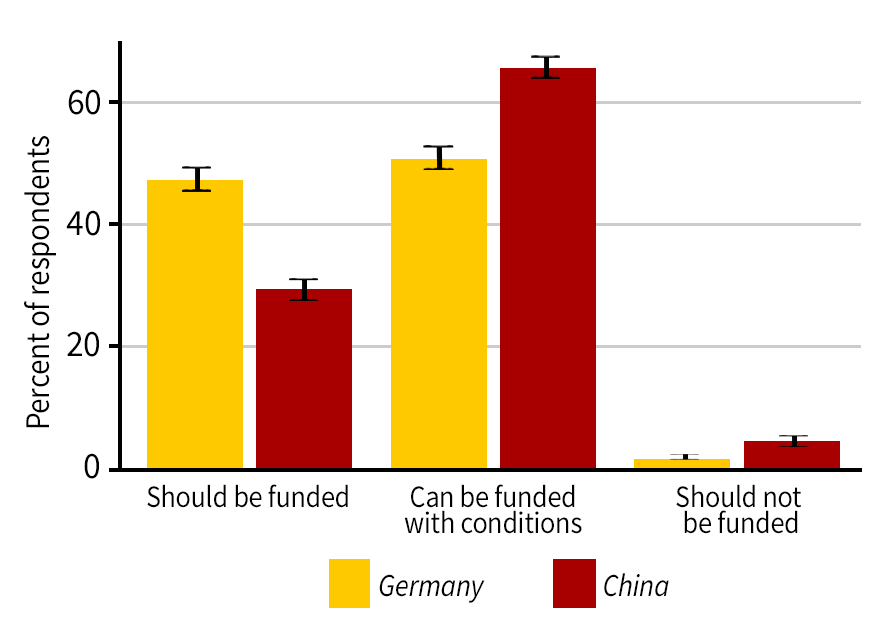
  • In a randomized experiment involving 7,154 U.S. scientists, 48% unconditionally supported a peer-reviewed NSF proposal with a partner in Germany, but only 30% supported the identical proposal when the partner was based in China.
  • The “China penalty” is not only outright rejection but also heightened conditionality: 66% of scientists favor funding China collaborations only with added safeguards — most commonly no military affiliation (53%) and no surveillance applications (49%), far higher than for Germany proposals (35%).
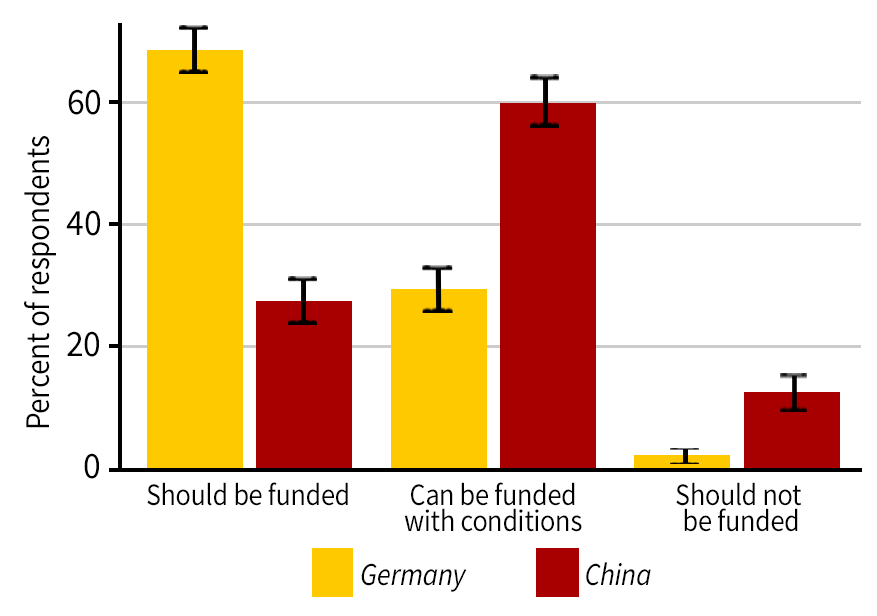
  • In a second survey of 1,249 U.S. policymakers and foreign policy experts, the gap is starker: 28% offered unconditional support for the China collaboration versus 68% for the Germany version — though policymakers’ inherently political roles make this less surprising.
  • The penalty persists across all four fields tested (batteries, biotechnology, robotics, and environmental science) and persists among scientists who have previously collaborated with China-based researchers and among Asian American scientists.


Source Publication: Alexander Furnas, Ruixue Jia, Margaret Roberts, and Dashun Wang (2026). Geopolitics in the Evaluation of International Scientific Collaboration. Center for Economic and Policy Research discussion paper.

Read this brief on SUBSTACK

Topics:

U.S.-China Economic Competition Science, Technology, and Innovation Education and Human Capital
Read the brief

International scientific collaboration has long rested on an ideal of universalism — that the best science happens when researchers share findings freely across borders, evaluated on merit rather than national origin. In the U.S.-China context, this ideal has come under increasing pressure. Over the past two decades, U.S.-China co-authored research produced some of the world's most cited science, spanning astronomy, cancer research, and clean energy. But since roughly 2018, amid rising concerns about intellectual property theft, national security, and surveillance, the partnership has fractured: collaboration rates declined sharply, visa restrictions tightened, and federal investigations targeted Chinese American scientists under the now-discontinued China Initiative. What has remained unclear is whether geopolitical pressure operates not just through formal policy but through the evaluative judgments of the scientists and officials who decide what gets funded in the first place. This paper provides the first large-scale experimental evidence that it does. 

The data. The authors ran two randomized survey experiments. The first recruited 7,154 active U.S.-based scientists, drawn from a random sample of 218,195 corresponding authors in Web of Science-indexed journals published between January 2022 and September 2024. The second recruited 1,249 participants from the U.S. policy community, including current and former government officials responsible for trade, national security, or development policy; think tank analysts; and international relations scholars in partnership with the Teaching, Research, and International Policy (TRIP) lab at William & Mary. Both groups read a hypothetical, unclassified National Science Foundation (NSF) grant proposal — explicitly stated to have cleared peer review — for a scientific collaboration in one of four fields. The only thing that varied across respondents was whether the foreign partner institution was in Germany or China. Respondents then chose among three options: fund unconditionally, fund with conditions (choosing from a menu of national security and human rights safeguards), or reject. Because the proposal content was identical across conditions, any difference in responses can be attributed to the collaborator’s nationality alone.


Support for U.S.-China collaborations vs. U.S.-Germany collaborations among U.S.-based scientists

Figure showing support for U.S.-China collaborations vs. U.S.-Germany collaborations among U.S.-based scientists

Support for U.S.-China collaborations vs. U.S.-Germany collaborations in the U.S. policy community

Figure showing support for U.S.-China collaborations vs. U.S.-Germany collaborations in the U.S. policy community


Scientists show a large and consistent bias against China. One might expect scientists, trained in norms of objectivity and merit-based evaluation, to be largely immune to geopolitical signals. They are not. The unconditional support rate among scientists was 48% for the German collaboration and 30% for the Chinese one — an 18-point gap that is both statistically and substantively significant. Nearly two-thirds of scientists (65.8%) would fund China collaborations only under conditions, with “no military affiliation” (53.1%) and “no surveillance applications” (49.1%) the most commonly  required —  both substantially higher than the corresponding conditions imposed on Germany proposals (around 35%). Outright rejection remained rare among scientists but was still more than double the baseline: 4.5% for China versus 1.9% for Germany.

Policymakers show an even starker penalty. Among the policy community, the results are more dramatic, if less surprising given their inherently political roles. Unconditional support for the Germany proposal reached 68% — the kind of rate one might expect for competitively selected, peer-reviewed research. For the otherwise identical China proposal, that figure collapsed to 28%. Policymakers were more than twice as likely to back the German collaboration unconditionally. The 12.6% who rejected the China proposal entirely — regardless of peer review — is roughly six times the 2.3% who rejected the Germany proposal on the same grounds. 

The penalty is consistent across scientific fields. A possible alternative explanation is that the gap reflects domain-specific concerns — perhaps respondents worried more about dual-use risks in robotics than in environmental science. But the China-Germany gap appears consistently across all four research fields tested, with only minor variation. Environmental science showed slightly higher overall support for international collaboration in both conditions but preserved the same China penalty. The pattern also holds among scientists who had previously collaborated with Chinese researchers, and among Asian American scientists, groups for whom cultural familiarity explanations might predict smaller effects. The stability of the effect across subgroups points to geopolitics as the primary driver, not familiarity, field-specific risk, or individual background. 

Geopolitics delaying discovery? When both policymakers and scientists apply a consistent, large, geopolitically driven discount to proposals from China-based collaborators — even when those proposals have already cleared peer review and involve no classified or export-controlled research — the cumulative effect may be a structural tilt in how international science gets supported. Scientists are not trained to assess national security risk, and yet they appear to be applying informal security-like conditions to research proposals, in ways that may not be consistent or transparent. Science often advances fastest at the borders between nations, disciplines, and ideas, and a geopolitical penalty that discourages crossing borders may prove to be a tax on discovery itself. The challenge for science policy is not to pretend geopolitics  is absent, but to build evaluation systems that acknowledge real risks while preserving the integrity of merit-based judgment.

Feature figure showing CT scans and blood vials
Photo credit Getty Images
Terms
Image
Feature for The China Penalty Is Quietly Reshaping American Science
Photo credit Getty Images
Feature figure showing CT scans and blood vials
Photo credit Getty Images
Date Label
Subscribe to Asia-Pacific