
The China Penalty Is Quietly Reshaping American Science
The China Penalty Is Quietly Reshaping American Science [ 5 min read ]
INSIGHTS
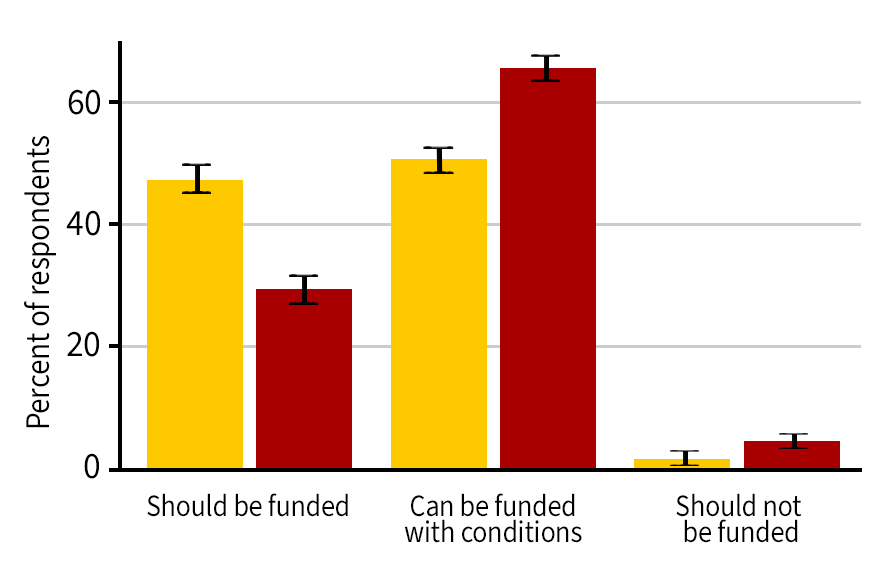
- In a randomized experiment involving 7,154 U.S. scientists, 48% unconditionally supported a peer-reviewed NSF proposal with a partner in Germany, but only 30% supported the identical proposal when the partner was based in China.
- The “China penalty” is not only outright rejection but also heightened conditionality: 66% of scientists favor funding China collaborations only with added safeguards — most commonly no military affiliation (53%) and no surveillance applications (49%), far higher than for Germany proposals (35%).
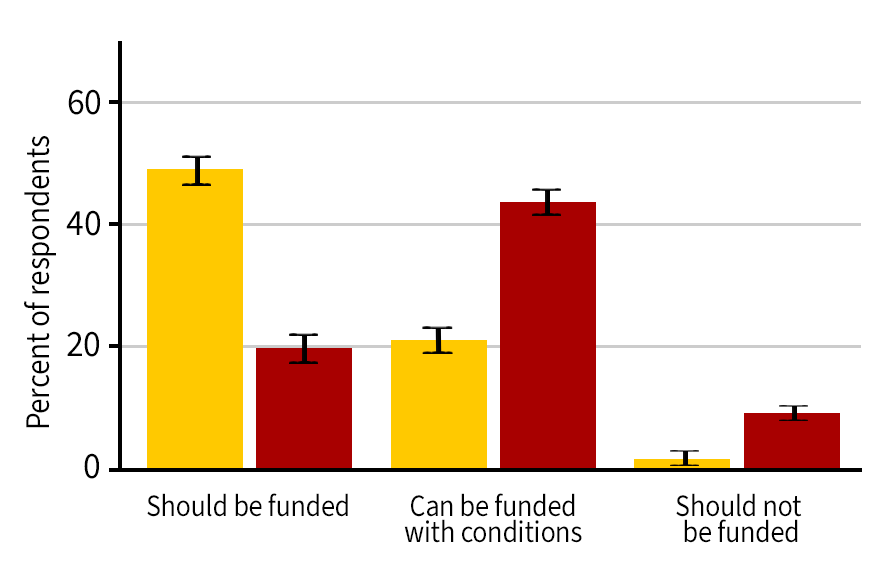
- In a second survey of 1,249 U.S. policymakers and foreign policy experts, the gap is starker: 28% offered unconditional support for the China collaboration versus 68% for the Germany version — though policymakers’ inherently political roles make this less surprising.
- The penalty persists across all four fields tested (batteries, biotechnology, robotics, and environmental science) and persists among scientists who have previously collaborated with China-based researchers and among Asian American scientists.
Read this brief on SUBSTACK
International scientific collaboration has long rested on an ideal of universalism — that the best science happens when researchers share findings freely across borders, evaluated on merit rather than national origin. In the U.S.-China context, this ideal has come under increasing pressure. Over the past two decades, U.S.-China co-authored research produced some of the world's most cited science, spanning astronomy, cancer research, and clean energy. But since roughly 2018, amid rising concerns about intellectual property theft, national security, and surveillance, the partnership has fractured: collaboration rates declined sharply, visa restrictions tightened, and federal investigations targeted Chinese American scientists under the now-discontinued China Initiative. What has remained unclear is whether geopolitical pressure operates not just through formal policy but through the evaluative judgments of the scientists and officials who decide what gets funded in the first place. This paper provides the first large-scale experimental evidence that it does.
The data. The authors ran two randomized survey experiments. The first recruited 7,154 active U.S.-based scientists, drawn from a random sample of 218,195 corresponding authors in Web of Science-indexed journals published between January 2022 and September 2024. The second recruited 1,249 participants from the U.S. policy community, including current and former government officials responsible for trade, national security, or development policy; think tank analysts; and international relations scholars in partnership with the Teaching, Research, and International Policy (TRIP) lab at William & Mary. Both groups read a hypothetical, unclassified National Science Foundation (NSF) grant proposal — explicitly stated to have cleared peer review — for a scientific collaboration in one of four fields. The only thing that varied across respondents was whether the foreign partner institution was in Germany or China. Respondents then chose among three options: fund unconditionally, fund with conditions (choosing from a menu of national security and human rights safeguards), or reject. Because the proposal content was identical across conditions, any difference in responses can be attributed to the collaborator’s nationality alone.
Support for U.S.-China collaborations vs. U.S.-Germany collaborations among U.S.-based scientists
Support for U.S.-China collaborations vs. U.S.-Germany collaborations in the U.S. policy community
Scientists show a large and consistent bias against China. One might expect scientists, trained in norms of objectivity and merit-based evaluation, to be largely immune to geopolitical signals. They are not. The unconditional support rate among scientists was 48% for the German collaboration and 30% for the Chinese one — an 18-point gap that is both statistically and substantively significant. Nearly two-thirds of scientists (65.8%) would fund China collaborations only under conditions, with “no military affiliation” (53.1%) and “no surveillance applications” (49.1%) the most commonly required — both substantially higher than the corresponding conditions imposed on Germany proposals (around 35%). Outright rejection remained rare among scientists but was still more than double the baseline: 4.5% for China versus 1.9% for Germany.
Policymakers show an even starker penalty. Among the policy community, the results are more dramatic, if less surprising given their inherently political roles. Unconditional support for the Germany proposal reached 68% — the kind of rate one might expect for competitively selected, peer-reviewed research. For the otherwise identical China proposal, that figure collapsed to 28%. Policymakers were more than twice as likely to back the German collaboration unconditionally. The 12.6% who rejected the China proposal entirely — regardless of peer review — is roughly six times the 2.3% who rejected the Germany proposal on the same grounds.
The penalty is consistent across scientific fields. A possible alternative explanation is that the gap reflects domain-specific concerns — perhaps respondents worried more about dual-use risks in robotics than in environmental science. But the China-Germany gap appears consistently across all four research fields tested, with only minor variation. Environmental science showed slightly higher overall support for international collaboration in both conditions but preserved the same China penalty. The pattern also holds among scientists who had previously collaborated with Chinese researchers, and among Asian American scientists, groups for whom cultural familiarity explanations might predict smaller effects. The stability of the effect across subgroups points to geopolitics as the primary driver, not familiarity, field-specific risk, or individual background.
Geopolitics delaying discovery? When both policymakers and scientists apply a consistent, large, geopolitically driven discount to proposals from China-based collaborators — even when those proposals have already cleared peer review and involve no classified or export-controlled research — the cumulative effect may be a structural tilt in how international science gets supported. Scientists are not trained to assess national security risk, and yet they appear to be applying informal security-like conditions to research proposals, in ways that may not be consistent or transparent. Science often advances fastest at the borders between nations, disciplines, and ideas, and a geopolitical penalty that discourages crossing borders may prove to be a tax on discovery itself. The challenge for science policy is not to pretend geopolitics is absent, but to build evaluation systems that acknowledge real risks while preserving the integrity of merit-based judgment.