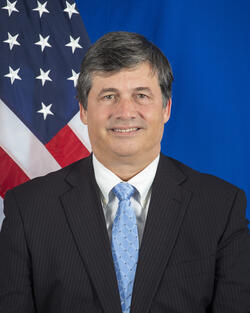
Craig Allen, President, U.S.-China Business Council
In 2018, Craig Allen began his tenure as the president of the US-China Business Council (USCBC), a private, nonpartisan, nonprofit organization representing over 270 American companies doing business with China. Prior to joining USCBC, Allen had a career in US public service. Allen began his government career in 1985 at the Department of Commerce’s International Trade Administration (ITA) where he served as an international economist in ITA’s China Office. He served as the Senior Commercial Officer at the US Embassy in Beijing in 2002 where he was later promoted to the rank of Minister Counselor of the Senior Foreign Service. Allen then became Deputy Assistant Secretary for Asia at the US Department of Commerce’s ITA and later became Deputy Assistant Secretary for China. Allen was sworn in as the United States Ambassador to Brunei Darussalam in 2014. He served there until 2018, when he transitioned to President of the US-China Business Council. Allen received a B.A. from the University of Michigan in Political Science and Asian Studies in 1979. He received a Master of Science in Foreign Service from Georgetown University in 1985.

Loren Brandt, Professor of Economics, Noranda Chair in Economics and International Trade, University of Toronto
Loren Brandt is the Noranda Chair Professor of Economics at the University of Toronto specializing in the Chinese economy. He is also a research fellow at the Institute for the Study of Labor in Bonn, Germany. He has published widely on the Chinese economy in leading economic journals and been involved in extensive household and enterprise survey work in both China and Vietnam. With Thomas Rawski, he recently completed Policy, Regulation, and Innovation in China’s Electricity and Telecom Industries (Cambridge University Press, 2019), an interdisciplinary effort analyzing the effect of government policy on the power and telecom sectors in China. He was also co-editor and major contributor to China’s Great Economic Transformation (Cambridge University Press, 2008), which provides an integrated analysis of China’s unexpected economic boom of the past three decades. His current research focuses on issues of industrial upgrading in China, inequality dynamics, and economic growth and structural change.

Yong Cai, Associate Professor of Sociology, University of North Carolina at Chapel Hill
Yong Cai is an Associate Professor and the Director of Graduate Studies in the Department of Sociology at the University of North Carolina at Chapel Hill. He received his Ph.D. from the University of Washington in 2005. Before joining UNC in 2009, Cai worked as a research scientist at the University of Washington (2005-2006), and as assistant professor at the University of Utah (2006-2009). Cai's research focuses on China's one-child policy and its implications for fertility and social policies. He continues to monitor China's fertility in the post-one-child era, but with a new focus on international comparisons of sustained low fertility and population aging. His broader research interests include social demography, sociology of health, Chinese society, comparative historical sociology, and research methodology.

Paul Gregory, Research fellow, Hoover Institution, Stanford University
Paul Gregory is a research fellow at the Hoover Institution. He is the Cullen Professor Emeritus in the Department of Economics at the University of Houston, a research fellow at the German Institute for Economic Research in Berlin, and emeritus chair of the International Advisory Board of the Kiev School of Economics. Gregory has held visiting teaching appointments at Moscow State University and the Free University of Berlin. Gregory was the director of the Russian Petroleum Legislation Project of the University of Houston Law Center from 1992 to 1997 and has written broadly on Russian energy. The holder of a Ph.D. in economics from Harvard University, he is the author or coauthor of twelve books and more than one hundred articles on economic history, the Soviet economy, transition economies, comparative economics, and economic demography. As a producer, Gregory worked with director Marianna Yarovskaya on the documentary film “Women of the Gulag,” which was short-listed for the 2019 Academy Awards.

Zhiguo He, James Irvin Miller Professor of Finance at the Graduate School of Business, Stanford University
Zhiguo He is the James Irvin Miller Professor of Finance at the Graduate School of Business at Stanford University. He is a financial economist whose expertise covers financial markets, financial institutions, and macroeconomics broadly. His current research focuses on Chinese financial markets and progress in cryptocurrency and blockchains. Before joining Stanford’s Graduate School of Business, he was a faculty member of Chicago Booth from 2008 to 2023, where he received tenure in 2015 and led the Becker Friedman Institute China from 2020 to 2023. He currently serves as the editor of the Review of Asset Pricing Studies. Professor He received his bachelor’s and master’s degrees from the School of Economics and Management at Tsinghua University before receiving his Ph.D. from the Kellogg School of Management at Northwestern University in 2008. Before his academic career at Chicago Booth, he worked as a stock analyst at the China International Capital Corporation in Beijing in 2001.

Chang-Tai Hsieh, Phyllis and Irwin Winkelried Distinguished Service Professor of Economics and PCL Faculty Scholar, University of Chicago Booth School of Business
Chang-Tai Hsieh conducts research on growth and development. He has published numerous papers in the Quarterly Journal of Economics, American Economic Review, the Journal of Political Economy, the American Economic Review, Econometrica, and NBER Macroeconomics Annual. Hsieh has been a visiting scholar at the Federal Reserve Banks of San Francisco, New York, and Minneapolis, as well as the World Bank's Development Economics Group and the Economic Planning Agency in Japan. He is a Research Associate for the National Bureau of Economic Research, a Senior Fellow at the Bureau for Research in Economic Analysis of Development, and a member of the Steering Group of the International Growth Center in London. He is the recipient of an Alfred P. Sloan Foundation Research Fellowship, an Elected Member of Academia Sinica, and a two-time recipient of the Sun Ye-Fang Prize.

Agatha Kratz, Director, Rhodium Group
Agatha Kratz is a Director at Rhodium Group. She heads Rhodium’s China corporate advisory team, as well as Rhodium’s research on European Union-China relations and China’s economic statecraft. She also contributes to Rhodium’s work on China’s global investment, industrial policy, and technology aspirations. Kratz holds a Ph.D. from King’s College London, on China’s railway diplomacy. Her previous positions include Associate Policy Fellow at the European Council on Foreign Relations and Editor-in-Chief of its quarterly journal China Analysis, Assistant Editor for Gavekal-Dragonomics’ China Economic Quarterly, and Junior Fellow at Asia Centre in Paris.

Hongbin Li, The James Liang Endowed Chair; Faculty Co-director of Stanford Center on China’s Economy and Institutions, Stanford University
Hongbin Li is the Co-director of Stanford Center on China's Economy and Institutions, and a Senior Fellow of Stanford Institute for Economic Policy Research and the Freeman Spogli Institute for International Studies. Li obtained his Ph.D. in economics from Stanford University in 2001 and joined the economics department of the Chinese University of Hong Kong (CUHK), where he became a full professor in 2007. He was also one of the two founding directors of the Institute of Economics and Finance at the CUHK. He taught at Tsinghua University in Beijing from 2007 to 2016 and was C.V. Starr Chair Professor of Economics in the School of Economics and Management. He also founded and served as the Executive Associate Director of the China Social and Economic Data Center at Tsinghua University. He founded the Chinese College Student Survey in 2009 and the China Employer-Employee Survey in 2014. Li’s research has been focused on the transition and development of the Chinese economy, and the evidence-based research results have been both widely covered by media outlets and well read by policy makers around the world. He is currently the co-editor of the Journal of Comparative Economics.

Barry Naughton, So Kwan Lok Chair of Chinese International Affairs, University of California, San Diego
Barry Naughton is the So Kwan Lok Chair of Chinese International Affairs at the School of Global Policy and Strategy at University of California, San Diego. He is an expert on the Chinese economy with an emphasis on issues relating to industry, trade, finance and China's transition to a market economy. His recent research focuses on regional economic growth in China and its relationship to foreign trade and investment. He has addressed economic reform in Chinese cities, trade and trade disputes between China and the United States, and economic interactions among China, Taiwan and Hong Kong. Naughton has written the authoritative textbook The Chinese Economy: Transitions and Growth, which has now been translated into Chinese. His groundbreaking book Growing Out of the Plan: Chinese Economic Reform, 1978-1993 received the Ohira Memorial Prize, and he most recently translated, edited, and annotated a collection of articles by the well-known Chinese economist Wu Jinglian.

Jennifer Pan, Professor of Communication, Stanford University
Jennifer Pan is a political scientist whose research focuses on political communication, digital media, and authoritarian politics. She is the Sir Robert Ho Tung Professor of Chinese Studies, Professor of Communication and (by courtesy) Political Science, and a Senior Fellow at the Freeman Spogli Institute. Pan's research uses experimental and computational methods with large-scale datasets on political activity to answer questions about the role of digital media in authoritarian and democratic politics, including how political censorship, propaganda, and information manipulation work in the digital age and how preferences and behaviors are shaped as a result. Her papers have appeared in peer reviewed publications such as the American Political Science Review, American Journal of Political Science, Journal of Politics, Political Communication, and Science. She graduated from Princeton University, summa cum laude, and received her Ph.D. from Harvard University’s Department of Government.

Minxin Pei, Tom and Margot Pritzker '72 Professor of Government and George R. Roberts Fellow, Claremont McKenna
Minxin Pei is the Tom and Margot Pritzker ‘72 Professor of Government and the director of the Keck Center for International and Strategic Studies at Claremont McKenna College. His research focuses on democratization in developing countries, economic reform and governance in China, and US-China relations. He is the author of From Reform to Revolution: The Demise of Communism in China and the Soviet Union (Harvard University Press, 1994) and China’s Trapped Transition: The Limits of Developmental Autocracy (Harvard University Press, 2006). Pei’s research has been published in Foreign Policy, Foreign Affairs, the National Interest, Modern China, China Quarterly, Journal of Democracy, and many edited books. Pei is a frequent commentator on CNN and National Public Radio; his op-eds have appeared in the Financial Times, New York Times, Washington Post, Newsweek International, and the International Herald Tribune. He is a columnist for L’espresso, a major Italian news magazine and a regular contributor to the Diplomat, a leading online international affairs journal. Pei received his Ph.D. in political science from Harvard University.

Gérard Roland, E. Morris Cox Professor of Economics and Professor of Political Science, University of California, Berkeley
Gérard Roland joined the Berkeley faculty as a professor in 2001. He received his Ph.D. from Université Libre de Bruxelles in 1988 and taught there from 1988-2001. Roland is also a CEPR research fellow, where he was program director between 1995 and 2006. He serves as editor of the Journal of Comparative Economics and was an associate editor for several other journals. Among Roland's awards and honors are as the recipient of the Medal of the University of Helsinki, Officier de l'Ordre de Léopold II, and entry in "Who's Who in the World," "Who's Who in America," and “Who's Who in Economics since 1776." He was a fellow at the Center for Advanced Studies in Behavioral Sciences in Stanford in 1998-1999. He was program chair of the Fifth Nobel symposium in Economics devoted to the Economics of Transition in 1999. He was named Jean Monnet Professor at Université Libre de Bruxelles in 2001 and received an Honorary Professorship of Renmin University of China in 2002.

Scott Rozelle, Helen F. Farnsworth Endowed Professorship; Faculty Co-director of Stanford Center on China’s Economy and Institutions, Stanford University
Scott Rozelle is the Helen F. Farnsworth Senior Fellow and the co-director of Stanford Center on China's Economy and Institutions in the Freeman Spogli Institute for International Studies and Stanford Institute for Economic Policy Research at Stanford University. He received his B.S. from the University of California, Berkeley, and his M.S. and Ph.D. from Cornell University. Previously, Rozelle was a professor at the University of California, Davis and an assistant professor in Stanford’s Food Research Institute and department of economics. His research focuses almost exclusively on China and is concerned with agricultural policy, including the supply, demand, and trade in agricultural projects; the emergence and evolution of markets and other economic institutions in the transition process and their implications for equity and efficiency; and the economics of poverty and inequality, with an emphasis on rural education, health, and nutrition.

Joseph Torigian, Research Fellow, Hoover Institution, Stanford University; Assistant Professor, School of International Service, American University
Joseph Torigian is an assistant professor at the School of International Service at American University in Washington, a global fellow in the History and Public Policy Program at the Wilson Center, and a center associate of the Lieberthal-Rogel Center for Chinese Studies at the University of Michigan. Previously, he was a visiting fellow at the Australian Center on China in the World at Australian National University, a Stanton Fellow at the Council on Foreign Relations, a postdoctoral fellow at the Princeton-Harvard China and the World Program, a postdoctoral (and predoctoral) fellow at Stanford’s Center for International Security and Cooperation, a predoctoral fellow at George Washington University’s Institute for Security and Conflict Studies, an IREX scholar affiliated with the Higher School of Economics in Moscow, and a Fulbright Scholar at Fudan University in Shanghai. His book Prestige, Manipulation, and Coercion: Elite Power Struggles in the Soviet Union and China after Stalin and Mao was published in 2022 by Yale University Press, and he has a forthcoming biography on Xi Jinping’s father with Stanford University Press. His research focuses on Chinese and Russian politics and foreign policy.

Yuhua Wang, Professor of Government, Harvard University
Yuhua Wang is Professor of Government at Harvard University. He is the author of Tying the Autocrat’s Hands: The Rise of the Rule of Law in China (Cambridge University Press, 2015) and The Rise and Fall of Imperial China: The Social Origins of State Development (Princeton University Press, 2022). His articles have appeared in American Political Science Review, Annual Review of Political Science, British Journal of Political Science, Comparative Political Studies, and Comparative Politics. Wang received his B.A. from Peking University and Ph.D. from the University of Michigan.

Guoguang Wu, Senior Research Scholar, Stanford Center on China’s Economy and Institutions, Stanford University
Guoguang Wu is a Senior Research Scholar at the Stanford Center on China’s Economy and Institutions, Stanford University. His research specializes in Chinese politics and comparative political economy, including, in China studies, elite politics, national political institutions and policy making mechanisms, transition from communism, the politics of development, China’s search for its position in the world, and, in comparative political economy, transition of capitalism with globalization, the emergence of capitalism in comparative perspectives, and the worldwide rise of the economic state. He is the author of four books, including Globalization against Democracy: A Political Economy of Capitalism after its Global Triumph (Cambridge University Press, 2017), and China’s Party Congress: Power, Legitimacy, and Institutional Manipulation (Cambridge University Press, 2015). Before joining Stanford in 2022, he taught at the University of Victoria in Canada and the Chinese University of Hong Kong. Currently he is also a Senior Fellow at the Center for China Analysis of the Asia Society Policy Institute.

Jörg Wuttke, Vice President; Chief Representative, BASF (China) Company Ltd.
Jörg Wuttke is Vice President and Chief Representative of BASF China in Beijing since 1997. From 2007 to 2010, from 2014 to 2017, and from 2019 to 2023, Wuttke was President of the European Union Chamber of Commerce in China. Since 2019, Wuttke is Vice Chairman of the CPCIF International Cooperation Committee, a group representing multinational companies in China’s Chemical Association. From 2011 to 2019, he served as Chairman of the Business and Industry Advisory Committee to the OECD’s China Task Force. He was a founding member of the German Chamber of Commerce in Beijing and served as Chairman of the Board from 2001 to 2004. Wuttke has lived in China for more than 20 years.

Wei Xiong, John H. Scully '66 Professor in Finance and Professor of Economics, Princeton University
Wei Xiong is the John H. Scully '66 Professor in Finance and Professor of Economics in the Department of Economics and Bendheim Center for Finance, Princeton University. He is also Academic Dean of School of Management and Economics, Chinese University of Hong Kong, Shenzhen, as well as Research Associate of the National Bureau of Economic Research. His research interests center on capital market imperfections, behavioral finance, digital economy, and China’s financial system. He has received various awards, including 2018 China Economics Prize, 2014 Inaugural Sun Yefang Financial Innovation Award, 2013 NASDAQ OMX Award by Western Finance Association, and 2012 Smith Breeden Award (first prize) by American Finance Association.

Chenggang Xu, Senior Research Scholar, Stanford Center on China's Economic and Institutions, Stanford University
Chenggang Xu is a Senior Research Scholar at the Stanford Center on China's Economic and Institutions, a Visiting Fellow at the Hoover Institution, and a Visiting Professor in the Department of Finance at Imperial College London. Xu received his Ph.D. in economics from Harvard University in 1991. His research is in political economics, institutional economics, law and economics, development economics, transition economics and the Chinese political economy. He is currently a board member of the Ronald Coase Institute (RCI) and a research fellow of the CEPR. He previously taught at the University of Hong Kong as Chung Hon-Dak Professor of Economics, at Tsinghua University as Special-term Professor of Economics, at Seoul National University as World-Class University Professor of Economics, and at LSE as Reader of Economics. He was the President of the Asian Law and Economics Association.

Kevin Xu, Author and founder of Interconnected
Kevin Xu is the author and founder of Interconnected, a bilingual newsletter exploring the intersections of tech, business, money, geopolitics, and US-China relations. He’s an investor and advisor to early-stage startups via OSS Capital. He studied law and computer science at Stanford, served in the White House and Department of Commerce during the Obama administration, and did his undergraduate studies in international relations at Brown.

Yiqing Xu, Assistant Professor of Political Science, Stanford University
Yiqing Xu is an Assistant Professor of Political Science at Stanford University. His primary research covers political methodology, Chinese politics, and their intersection. He received a Ph.D. in political science from Massachusetts Institute of Technology in 2016, an MA in economics from China Center for Economic Research at Peking University in 2010, and a BA in economics in 2007 from Fudan University. His work has appeared in American Political Science Review, American Journal of Political Science, Journal of Politics, Political Analysis, Political Science Research and Methods, among other peer-reviewed journals. He has won several professional awards, including the best article award from American Journal of Political Science in 2016 and the Miller Prize (2018, 2020) for the best work appearing in Political Analysis the preceding year.

David Yang, Professor, Department of Economics, Harvard University
David Y. Yang is a Professor in the Department of Economics at Harvard University and Director of the Center for History and Economics at Harvard. Yang is a Faculty Research Fellow at NBER, a Global Scholar at CIFAR, and a fellow at BREAD. Yang’s research focuses on political economy. In particular, Yang studies the forces of stability and forces of changes in authoritarian regimes, drawing lessons from historical and contemporary China. Yang received a B.A. in Statistics and B.S. in Business Administration from University of California at Berkeley, and Ph.D. in Economics from Stanford.

Dandan Zhang, Professor in Economics, National School of Development, Peking University
Dandan Zhang is a Professor in Economics and Deputy Dean at the National School of Development, Peking University. She is also a Youth Cheung-Kong Scholar and Peking University Boya Young Scholar. Zhang graduated from the Australian National University with a Ph.D. in Economics. Her research fields include labor economics, applied econometrics, and experimental economics, focusing on the welfare of vulnerable groups during transition periods and the impact of social change on human behavior. Her academic work has been published in top economic and general-science journals both domestically and internationally. In recent years, she has led several major projects funded by the National Natural Science Foundation of China, the National Social Science Fund, and the National High-Level Think Tank. She has provided policy recommendations on epidemic prevention and control and unemployment issues. The policy reports from her research have been adopted by the General Office of the Communist Party of China Central Committee, the State Council, and related ministries and commissions.

Xueguang Zhou, Kwoh-Ting Li Professor in Economic Development, Stanford University
Xueguang Zhou is the Kwoh-Ting Li Professor in Economic Development, a Professor of Sociology, and a Senior Fellow at the Freeman Spogli Institute for International Studies. His main area of research is on institutional changes in contemporary Chinese society, focusing on Chinese organizations and management, social inequality, and state-society relationships. His current research projects examine the rise of the bureaucratic state in China and rural governance in China. Before joining Stanford in 2006, Zhou taught at Cornell University, Duke University, and Hong Kong University of Science and Technology. He is a guest professor at Peking University, Tsinghua University, and the People's University of China. Dr. Zhou received his Ph.D. in sociology from Stanford University in 1991.