
Elite Death Notices Expose the Hidden Toll of China’s Zero-COVID Exit
Elite Death Notices Expose the Hidden Toll of China’s Zero-COVID Exit [ 5 min read ]
INSIGHTS
Researchers estimate between 1.44 million and 2.56 million excess deaths following China’s abrupt end of zero-COVID controls, extrapolating from obituaries and death notices of more than 10,000 social elites such as People’s Congress delegates and top academics.
In the sample of social elites, the mortality shock was concentrated among the oldest: deaths among male elites aged 85 and above increased 16-fold at the peak.
Higher-status elites tended to be older and therefore died at higher rates than lower-status ones when hospital resources collapsed.
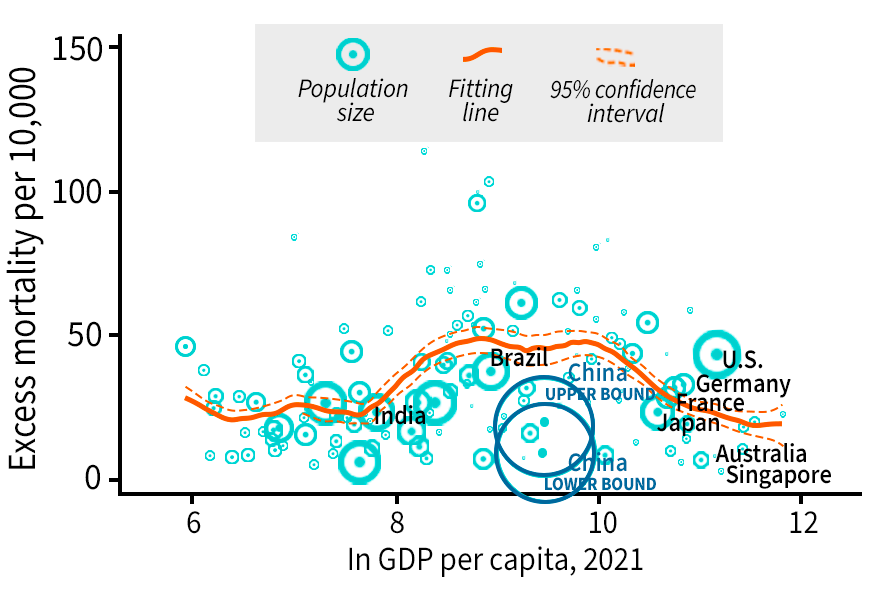
Despite the deadly exit wave, China’s cumulative pandemic mortality significantly remained lower than many comparable countries, as zero-COVID suppressed earlier waves from 2020–2022. India’s cumulative pandemic mortality, for example, was between 42% and 162% higher than the estimates for China.
Read this brief on SUBSTACK
On December 7, 2022, China abruptly ended its zero-COVID policy, dismantling one of the most intensive disease-suppression regimes in modern history. For nearly three years, the government had used mass testing, mobility tracking, strict quarantines, and periodic city-wide lockdowns to keep COVID-19 infections near zero. The strategy succeeded in curbing infection: from 2020 through mid-2022, China was the only major economy to prevent population-wide COVID infections and deaths. But the emergence of the highly transmissible Omicron variant in late 2021 made suppression increasingly untenable, and by late 2022 the government abandoned restrictions almost overnight. The result was a nationwide infection surge with severe shortages of antivirals, hospital beds, and ICU capacity. But with the government no longer reporting reliable death data, how bad was it?
The data. Because official Chinese mortality statistics became unreliable during the exit wave — the government reporting only 121,000 COVID deaths through early May 2023 — the authors developed an alternative approach using verifiable death records of social elites. They manually collected information on 19,933 members of China’s most prominent institutions: academicians of the Chinese Academy of Sciences and Chinese Academy of Engineering, deputies of the National People’s Congress, members of the Chinese People’s Political Consultative Conference, and senior Chinese Communist Party leaders. After restricting the sample to individuals over 65 who were alive in 2017, the final dataset tracked 10,705 elites from January 2017 through March 2023. Because elite deaths are publicly memorialized through obituaries and institutional announcements, this group provides a rare source of verifiable mortality data. The researchers compared weekly elite deaths in 2022–23 to the same weeks in prior years, controlling for seasonal patterns and longer-run mortality trends.
The exit wave produced an extraordinary mortality spike. In the weeks following the policy change, elite deaths remained near normal for about two weeks — consistent with the time required for infection, symptom onset, and severe disease progression. Starting in the third week, deaths rose sharply, peaking in the last week of 2022 at an estimated 30.6 excess deaths — PP10 times the pre-pandemic weekly baseline. Weekly mortality rates were 1,030% above normal at the peak, falling to 680% in the first week of 2023 before returning to baseline levels by February. The entire elevated mortality period lasted fewer than five weeks. In annualized terms, the exit wave increased elite mortality by 19% for 2022 and 24% for 2023.
Death trends among China's elites, 2017-2023
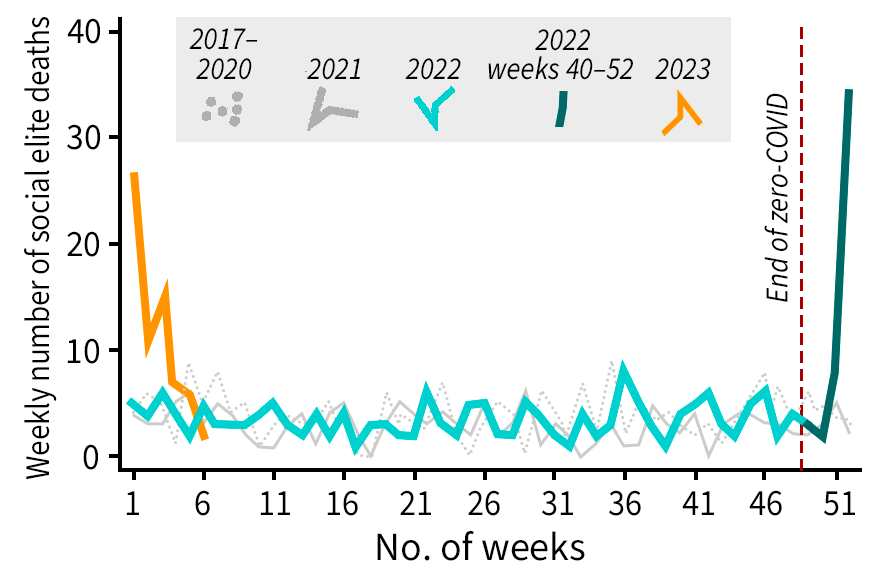
Age and status shaped who died. Excess mortality was sharply concentrated among the oldest elites. For males aged 65–74, the effect was statistically insignificant. For those aged 75–84, annual mortality rose by 36%; for those 85 and older, it rose by 61%, with a 16-fold increase in deaths at the peak week. Perhaps counterintuitively, higher-status elites showed larger mortality increases than lower-status ones — not because they lacked healthcare access, but because they were older on average and had survived with more severe underlying conditions. The most elite group (senior national leaders, top academicians) saw annual mortality rise 114%, compared to 13% for the least elite group. Males were also harder hit than females, with annualized excess mortality about 45% for men versus 25% for women, consistent with global COVID gender patterns.
Extrapolating to the national population. Because elites have better healthcare access than the general public, their mortality during the exit wave represents a floor, not an average. The authors applied age- and sex-specific elite mortality rates to China’s full population, assuming non-elites were at least as likely to die from COVID within each age-gender group. This yielded a lower-bound estimate of 1.44 million excess deaths nationally among those over 65, with an exploratory upper bound of 2.56 million — broadly consistent with other independent projections ranging from 0.97 to 1.87 million. Despite the scale of this mortality shock, China’s cumulative pandemic death toll, when compared across the full 2020–2023 period, remained lower than that of countries with similar GDP per capita or population size, largely because the zero-COVID strategy prevented mass infections during earlier, more lethal waves.
Cumulative COVID deaths in China and various countries
The abruptness of the shift cost lives. The sudden lifting of zero-COVID controls caught China’s health system and society largely unprepared. Antiviral stockpiles and ICU capacity were insufficient to absorb a rapid, nationwide surge; pre-positioning medical supplies likely could have reduced preventable deaths substantially. The timing of reopening was also poorly coordinated with vaccination: booster levels were not at their peak when restrictions lifted, leaving the population less protected than it could have been. The abrupt, opaque policy shift also prevented households from preparing — panic buying stripped pharmacies of basic fever reducers within days. The infection surge that followed was not itself surprising — Omicron was always going to spread once controls lifted — but its collision with an unprepared health system exacerbated the toll and likely increased preventable deaths.