
The Highest Exam: How the Gaokao Shapes China
The Highest Exam: How the Gaokao Shapes China [ 8 min read ]
BOOK SYNOPSIS | The Highest Exam: How the Gakao Shapes China
| Image
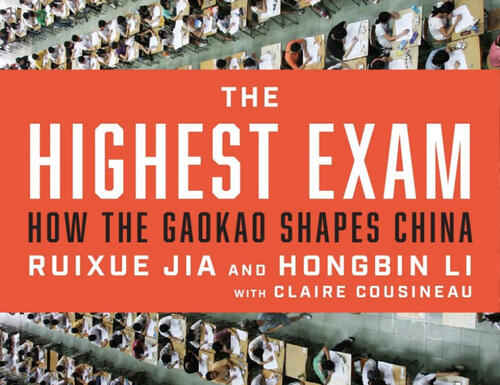
In The Highest Exam, authors Ruixue Jia, Hongbin Li, and Claire Cousineau present a sweeping, data-rich account of China’s exam-centered education system — a “centralized, hierarchical tournament” culminating in the Gaokao, a grueling three-day college entrance exam. Drawing on decades of empirical research and lived experience, Jia and Li — both leading economists who took the Gaokao and later taught at top universities in Beijing, Hong Kong, and the U.S. — reveal how this state-managed system shapes education, labor markets, political legitimacy, and social values. |
Source Publication: Ruixue Jia, Hongbin Li, and Claire Cousineau (2025). The Highest Exam: How the Gaokao Shapes China. Harvard University Press. Read this brief on SUBSTACK |
A Nation Governed by Exams. The Gaokao, the authors write, is “three days of testing [that] mark the final game in a nationwide tournament for which China’s students have spent most of their lives preparing.” A single numerical score determines access to elite universities, coveted public-sector jobs, and life-changing benefits like housing, healthcare, and quality education for children. Through centrally calibrated quotas and cutoffs — by province, discipline, and occupation — the state steers talent toward strategic sectors, fills bureaucracies and boardrooms with capable administrators, and disperses opportunity across China’s vast geography. Though the system rewards not only talent but also wealth and connections, it retains a powerful reputation for meritocratic fairness — earning the buy-in of millions of families who invest earlier and more intensely in education than perhaps anywhere else in the world.
High Costs, High Rewards. The authors document the extraordinary resources China’s families devote to scoring well on tests that govern one’s path through grade school. Although public schooling is officially free through high school, households spend an average of 17% of their income on education — five times the global average. Admission to China’s top universities — Peking and Tsinghua — is virtually impossible without attending one of the top 10% of high schools in a province. But to enter those high schools, students must be top exam scorers at elite middle schools, which in turn require top scoring in elementary school. This cascading structure of high-stakes selection pressures many families to start tutoring their children as early as age four or five. In Beijing, a 550-square-foot apartment in a prestigious elementary school district can cost $1.2 million — more per square foot than in Palo Alto, California.
What motivates families to bear these costs is the extraordinary payoff of scoring high enough to get into elite college. The authors’ analysis shows four years of higher education in China yields a 40% premium on income, with another 40% premium for graduates from top-tier universities. But the real reward is access to a parallel system of privilege. Elite graduates are funneled into the state sector or major state-owned enterprises, gaining not just stable jobs, but preferential access to subsidized housing, premium healthcare, residency permits, and public-school seats for their children. The Gaokao, in effect, is not just an academic test — it is a gate into an entirely different social contract.
Meritocracy or Myth? One of the book’s strongest contentions relates to the Gaokao system’s illusion of fairness. While the test is lauded for its objectivity, the data tell another story. Only 35% of rural students go to college, compared to 51% of urban students. Urban children receive four times more tutoring than rural peers. The wealthiest 25% of households earn almost 14 times more than the poorest 25%, yet the poorest spend 57% of their income on education, compared to just 11% for the rich. Nevertheless, the top 20% are twice as likely to send children to college. Meanwhile, 10% of elite university admissions go to repeat test-takers — those who can afford extra preparation time. Families outside a prized school district can pay out-of-district fees as high as $75,000 or rely on personal connections to secure a spot, further stacking the deck against disadvantaged students.
Despite stark inequalities in opportunity and access, the system retains broad legitimacy because it appears to offer fairness in an otherwise opaque and unaccountable institutional environment. In a society where wealth, politics, and power are often governed by informal networks and corruption, this perception of fairness, even if partial or illusory, helps the system maintain stability. As one student puts it: “Without the Gaokao, how could you compete with the second generation of the rich?”
Distributing Privilege, Cultivating Loyalty. The authors emphasize the test-based education system serves a deeply political function. Of the 10 million students who take the exam each year, only 500,000 — just 5% — gain admission to a top 100 university. For those who do, the rewards are profound: attending one of these elite schools increases the likelihood of securing a state-sector job by 33%. These positions offer more than stable employment — they serve as soft-entry points into China’s ruling class. By funneling top scorers into government posts and state-owned enterprises, the system anchors technical talent within the bureaucracy, reinforcing both competence and ideological alignment. The authors frame this as political engineering: a mechanism for selecting and socializing the next generation of loyal technocrats.
The Test that Fuels China’s Growth. The book also underscores how the expansion of the Gaokao-led education system has powered China’s economic rise. Since 1977, college attendance among 18–24-year-olds has grown from 1% to 67%. The share of college-educated workers in the labor force rose from 6% to 28%, and average years of schooling for adults over 25 has more than doubled from 4 to 9. This expansion of education, calibrated through tests and quotas, has enormously enhanced the knowledge and skills of China’s labor force. The authors estimate education accounts for roughly one-third of China’s growth in recent decades, with the rest owing to market-friendly reforms.
The state also wields the education system to steer skill formation across the population. Nearly 70% of education funding comes from the central government, which also controls textbook publication. With this influence, the state channels investment into STEM by raising university quotas for those fields. Meanwhile, the authors’ research shows that students exposed to more ideologically rigid curricula are 7% more likely to join the Chinese Communist Party and 11% more likely to secure a state-sector job. In this way, the central government shapes a “university-to-industry pipeline” that is also ideologically aligned with the Party’s vision.
A Path Too Narrow? The authors point out that the system’s rigidity has downsides. Its emphasis on obedience, memorization, and test performance leaves little room for independent thinking or risk-taking. The ideal student, the authors note, is one who is quiet and aces tests — not one who asks questions. The authors suggest this culture can hinder China’s innovation potential, as “outside the box” thinkers go unrewarded. Their analysis also shows that would-be trailblazers with high scores tend to join the state sector that prizes conformity rather than the more dynamic private sector. They also point out that shifting emphasis in national planning can lead to an adjustment of quotas that kneecaps entire fields, citing plummeting enrollment in economics as an example.
Under the Gaokao, China’s universities function more as signals of testing success than as centers of learning. As evidence, the authors show how students’ academic engagement drops sharply once admitted to college: from an average of 27 hours of study and 45 hours of class per week before college to about half that after. They cite studies showing China’s college freshmen, initially ahead of global peers, often stagnate or even regress during college. For these reasons they argue a college diploma signals past discipline, not knowledge gained — representing a lost chance to further train students and foster initiative and original thinking.
Global Spillovers. The authors also reveal how the Gaokao’s emphasis on standardized, “objective” test scores has spilled over into Chinese immigrant communities in the U.S., where many families maintain a strong focus on academic rigor and exam performance as the surest path to opportunity. This mindset often clashes with the more “holistic” educational values embraced by other families and many American institutions — values that prioritize creativity, leadership, and well-roundedness over test scores alone. The result is growing tension, particularly around elite college admissions, where debates over merit, fairness, and cultural bias have intensified.
An Exam that Picks Winners — and Rulers. Taken together, the book offers a fresh perspective on a system that shapes the lives of millions of families within — and increasingly beyond — China. The authors convincingly portray the Gaokao as a mechanism to select individuals with high ability or advantageous family background and sort them into tiers of privilege. To date, the upside for China’s economy has been tremendous, and the payoff to individual winners is tacit admission into the top of China’s social hierarchy. For the 95% of students who don’t reach the top of the Gaokao rankings, the system can feel punishingly unforgiving, and the growing gap between effort and outcome may someday threaten the test’s meritocratic reputation. Until then, the authors argue, “the system works in favor of a select set of families, but it serves nobody more than those drawing up the rules."
ABOUT THE AUTHORS
Ruixue Jia is Professor of Economics at the University of California, San Diego, School of Global Policy and Strategy
Hongbin Li is Co-director of the Stanford Center on China's Economy and Institutions, a Senior Fellow at Stanford’s Institute for Economic Policy Research (SIEPR) and the Freeman Spogli Institute (FSI)
Claire Cousineau is a writer and former researcher at the Stanford Center on China’s Economy and Institutions, and is currently pursuing her MBA at Duke University