
China’s Industrial Policy Extends to the IPO Market
China’s Industrial Policy Extends to the IPO Market [ 5 min read ]
INSIGHTS
- Government-favored industries in China receive substantially more IPO financing. From 2002 to 2022, industries prioritized in China’s Five-Year Plans had an estimated 287% more IPOs and raised 148% more IPO capital than non-favored industries, controlling for industry size and market valuations.
- Government priorities predict IPO activity in China; market valuations do not. The U.S. shows the opposite pattern: highly valued industries attract more IPOs, while industrial-policy support does not predict IPO activity.
- Policy shapes the applicant pool, but fundamentals still matter. Favored industries generate about 414% more IPO applications, yet approval rates are nearly identical (69.5% versus 69.4%). Larger, faster-growing, and more profitable applicants are more likely to successfully list.
- Investors pay a premium for firms in favored industries. At listing, these firms carry a valuation premium equal to 14.4% of the average valuation. The premium grows over the next three years, suggesting investors expect lasting benefits from government support.
Source Publication: Zhiguo He, Yiming Qian, Xi Sun, and Wang Renxuan (2026). Industrial Policy via the IPO Market. NBER working paper.
Read this brief on SUBSTACK
China has long relied on subsidies, tax incentives, and state-directed lending to support industries deemed strategically important. But the government also exercises considerable control over which companies can raise capital through initial public offerings (IPOs). This gives the government another way to steer private capital toward strategic industries without spending public funds. How extensively does China use access to its stock markets as an instrument of industrial policy, and how does this influence the allocation of capital?
The data. To investigate these questions, the researchers assemble data on China’s domestic A-share IPO market between 2002 and 2022, spanning five national Five-Year Plans. They identify industries receiving preferential policy attention using references to strategic priorities in the plans, then examine how this designation relates to the number of IPOs and the amount of capital raised. Their analysis controls for industry size, market valuations, and year-specific factors. They also compare these patterns with IPO activity in the U.S., examine more than 3,500 IPO applications in China between 2014 and 2022, and analyze the market valuations of nearly 3,800 newly listed firms.
The promise and politics of going public in China. A successful IPO in China offers firms benefits beyond the initial capital raised, including access to additional equity, corporate bond markets, cheaper bank financing, and greater ability to attract talent. Equity financing is particularly valuable for innovation-driven industries, where investments are risky, returns are uncertain, and firms often lack the collateral needed for bank loans. But access to China’s stock markets remains subject to government approval. The China Securities Regulatory Commission has long exercised broad discretion over which firms can list, and even the newer registration-based system requires issuers to comply with national industrial policies. In 2021, a government crackdown shut academic tutoring companies out of the IPO market entirely. China thus seeks to harness the benefits of equity markets while retaining government control over which firms and industries can access them.
Change in IPO activity when an industry valuation is 1 percentage point higher, 2002–2022
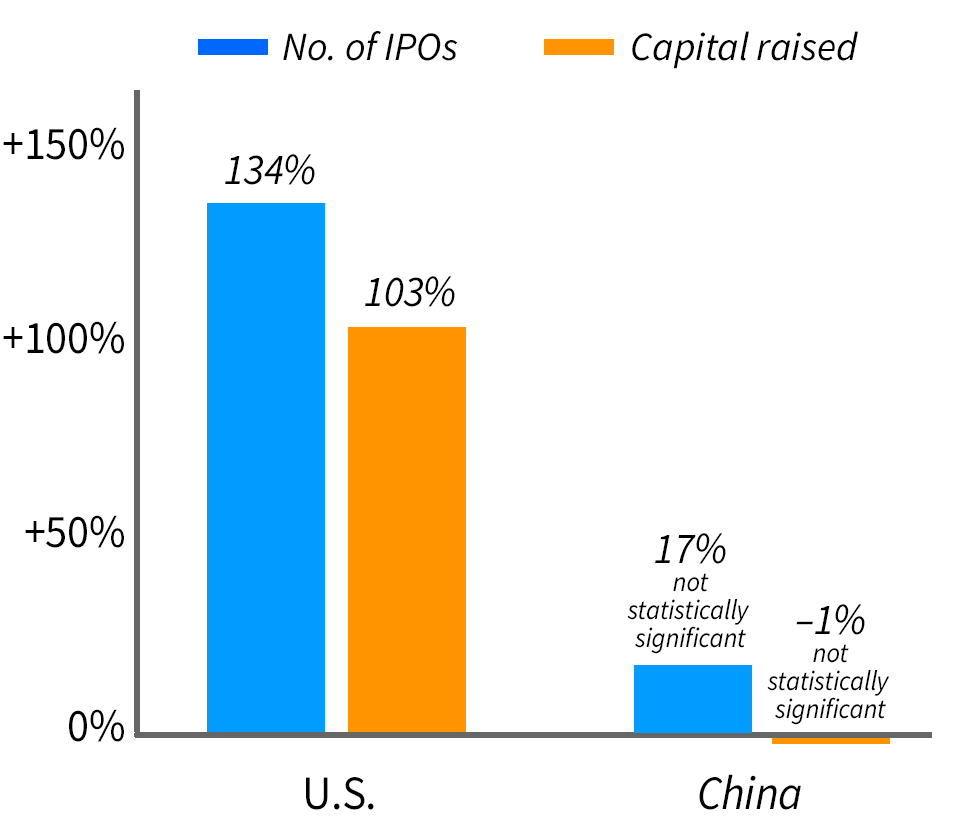
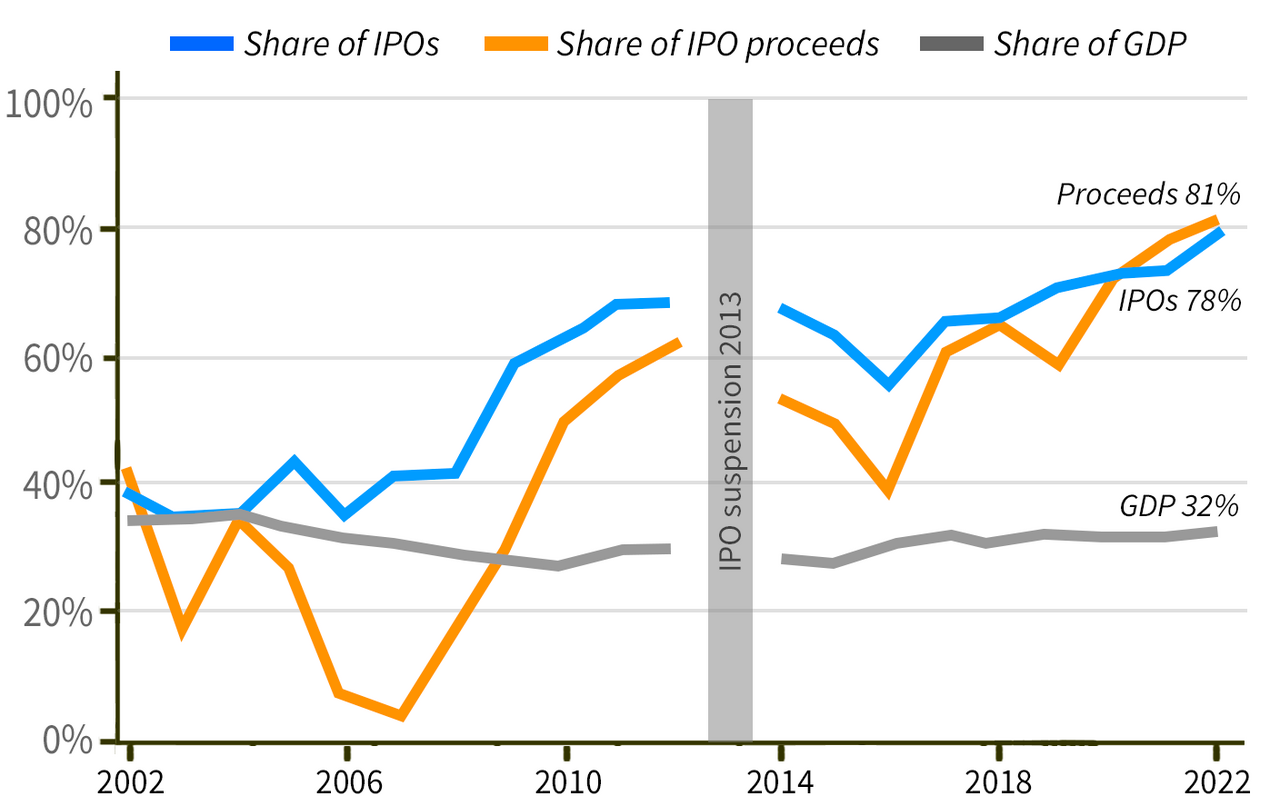
Government-favored industries receive substantially more IPO financing. Industries designated as priorities in China’s Five-Year Plans account for approximately 64% of IPOs and 53% of capital raised through IPOs between 2002 and 2022, despite accounting for only 31% of the combined economic output of industries in the sample. After controlling for industry size and market valuations, the researchers estimate that favored industries have 287% more IPOs and raise 148% more capital through IPOs than non-favored industries. The more often a plan singles out an industry as a priority, the more IPO activity that industry sees. The advantage enjoyed by favored industries has also grown over time and was largest in the most recent Five-Year Plan.
Market valuations predict IPO activity in the U.S., but not in China. In the U.S., industries whose publicly traded firms command higher valuations relative to their assets (suggesting stronger growth prospects) attract more IPOs and raise more capital, while U.S. industrial-policy measures have no statistically significant relationship with IPO activity. In China, however, industry valuations do not significantly predict IPO activity once policy priorities and other factors are controlled for. The researchers also find that industries experiencing the greatest expansions in IPO access do not exhibit significantly stronger profitability or growth before the relevant Five-Year Plan begins. These findings suggest that government priorities influence access to public equity markets independently of the investment opportunities reflected in market valuations.
Government priorities shape the applicant pool, but firm fundamentals remain important. Using 3,559 IPO applications with final outcomes between 2014 and 2022, the researchers find that favored industries generate approximately 414% more applications than non-favored industries, after accounting for industry size and other factors. Yet the proportion of applications ultimately approved is nearly identical: 69.5% in favored industries compared with 69.4% elsewhere. Among firms that apply, larger companies with stronger profitability and faster growth are more likely to complete the IPO process. These findings suggest that government priorities influence which industries generate IPO applicants, but do not necessarily give individual firms in favored industries an advantage in securing approval. Firm fundamentals remain important in determining which applicants ultimately enter the public market. Tellingly, the favored-industry advantage disappears among firms from China that are listed in the U.S., beyond the reach of China’s regulators.
Industries prioritized in Five-Year Plans
Investors assign a growing valuation premium to firms in favored industries. The researchers find that at listing, investors value firms in favored industries roughly 14% more highly than otherwise similar firms in other industries. Rather than fading, the premium grows, reaching approximately 20% of the average valuation three years after listing. A similar pattern appears when comparing firms within the same industry according to how closely their business activities align with the priorities of the prevailing Five-Year Plan. These findings are consistent with investors pricing the anticipated benefits of continued government support into the valuations of favored firms, although the analysis does not directly establish which benefits investors expect.
Industrial policy through private capital markets. China’s IPO-based industrial policy shows how government priorities shape which industries gain access to public equity financing, firm fundamentals help determine which applicants complete the IPO process, and investors assign a valuation premium to companies aligned with national priorities. While the researchers do not establish whether China’s approach improves productivity, innovation, or overall economic efficiency, their findings point to a potential tradeoff. By controlling access to IPO financing, the government can steer private capital toward strategic industries without directly funding those investments. Yet the same controls effectively tax non-favored industries by starving them of risk capital, and their success depends on whether the government can identify industries with genuine long-run potential.