
Behind China’s Local Protectionism: Political Rivalry
Behind China’s Local Protectionism: Political Rivalry [ 5 min read ]
INSIGHTS
- Analysis of 3.8 million government procurement contracts and 200 million firms shows that cities in China whose mayors compete more closely for promotion do less business with each other. A 10-percentage-point widening in the gap between the estimated promotion chances of two mayors (meaning less direct competition between them) is associated with about 3.7% more cross-city procurement and investment.
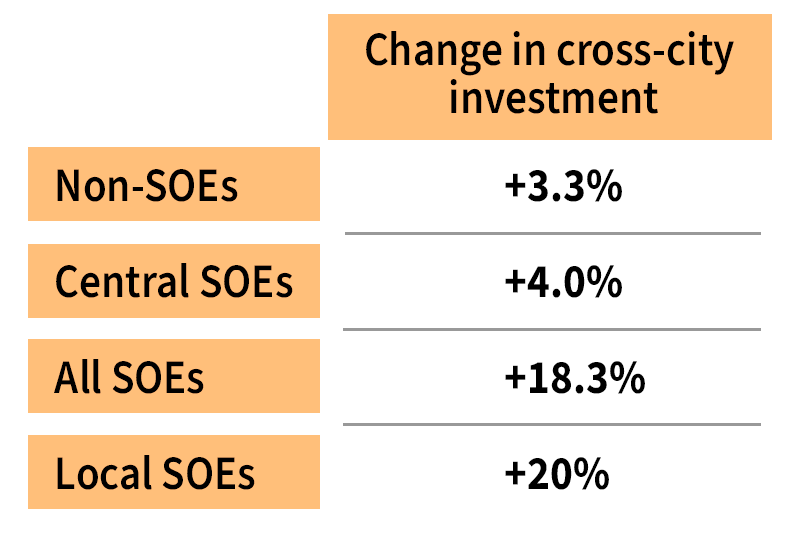
- Local SOE investment aligns with the political interests of mayors. When the gap in the promotion chances of two mayors widens by 10 percentage points, cross-city investment by local SOEs rises by more than 20%, compared with just 3.3% for non-SOE firms.
- When mayors don’t compete, the effect disappears. Among neighboring cities separated by a provincial border, whose mayors generally do not compete for the same promotions, political rivalry has no significant correlation with cross-city procurement or investment.
- By discouraging cross-city procurement and investment, promotion competition reinforces local protectionism, with possible knock-on effects including redundant investment, lower productivity, and excess capacity.
Source Publication: Hanming Fang, Ming Li, and Zenan Wu (2025). Tournament-style political competition and local protectionism: Theory and evidence from China. Journal of Public Economics.
Read this brief on SUBSTACK
China’s system of promoting local officials based partly on their economic performance has long been credited with giving officials strong incentives to pursue GDP growth. Much of this competition takes place among China’s roughly 300 prefectural-level cities, the administrative unit below provinces and above counties and townships, whose leaders compete for a limited number of higher-level positions. While these “promotion tournaments” may encourage growth, they can also give officials incentives to favor their own cities over those governed by political rivals. And because local governments exercise substantial influence over firms, these political incentives may shape business decisions as well. How does competition for promotion affect the economic policies of local governments and the investment decisions of local firms?
The data. To answer this question, the researchers combine data on 3.8 million government procurement contracts from 2013–2019 with a national business-registration database covering more than 200 million firms, which allows them to track equity investment between cities. They then match these data to detailed career histories of China’s city mayors. The researchers estimate each mayor’s promotion potential based on characteristics that predict advancement, including age, education, experience, and the economic performance of the city they govern. They use the difference between two mayors’ estimated promotion chances as a measure of political rivalry: the more similar their promotion prospects, the more closely they are competing for advancement. The analysis then asks whether cities whose mayors are more intense political rivals do less business with one another.
Political rivalry reduces economic ties between cities. The researchers find that about 20% of city mayors in the sample are promoted each year, the average mayor serves 2.6 years in office, the average age is 50, and 94% are male. Cities whose mayors are more intense political rivals do less business with one another. A 10-percentage-point widening in the gap between two mayors’ estimated promotion chances — meaning they are less closely matched for promotion — is associated with about 3.7% more cross-city government procurement contracts and 3.7% more cross-city equity investment. Put differently, the more closely two mayors compete for promotion, the less their cities procure from and invest in one another.
Change in cross-city procurement and investment associated with a
10% increase in the gap between two mayors' promotion prospects
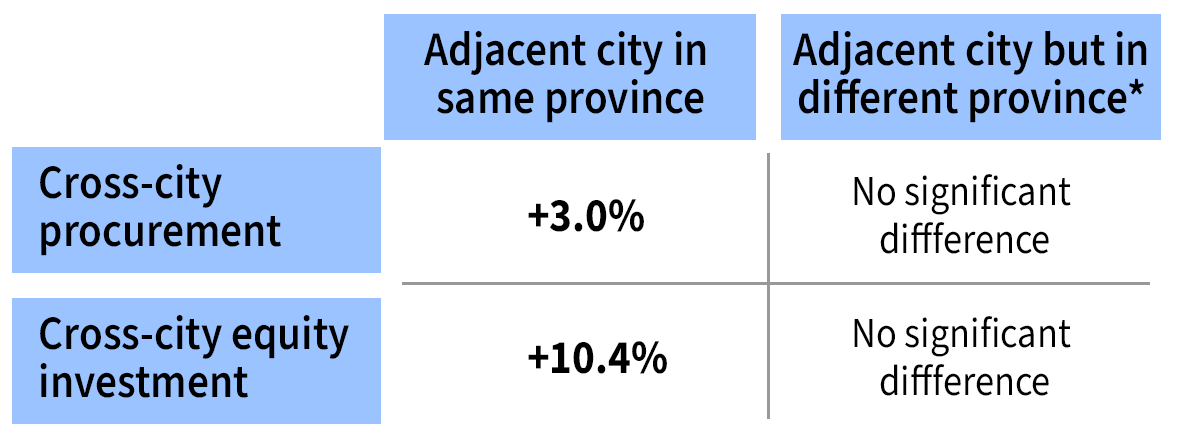
*More than 95% of city-mayor promotions in the sample occur within provinces
Local SOE investment aligns with mayors’ political interests. The effect of political rivalry on local firms’ investment decisions is especially pronounced among local state-owned enterprises (SOEs). A 10-percentage-point widening in the gap between the promotion chances of two city mayors is associated with over 20% more cross-city investment by local SOEs, compared with just 3.3% more cross-city investment by non-SOE firms. The researchers argue that this large difference reflects the particularly close ties of local SOEs to local governments: their investment decisions may be more likely to align with the political interests of city mayors than is the case with non-SOE firms.
Change in cross-city equity investment associated with a
10% increase in the gap between two mayors' promotion prospects
When mayors don’t compete, the effect disappears. About 95% of the promotions of city mayors in the sample occurs within provinces. This means neighboring city mayors in the same province are potential competitors for promotion, while those on opposite sides of a provincial border generally are not. Among neighboring cities within the same province, a 10-percentage-point widening in the gap between the promotion chances of mayors is associated with about 3% more cross-city procurement and 10.4% more equity investment. But among neighboring cities on opposite sides of a provincial border, neither correlation is statistically significant. This suggests that it is competition for promotion, rather than simply differences between cities or their leaders, that limits economic activity across city boundaries.
Political networks mitigate rivalry. Cities do more business with one another when their mayors share political networks. The researchers examine several kinds of political networks, such as connections to the Communist Youth League, Central Party School, or mishu bang, a network of officials who served as secretaries or aides to more senior leaders. They also examine whether mayors previously worked in the same provincial or central government institutions or have personal connections to the same provincial leaders. Cities whose mayors belong to the same political network have 6.1% more cross-city procurement and 18.7% more cross-city investment. One possible explanation is if two mayors share connections, it may be less politically costly to support economic activity in the cities of one another.
The economic costs of China’s “promotion tournament.” China’s promotion system is designed in part to give local officials strong incentives to deliver economic growth. But the findings suggest that those same incentives can discourage economic activity across city boundaries. When city mayors view one another as political competitors, local governments procure less from firms in rival cities, while local firms invest less in those cities. The result is greater local protectionism and fragmentation of economic activity across China’s cities, with possible knock-on effects including redundant investment, lower productivity, and excess capacity.