
China’s Financial System Boosts Production but Bypasses Demand
China’s Financial System Boosts Production but Bypasses Demand [ 6 min read ]
INSIGHTS
- When central banks make credit cheaper and easier, the usual expectation is that businesses invest, households spend, demand rises, and prices follow. An analysis of two decades of national- and industry-level data finds that in China, that chain repeatedly breaks down.
- More credit barely boosts prices. A 1-percentage-point increase in credit expansion initially raises factory-price inflation by about 0.4 percentage points, but the effect reverses within two years; consumer-price inflation shows no meaningful response over five years.
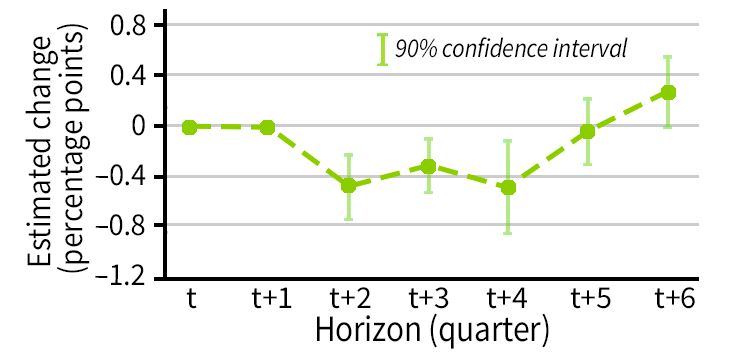
- Instead, more industry borrowing is associated with weaker business performance and more idle capacity. A 1-percentage-point increase in borrowing is associated with weaker profit growth, unsold inventory accumulation, rising debt, and a roughly 0.45-percentage-point decline in factory capacity utilization within a year — a pattern consistent with credit sustaining or expanding production capacity faster than local demand can absorb it.
- The result appears to be a financial system better at sustaining investment and production than household demand. Credit flows disproportionately to capital-intensive, state-affiliated firms and reaches households only indirectly, potentially bypassing the lower-income households most likely to spend additional income.
Source Publication: Jeffrey (Jinfan) Chang and Xiong Wei (2026). Monetary Policy in Mandarin Capitalism. Asian Economic Policy Review.
Read this brief on SUBSTACK
When China's economy slows, its central bank reaches for a familiar remedy: make lending cheaper and easier so businesses invest, households spend, and demand picks up. In most economies, that stimulus eventually pushes prices higher. In China, it repeatedly hasn’t. After the 2008 global financial crisis, credit expansion accelerated to roughly 28% in 2009 even as economic growth fell roughly in half, from 18% to 9%. From 2012 through 2015, credit expansion outpaced growth by 3 to 6 percentage points a year, yet factory prices fell nearly 6% by 2015. And from 2022 through 2025, credit expansion again outran a slowing economy by 3 to 7 percentage points a year, while factory prices declined and consumer prices barely moved. Two successive heads of China’s central bank have called this pattern a puzzle. This study asks why making credit cheaper and more plentiful in China does so little to durably boost demand and prices — and whether the answer helps explain one of China’s biggest economic imbalances: persistently weak household consumption.
The data. The study combines two decades of national data on economic growth, credit expansion, and prices with financial filings from thousands of publicly listed industrial companies in China, grouped by industry, tracking each industry’s borrowing, prices, profits, inventories, and leverage from 2008 through 2025. It also uses government data on which industries typically buy from and sell to which others, for example, that steelmakers mainly sell to construction firms and carmakers, and mainly buy from iron-ore miners. Using those links, the study asks two questions for each industry: when industry customers borrow more, do prices move? And separately, when its suppliers borrow more, do their own prices move?
A unique toolkit at China’s Central Bank. In advanced economies like the U.S., central banks typically manage demand by raising interest rates when spending is pushing prices up and cutting them when growth is weak and unemployment is rising. The Federal Reserve does this mainly by changing borrowing costs economy-wide and letting markets determine where credit flows. While the timing and magnitude vary, lower rates generally boost spending and inflation. China’s central bank (the People’s Bank of China) uses a wider set of tools: adjusting bank reserve requirements, providing subsidized loans for priority sectors, and channeling funds through policy banks. Though these tools differ, they all make lending cheaper and easier. This paper therefore uses “credit expansion” as a catch-all for the set of policies that expand credit through China’s banking system.
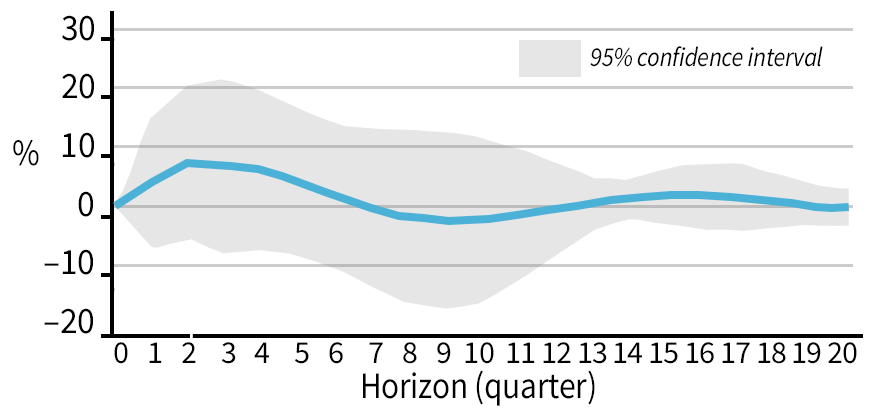
Impact of growth in money supply (M2) on producer price inflation (PPI)
Impact of growth of money supply (M2) on consumer price inflation (CPI)
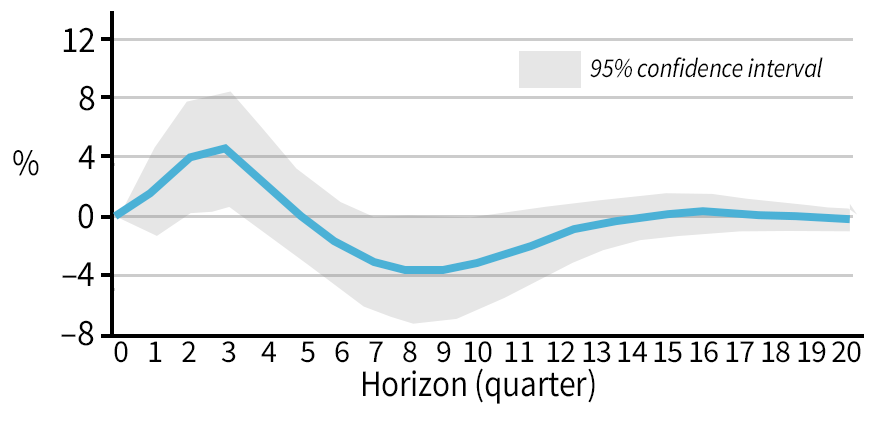
Credit expansion in China raises prices only briefly, then they decline. Using national level statistics, the analysis shows China’s credit expansions do not durably raise either spending or inflation. A 1-percentage-point increase in credit expansion initially raises factory prices by about 0.4 points, peaking three quarters later. But the effect reverses after about two years, with factory prices eventually running about 0.4 points lower than they otherwise would have. More strikingly, consumer prices show no meaningful change at any point over five years.
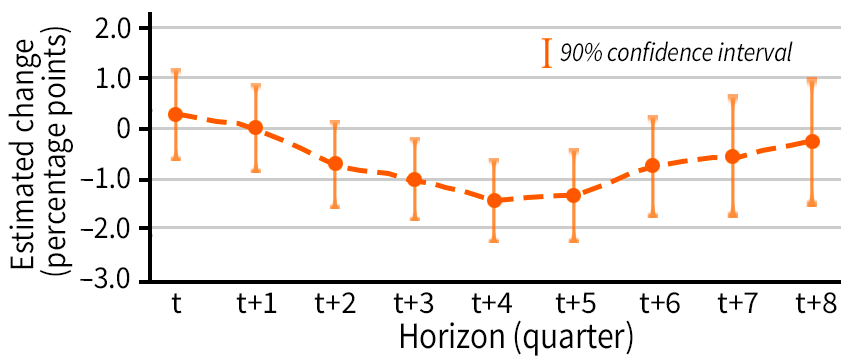
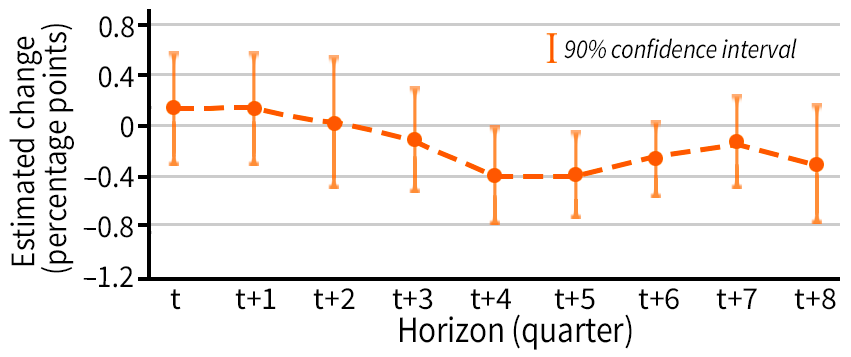
More credit is associated with weaker firm performance. At the industry level, the pattern is even starker: faster borrowing is associated with more inventory, lower profits, more debt, and more idle capacity. A 1-point increase in borrowing is followed four quarters later by a 0.05-point decline in prices, a 1.3-point slowdown in inventory sales (from an average quarterly rate of about 84%, consistent with unsold goods accumulating), and a 0.4-point slowdown in profit growth. Debt loads rise by 0.09 points and remain elevated for the rest of the two-year observation window, while each additional point of industrial borrowing is associated with about a 0.45-point decline in capacity utilization economy-wide within a year. But the analysis shows credit continues to flow even as profitability weakens, consistent with a financial system that sustains state-prioritized sectors despite declining returns.
Impact of industry debt growth on firm inventory turnover
Impact of industry debt growth on firm profit
More demand raises prices; more supply doesn’t lower them. The analysis then looks within supply chains, finding that only the demand side works as expected: when a company’s customers borrow and buy more, its prices rise. But when its suppliers borrow and produce more, the prices it pays do not fall — or move at all. The authors conclude that price pressure in China travels through demand — buyers spending more — but not through supply, consistent with credit expanding production without generating enough additional demand to absorb it.
Impact of debt growth on firm capacity utilization
Why credit doesn’t reach the households most likely to spend it. In a conventional, commercially driven economy, even credit that initially goes to companies eventually boosts household demand through gains in wages, jobs, payments to suppliers, and shareholder returns. In China, that channel is weaker. Credit flows disproportionately to capital-intensive, state-affiliated firms, generating relatively little wage income, while more of the returns accrue to capital rather than workers. And the income that does reach workers tends to go to higher-income, formally employed, urban households, who save more of each additional dollar. Rural, migrant, informal, and lower-income households — those most likely to spend additional income — are least connected to these credit flows. The result is that monetary stimulus is better at sustaining investment and production than at generating household spending.
A financial system built for factories, not households. China’s state-dominated banking system was built to turn the country’s enormous pool of household savings into financing for companies, infrastructure, and industrial development. Capital controls keep those savings largely inside China and, historically, low deposit rates have allowed banks to provide relatively cheap financing to firms. That model helped power decades of rapid industrialization, but it also helps explain why consumption continues to lag investment. When growth slows, the system can readily mobilize more credit to cushion companies, sustain investment, and preserve production capacity, but it is much less effective at putting additional income into households’ hands. As long as new financing continues to travel primarily through banks to firms and investment, additional credit may preserve production capacity without fixing the underlying shortage of consumer demand. The constraint, in other words, may be less how much credit China creates than where that credit ultimately goes.