
China’s Scientific Rise Is Increasingly Fueled by Scientists Coming Home
China’s Scientific Rise Is Increasingly Fueled by Scientists Coming Home [ 6 min read ]
INSIGHTS
- Scientist returnees to China have surged: from 31 in 2004 to 1,409 in 2022, totaling nearly 10,000 returnees — more than half from the U.S.
- Meanwhile, China’s presence in elite science journals has soared: papers with a China-based author rose from about 4% in 2003 to 27% in 2022, reaching nearly half of chemistry papers.
- Returnees are increasingly higher performers: among U.S.-based Chinese scientists, top performers became about 3 percentage points more likely to return than lower performers between 2003 and 2022, with variation across STEM fields.
- Returnees boost their local collaborators, whose citation-based quality rises about 8% in the collaboration year and roughly 15% three years later, even for scientists with other international coauthors.
- The benefits extend beyond collaborators: one additional returnee at a typical institution is linked to a roughly 17% citation-based quality gain among local scientists who never worked with returnees, alongside broader participation and higher research output.
Source Publication: Shihang Ru, Heiwai Tang, Bernard Yeung, and Xinbei Zhou (2026). Brain Circulation and Knowledge Creation: Evidence from Elite Chinese Scientists. Working paper.
Read this brief on SUBSTACK
Since China reopened its doors to overseas study in 1978, it has sent more students and scholars abroad than any other country, but for decades the flow ran almost entirely one way. More than 9 in 10 Chinese nationals who earned U.S. science and engineering doctorates in the early 2000s were still in the U.S. five years later. That stay rate has since eased to roughly 83% for more recent doctorate recipients, as of 2023. Meanwhile, China has actively worked to reverse the flow, rolling out talent-recruitment programs starting in 2006, most notably the Thousand Talents Program (2008) and its Young Thousand Talents counterpart (2011), and has steadily climbed the ranks of elite global science. This study asks whether that rise was fueled by returning scientists, and whether their impact extends beyond their own output to the broader scientific community in China.
The data. The study draws on publication records from 2003 to 2022 in a set of the world’s most selective scientific journals across chemistry, physics, and the life sciences, plus several general science outlets: more than 600,000 papers by over 1.2 million scholars at roughly 65,000 institutions. The authors identify scientists’ likely ethnicity from their names, track institutional affiliations over time, and flag a “returnee” as an ethnically Chinese scientist whose affiliation shifts from overseas to China. Research quality is measured with a citation-based score for each scientist, adjusted for coauthorship and compared against scientists who published in the same year.
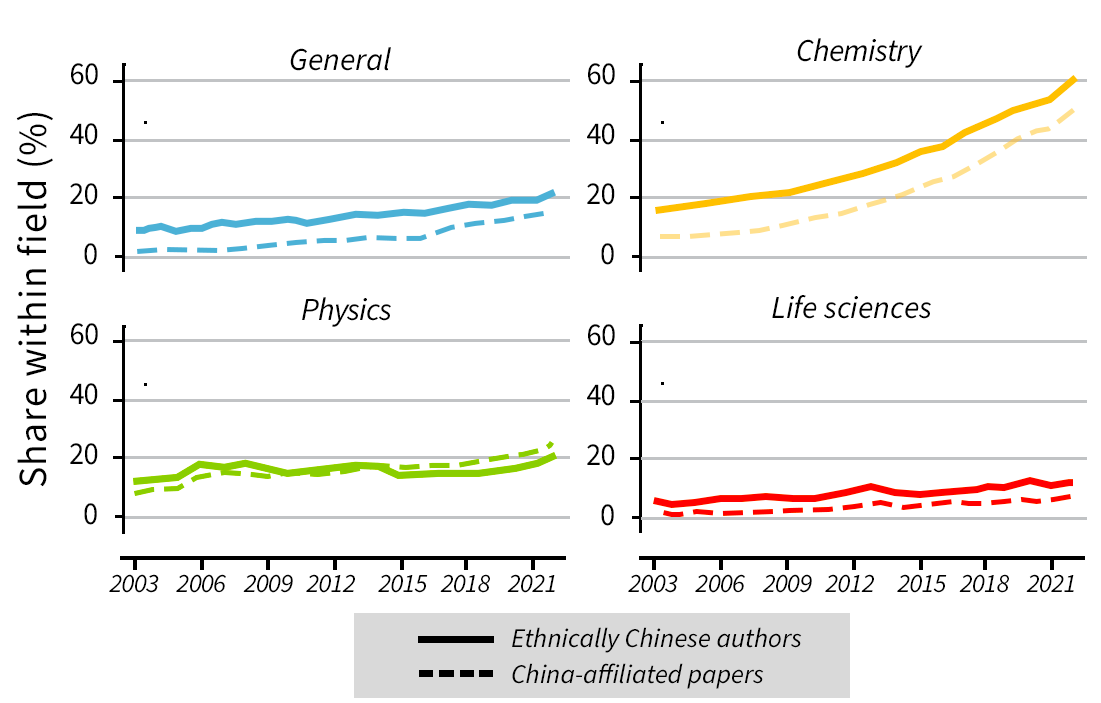
China’s rise in frontier science is increasingly homegrown. The share of papers in these elite journals with at least one China-based author climbed more than fivefold, from about 4% in 2003 to 27% in 2022, approaching half of all chemistry papers by the end of the period, with far more modest growth in physics and the slowest growth in the life sciences. That presence increasingly reflected genuine influence, not just volume: the share of citations earned by China-based Chinese scientists (a standard gauge of research impact) rose roughly tenfold, from about 2% to 25% of the total in these fields, while the same figure for ethnically Chinese scientists based in the U.S. stayed essentially flat over the same two decades.
China-affiliated paper and ethnically Chinese author shares by field
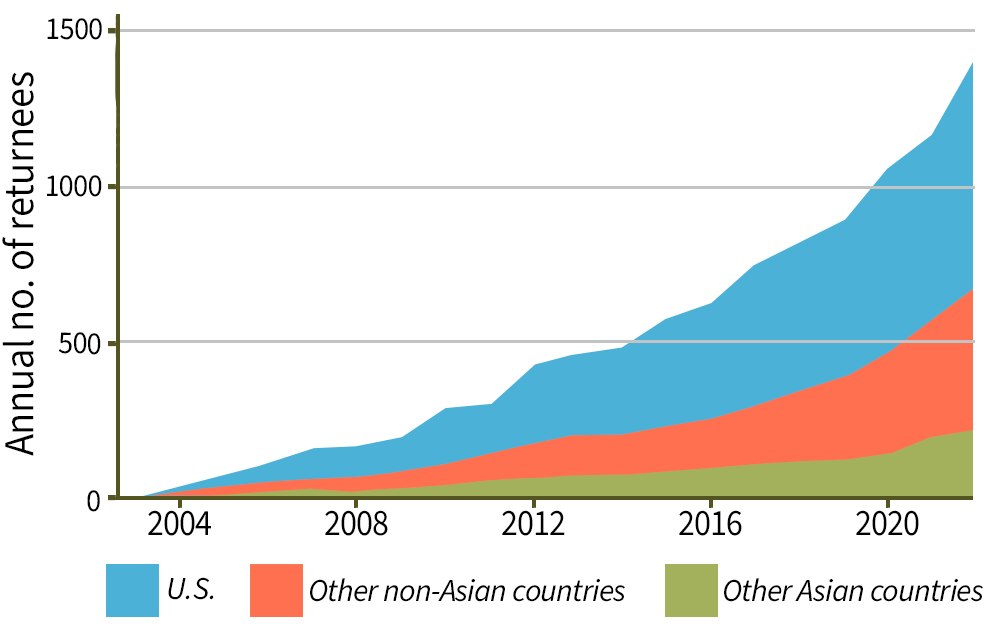
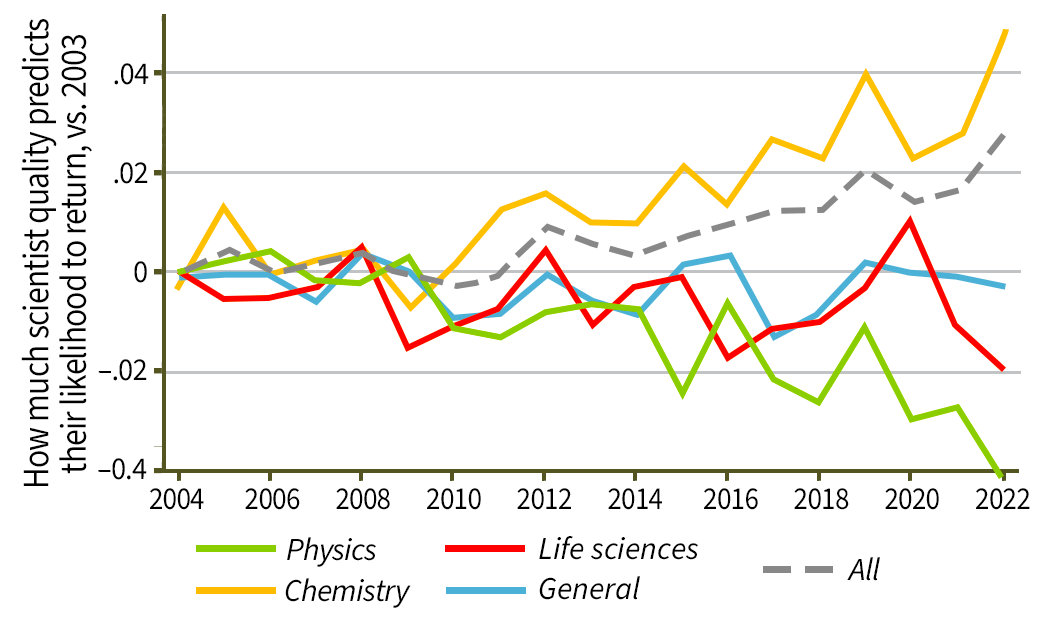
Higher-quality scientists are increasingly the ones returning to China, though not in all fields. Annual returnee inflows grew from 31 scientists in 2004 to 1,409 in 2022, and the pool skewed toward higher performers over time: among U.S.-based Chinese scientists, the gap in return likelihood between top- and bottom-half performers (based on citation share) was about 3 percentage points larger in 2022 than in 2003. That shift was driven almost entirely by chemistry, where the gap was roughly 5 percentage points larger in 2022 than in 2003, while it was smaller in physics and the life sciences over the same period. Performance after return followed a similar pattern: returning chemists went on to outperform similarly qualified peers who stayed in the U.S., but returning life scientists fell behind theirs, and returning physicists showed mixed results, edging out Chinese peers who stayed in the U.S. but trailing non-Chinese ones.
Annual inflows of returnees by region of prior affiliation
Collaborating with a returnee delivers a lasting boost to local scientists’ own work. Studying scientists who already had coauthors outside China before working with a returnee for the first time (a design meant to isolate the returnee’s specific contribution from the general benefit of international collaboration), the authors find that research quality rises significantly and persistently after that first joint paper: a gain of roughly 8% in the author’s own citation-based quality score in the collaboration year, growing to about 15% three years on. The pattern held up across multiple statistical approaches, suggesting the gain reflects something returnees specifically bring, such as specialized expertise, familiarity with how elite journals work, and access to international networks, rather than simply broader collaboration.
Scientist quality and U.S.-to-China return probability
Even scientists who never work with a returnee benefit from having more of them nearby. Among scientists with no prior collaboration with either a returnee or an international coauthor, greater institutional exposure to returnees is associated with meaningfully higher research quality, even accounting for how strong the institution already was. At a typical institution, one additional returnee is linked to an estimated 17% quality gain for local scientists nearby. The relationship holds, in more modest form, across the full population of local scientists, including those who do collaborate directly, and institutions absorbing more returnees go on to support more active researchers and greater overall publication output.
Returnees have fueled China’s ascent in science, if unevenly. The increase in scientists returning to China from overseas, mostly from the U.S., has coincided with China’s growing presence in elite science. Those returnees are increasingly the field’s stronger performers, though how strongly varies by field. They remain productive after coming home, again unevenly across fields. And the benefits reach well past the returnees themselves, lifting the local collaborators, colleagues, and institutions around them. But the gains documented in the analysis are not uniform: they concentrate heavily in chemistry and physics, while general science journals and life sciences show weaker or no comparable effect, a pattern the authors suggest reflects how well different research environments can put returnees’ expertise to use, though the paper doesn’t test that explanation directly. Still, the findings suggest that the value of recruiting scientists home lies only partly in the returnees’ own productivity; a substantial share comes from how their presence reshapes the labs, collaborations, and research cultures around them.