
China Leads the World in AI Patents, but Still Learns More from America
China Leads the World in AI Patents, but Still Learns More from America [ 6 min read ]
INSIGHTS
- The U.S. government’s official AI patent classifier correctly identifies fewer than 4 in 10 true AI patents. Researchers developed a new classifier that catches over 91% of all true AI patents — enabling the first reliable U.S.-China comparison.
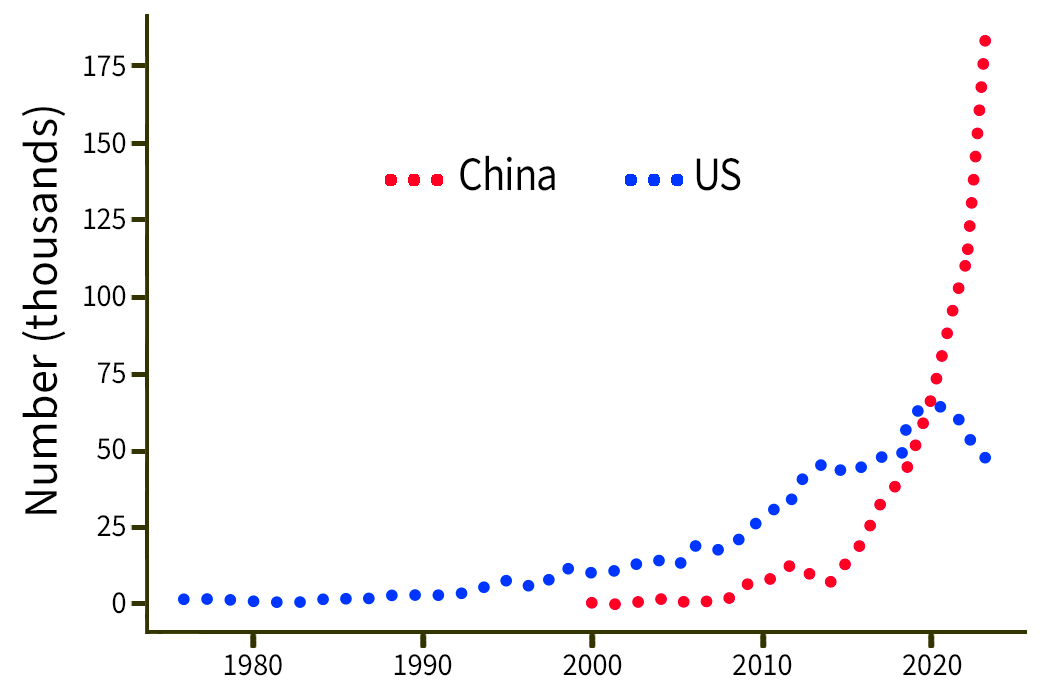
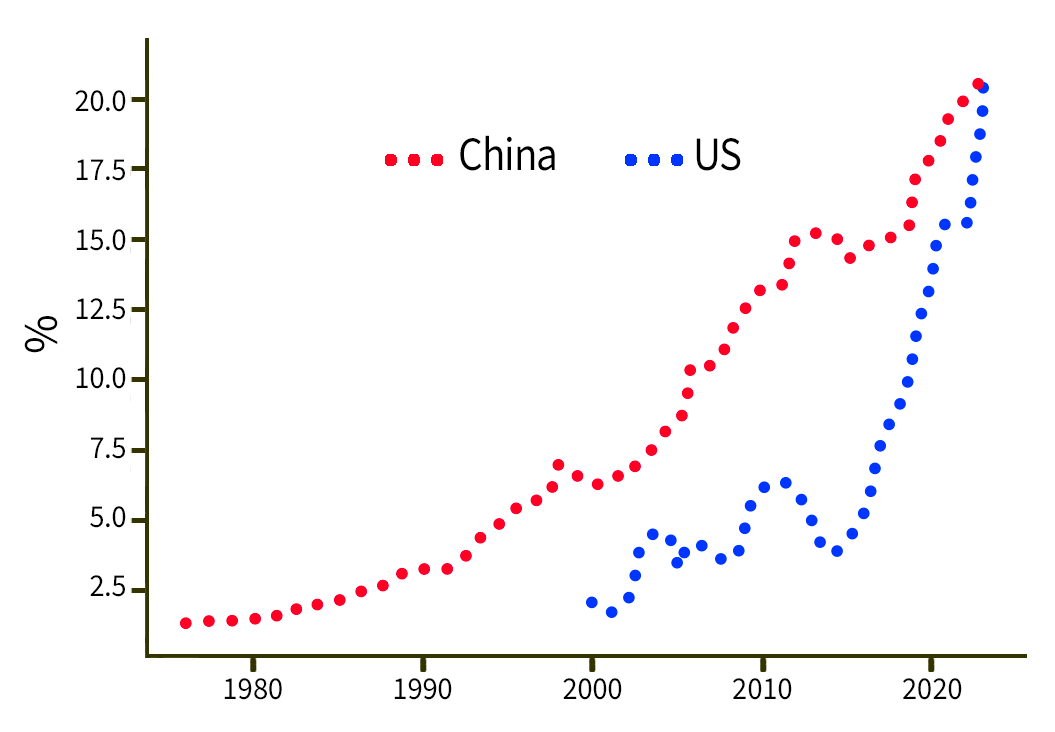
- China surpassed the U.S. in annual AI patent grants around 2020 and by 2023 was issuing nearly four times as many AI patents per year (183,302 vs. 48,197). The share of AI patents among all patents in both countries has converged to roughly 20–21%.
- U.S. patenting is dominated by a handful of large private firms (IBM, Microsoft, Google), while in China universities and state-owned enterprises (SOEs) play prominent roles alongside Tencent, Baidu, and Huawei.
- AI patents command a robust stock-market valuation premium over non-AI patents in both countries — including patents held by China’s SOEs and universities — undermining the view that China’s AI patent boom produces limited economic value.
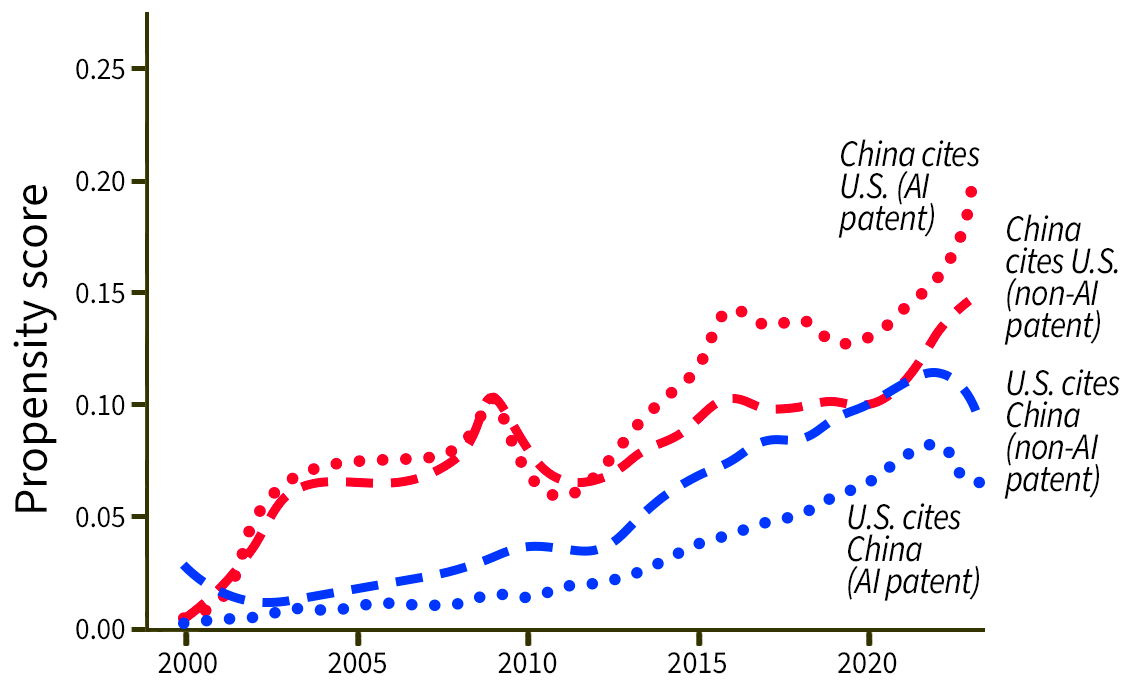
- China’s AI inventors cite U.S. frontier research far more intensively than vice versa, pointing to a continued and asymmetric knowledge dependency.
Source Publication: Hanming Fang, Xian Gu, Hanyin Yan, and Wu Zhu (2026). AI Patents in the United States and China: Measurement, Organization, and Knowledge Flows. NBER working paper.
Read this brief on SUBSTACK
Artificial intelligence has become the central arena of technological competition between the U.S. and China, yet until now there has been no reliable tool for measuring that competition at scale. The official U.S. government classifier — the U.S. Patent and Trade Office’s (USPTO) Artificial Intelligence Patent Dataset for State-Owned Enterprises (SOEs) — turns out to be deeply flawed, correctly identifying fewer than 40% of true AI patents while misclassifying nearly 60% of those it does flag. New research introduces a new high-precision classifier and uses it to produce the first comprehensive bilateral portrait of AI innovation, covering 876,668 U.S. AI patents (1976–2023) and 651,630 Chinese AI patents (2010–2023). The picture that emerges is one of technological convergence in what AI looks like, alongside sharp divergence in where it comes from and who produces it — and, perhaps most strikingly, of continued and deepening interdependence between two countries widely assumed to be decoupling.
The data. The authors fine-tune PatentSBERTa — a language model pre-trained on patent texts — using the USPTO’s manually labeled AI and non-AI patents as a training set. The resulting classifier achieves 97% precision, and 91% recall across seven AI subfields (machine learning, natural language processing or NLP, speech, vision, planning, knowledge processing, and hardware), dramatically outperforming the existing USPTO approach, which scores 40.5% precision and 37.5% recall. The classifier is then validated on Chinese patents by checking that the patents it flags as AI are more closely connected — both in their citations and their technical vocabulary — to known U.S. AI patents than to non-AI ones. Both validations pass cleanly across multiple subfields like machine learning, computer vision, and NLP.
China’s rise and the convergence of AI portfolios. By the early 2020s, China had overtaken the U.S. in the raw annual count of AI patents, granting 183,302 AI patents in 2023 compared to 48,197 in the U.S. The share of AI patents among all patents has converged to approximately 20–21% in both countries by 2023, up from just 3% in China and 15% in the U.S. in 2014. The distribution of AI patents across subfields is also broadly similar in both countries. The one notable divergence is NLP, where U.S. patenting expanded earlier and more steadily, while China’s NLP patenting accelerated sharply only after 2020 — coinciding with the emergence of large language models (LLM) — suggesting that China is rapidly absorbing lessons from the LLM wave.
Number of AI patents granted
Percentage of AI patents among all patents granted
Big Tech dominates in the U.S.; China’s AI ecosystem more distributed. The institutional and geographic landscape of AI innovation differs markedly across the two countries. In the U.S., AI patenting is dominated by a small set of large private incumbents — IBM and Microsoft consistently rank first and second across virtually every subfield, followed by Google, Amazon, and a handful of electronics firms — and it remains tightly concentrated in a few coastal super-clusters, most notably the San Francisco Bay Area and the Northeast Corridor, with limited geographic diffusion since 2010. In China, the picture is considerably more varied. Tencent and Baidu lead most subfields, but SOEs such as State Grid and universities including Tsinghua, Zhejiang University, and University of Electronic Science and Technology of China (in Chengdu) rank among the top assignees in subfields like hardware, planning, and vision. China’s AI activity has also spread far more rapidly beyond pioneer hubs: the share of AI patents from non-pioneer cities nearly doubled over the sample period, as AI clusters emerged in provincial capitals across the interior — a pattern consistent with deliberate state-led efforts to diffuse R&D capacity nationwide.
Citation propensity of AI and non-AI patents between U.S. and China
AI patents are economically valuable in China and the U.S. A skeptical view of China’s AI patent surge holds that government subsidies and administrative targets inflate patent counts without producing real economic value. The paper tests this directly by applying a market-based patent valuation method — measuring the bump in a company’s stock price on the day their patent is granted, adjusted for broader market movements — to both U.S. and China companies. In both countries, AI patents command a robust and consistent valuation premium over non-AI patents across multiple subfields. The premium is largest in software- and data-intensive domains such as machine learning and NLP, and somewhat smaller in hardware-oriented areas. Crucially, citation analysis shows that private firms in China are actually more likely to cite patents from SOEs and universities than from other private firms, with a combined propensity of 0.533 versus 0.467 for private-to-private citations. This pattern — firms voluntarily building on state-sector research — strongly suggests that non-market AI patents contain genuinely useful technological knowledge.
America still sets the frontier; China’s state sector contributes unexpected value. The results suggest that the AI competition between the U.S. and China, despite its geopolitical framing, is not a story of isolation or decoupling. Cross-border citation propensities have increased steadily since 2005 in both AI and non-AI domains. China AI inventors cite U.S. patents far more intensively than China’s non-AI inventors do — and more intensively than U.S. inventors cite China patents — pointing to an asymmetric but deepening technological dependency on the U.S. frontier. Export controls and technology restrictions may interrupt some of these flows, but the underlying demand for knowledge transfer from the U.S. AI frontier remains strong. China’s universities and SOEs appear to function as genuine upstream knowledge producers whose outputs are subsequently absorbed by private firms, a model that may deserve more serious attention than the “ivory tower” or “subsidy capture” narratives often applied to them.