
Ideological spectrum of China
Image
China's Ideological Spectrum
A new study sheds light on whether there is a “left” or a “right” in China
INSIGHTS
- Ideological positions in China do not align neatly along a left-right spectrum.
- Instead, they loosely cluster around preferences for markets versus state intervention in the economy, more or less democracy in government, and more or less nationalism.
- These positions are also correlated with individual and regional characteristics like wealth, openness to trade, and level of education.
- However, these correlations are relatively weak when compared to those found in competitive democracies like the United States.
Understanding the ideological spectrum in China can shed light on public support or opposition to policies of the central government and highlight possible constraints on regime behavior. However, in part due to the difficulty of collecting public opinion data in China, little research has been done to determine the ideological spectrum there. Is there a “left” or a “right” in China? What positions are correlated with what regional or individual characteristics
The data. Nearly 500,000 individuals participated in an online survey that included core debates typically excluded from China’s nationally representative surveys due to their sensitivity. Using the original 500,000 responses, researchers applied a resampling scheme to create a first of its kind sample of 10,000 observations nationally representative of China’s ideological spectrum.
Ideological positions cluster at either end of political, economic, and nationalistic spectrums. Researchers identified three key dimensions around which Chinese ideas and attitudes cluster:
-
Preference for authoritarian institutions versus preference for democratic institutions;
-
Preference for state intervention in the economy and traditional social values versus preference for pro-market policies and non-traditional social values;
-
Preference for nationalism versus less nationalism
Data indicated that wealthier, urban and more highly educated Chinese are less nationalistic and tend to prefer additional market liberalization and democratizing political reforms, and do not endorse traditional social norms. Meanwhile, poorer, less educated citizens are more nationalistic and tend to support authoritarian rule, state intervention and traditional social values.
Ideological positions reflect a split between “winners” and “also-rans” in China’s economic development. Results suggest China’s ideological spectrum is linked with individual and regional outcomes of market reforms. Those who have benefited from China’s market oriented reforms tend to prefer policies that further liberalization and democratization, whereas those who remain relatively disadvantaged are likely to support more conservative positions, such as wealth redistribution and authoritarian rule.
Greater political liberalism associated with higher income, geographic areas open to trade, and urbanization
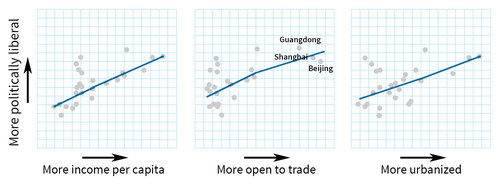
For example, individuals from regions such as Guangdong, Shanghai, and Beijing with higher levels of economic development, trade openness, and urbanization on average lean toward the liberal, pro-market/nontraditional, and non-nationalist end of the spectrum. In comparison, respondents from poorer regions such as Guizhou, Guangxi, and Henan lean on average toward the conservative, anti-market/traditional, and nationalist end of the spectrum. At the individual level, those with the liberal, pro-market/nontraditional, and non-nationalist clustering of preferences are more likely to have higher levels of income and education.
More education and higher income correlated with political liberalism and pro-market sentiment; less education and lower income correlated with stronger nationalistic views
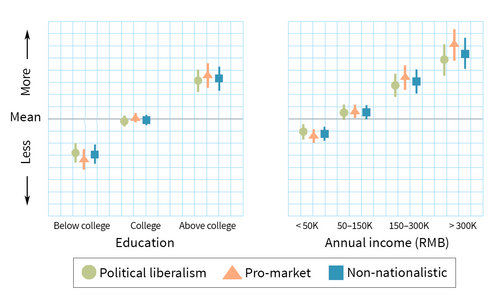
Correlation between individual characteristics and ideological positions are weaker than in many democratic societies, hindering the formation of coherent political opposition. The analysis indicates that while political and economic preferences in China are grouped along known debates and reflect familiar political, economic, and ideological splits, their correlations are relatively weak, particularly in comparison to competitive democracies like the United States, where tighter clustering of views reflect more polarized partisan divides.
The relatively diffuse nature of China’s ideological spectrum may impede formation of organized political opposition. Even though regions or individuals with more education and wealth may prefer changes to China’s current political system, these preferences may not lead to opposition if the CCP maintains the trajectory of a market-based economy. This is because those who espouse liberal political values would still support the CCP as long as it generally maintains market-oriented economic policies and, conversely, those who oppose economic reforms will continue to uphold the CCP for its authoritarian political orientation. Because China’s multidimensional ideological spectrum is not cleanly split between pro-regime and anti-regime factions, it is unlikely that an organized opposition to the regime will emerge.
Source Publication