
Hanming Fang | Decoding China's Industrial Policies
Hanming Fang | Decoding China's Industrial Policies
Friday, October 10, 202512:00 PM - 1:20 PM (Pacific)
Goldman Room E409, Encina Hall
SCCEI Seminar Series (Fall 2025)
Friday, October 10, 2025 | 12:00 pm -1:20 pm Pacific Time
Goldman Room E409, Encina Hall, 616 Jane Stanford Way
Due to room capacity limitations and high interest in this seminar, registration is now closed.
Decoding China’s Industrial Policies
We decode China’s industrial policies from 2000 to 2022 by employing large language models (LLMs) to extract and analyze rich information from a comprehensive dataset of 3 million documents issued by central, provincial, and municipal governments. Through careful prompt engineering, multistage extraction and refinement, and rigorous verification, we use LLMs to classify the industrial policy documents and extract structured information on policy objectives, targeted industries, policy tones (supportive or regulatory/suppressive), policy tools, implementation mechanisms, and intergovernmental relationships, etc. Combining these newly constructed industrial policy data with micro-level firm data, we document four sets of facts about China’s industrial policy that explore the following questions: What are the economic and political foundations of the targeted industries? What policy tools are deployed? How do policy tools vary across different levels of government and regions, as well as over the phases of an industry’s development? What are the impacts of these policies on firm behavior, including entry, production, and productivity growth? We also explore the political economy of industrial policy, focusing on top-down transmission mechanisms, policy persistence, and policy diffusion across regions. Finally, we document spatial inefficiencies and industry-wide overcapacity as potential downsides of industrial policies.
About the Speaker
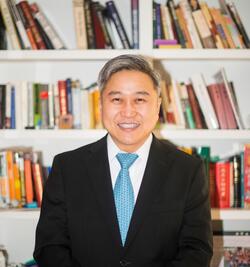
Professor Hanming Fang is an applied microeconomist with broad theoretical and empirical interests focusing on public economics. His research integrates rigorous modeling with careful data analysis and has focused on the economic analysis of discrimination; insurance markets, particularly life insurance and health insurance; and health care, including Medicare. In his research on discrimination, Professor Fang has designed and implemented tests to examine the role of prejudice in racial disparities in matters involving search rates during highway stops, treatments received in emergency departments, and racial differences in parole releases. In 2008, Professor Fang was awarded the 17th Kenneth Arrow Prize by the International Health Economics Association (iHEA) for his research on the sources of advantageous selection in the Medigap insurance market.
Professor Fang is currently working on issues related to insurance markets, particularly the interaction between the health insurance reform and the labor market. He has served as co-editor for the Journal of Public Economics and International Economic Review, and associate editor in numerous journals, including the American Economic Review.
Professor Fang received his Ph.D. in Economics from the University of Pennsylvania in 2000. Before joining the Penn faculty, he held positions at Yale University and Duke University. He is a research associate at the National Bureau of Economic Research, where he served as the acting director of the Chinese Economy Working Group from 2014 to 2016. He is also a research associate of the Population Studies Center and Population Aging Research Center, and a senior fellow at the Leonard Davis Institute of Health Economics at the University of Pennsylvania.