
More Targets, New Tradeoffs: How China’s Local Officials Navigate Competing Priorities
More Targets, New Tradeoffs: How China’s Local Officials Navigate Competing Priorities [ 5 min read ]
INSIGHTS
- China’s system for evaluating local officials increasingly combines incentives to deliver economic growth with binding requirements in other areas, including environmental protection. Environmental targets primarily penalize failure, with little additional reward for exceeding them.
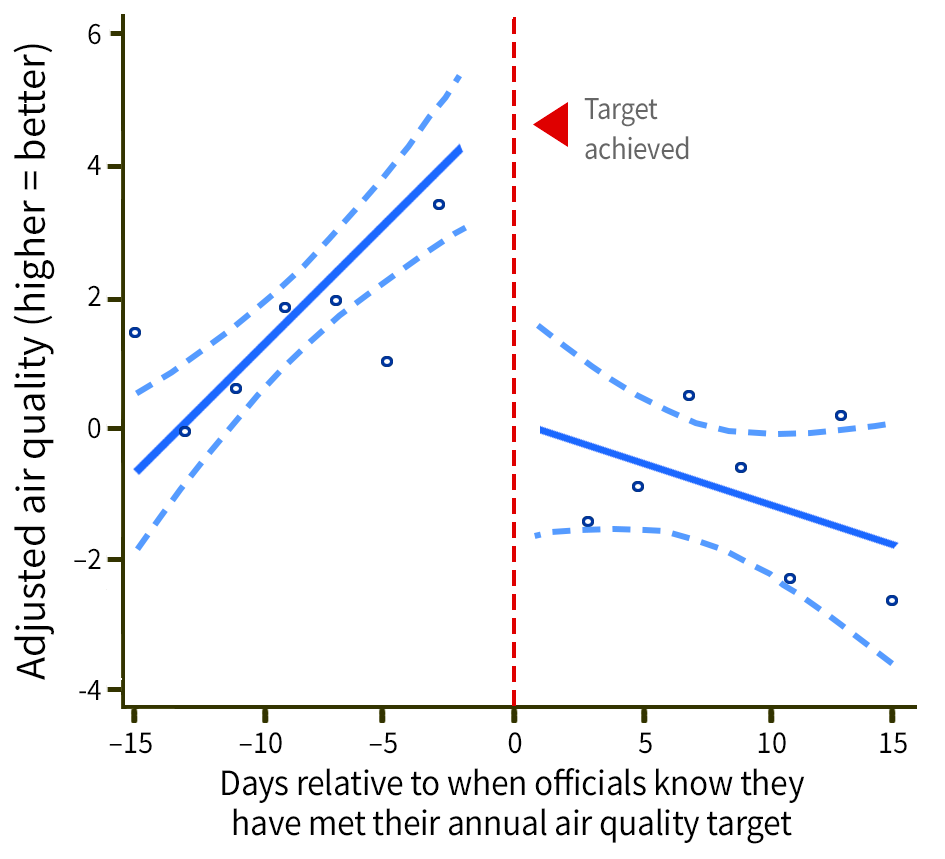
- Analysis of daily air-quality data from 311 prefectures in China (2015–2019) shows that air quality deteriorates by 4.9 Air Quality Index (AQI) points, or 6.8%, once officials meet their annual environmental targets early, reducing incentives to control pollution at the expense of growth.
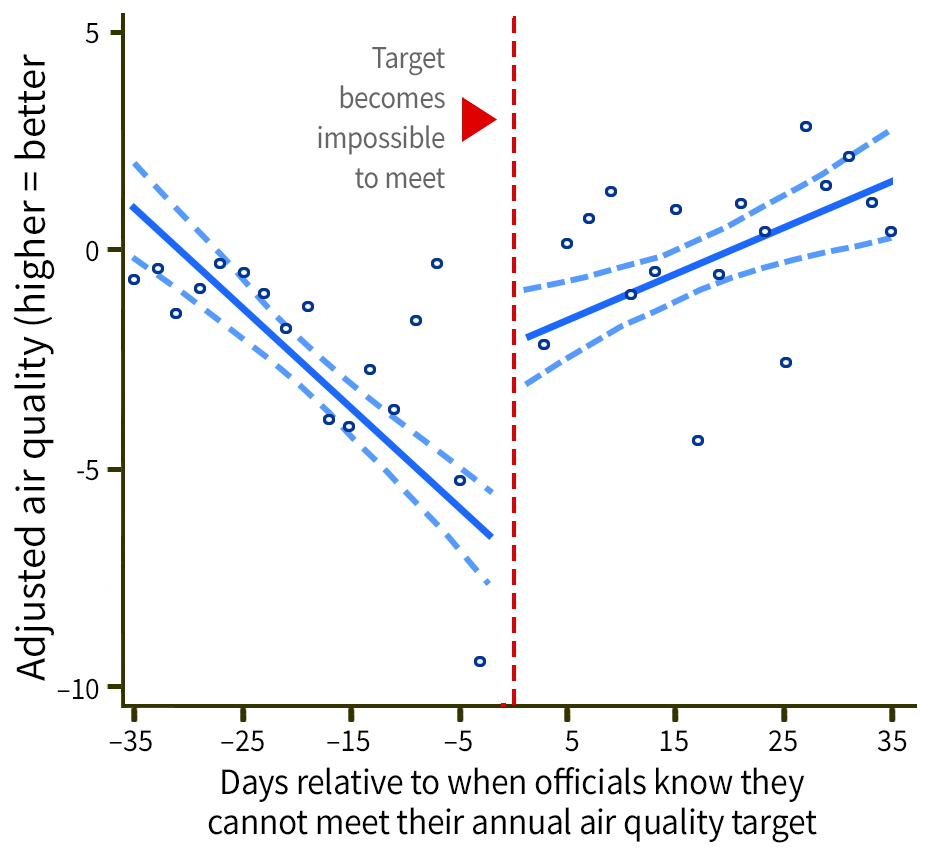
- Even after officials determine they cannot meet annual environmental targets, air quality improves by approximately 4.9 AQI points, or 5.4%, because missing targets by larger margins means greater risk of administrative punishment.
- Officials facing greater growth pressure relative to their provincial peers see air quality deteriorate more (7.4 AQI points) once they’ve met their environmental targets.
Read this brief on SUBSTACK
China’s system for evaluating local officials has long emphasized economic performance. Officials have strong career incentives to promote GDP growth, generate fiscal revenue, and attract investment, with better economic performance potentially improving their prospects for promotion. Beginning in the mid-2000s, China’s central government increasingly incorporated other priorities into these evaluations, including environmental protection and poverty alleviation. Importantly, these objectives carry different incentives. While officials can benefit from delivering more economic growth, environmental targets typically establish minimum requirements: failing to meet them can bring punishment, while exceeding them offers little additional reward. How do local officials navigate these competing incentives, and what happens when they have already satisfied, or can no longer satisfy, one of their targets?
The data. To answer these questions, the researchers assemble daily air-quality observations from 311 prefectures across 24 Chinese provinces between 2015 and 2019, together with annual environmental targets and information on local political leaders. China’s air-quality targets require prefectures to achieve a minimum number of days each year with an Air Quality Index (AQI) of 100 or below, indicating good or moderate air quality. The researchers exploit two situations in which the incentives of officials change abruptly: when a prefecture has accumulated enough qualifying days to guarantee that it will meet its annual target, and when too few days remain for the prefecture to meet its target even if air quality is satisfactory every remaining day. By examining changes in air quality around these thresholds, while accounting for weather and other factors, the researchers estimate how officials respond when their target outcomes become certain.
Officials relax pollution controls once environmental targets are met. When prefectures achieve their annual air-quality targets ahead of schedule, air quality subsequently deteriorates by approximately 4.9 AQI points, equivalent to about 6.8% of the average AQI before the threshold. The researchers interpret this deterioration as evidence that officials reduce their pollution-control efforts once they have satisfied the minimum requirement. Because exceeding the target offers little additional political reward, continued environmental enforcement may come at the expense of other priorities, particularly economic development. The finding illustrates an important difference between environmental and economic targets: officials have incentives to keep pursuing additional growth, but not necessarily additional environmental improvements once a binding requirement has been met.
When the target is secured, air quality deteriorates (to boost GDP growth)
Officials continue improving air quality even when targets become impossible to meet. Surprisingly, officials do not abandon pollution controls when they know their prefectures can no longer achieve their annual targets. Instead, air quality improves by approximately 4.9 AQI points, or about 5.4% of the average AQI before the threshold. The researchers find evidence that this behavior reflects the consequences of falling short. Compared with prefectures that meet their targets, those that miss by moderate margins are 6.7 percentage points more likely to have officials publicly named or summoned for an administrative discussion, while those that miss by larger margins are 11.6 percentage points more likely to face these measures. Although officials can no longer avoid failure, they still have incentives to minimize its severity and reduce the risk of punishment.
When failure becomes inevitable, air quality improves (to lessen punishment)
Economic growth pressure shapes environmental enforcement. The researchers also examine whether officials respond differently depending on the recent economic performance of their prefectures. They compare prefectures whose quarterly GDP growth exceeds that of their provincial peers with those whose growth falls below the provincial median. Among prefectures facing greater pressure to improve economic performance, air quality deteriorates by approximately 7.4 AQI points once environmental targets are secured. Among prefectures with stronger recent economic performance, the estimated deterioration is only 2.0 points and is not statistically significant. A similar pattern emerges when meeting environmental targets becomes impossible: prefectures facing less growth pressure experience larger improvements in air quality than those facing greater pressure. These findings suggest that the willingness of officials to pursue environmental protection depends partly on the competing incentives they face to deliver economic growth.
The challenge of multiplying targets. China’s central government has not eliminated the incentives that historically encouraged local officials to pursue economic growth. Instead, it has added binding requirements reflecting other national priorities, creating a system in which officials must balance objectives that reward different kinds of performance. The findings show that officials respond strategically to these incentives, adjusting their environmental efforts depending on whether targets have been met, how severely they risk falling short, and how much pressure they face to deliver growth. The researchers do not directly estimate the economic costs of environmental targets, but their findings reveal how competing political priorities can shape local government behavior. As the central government holds local officials accountable for an expanding set of priorities, the competing incentives they face may complicate their ability to deliver economic growth.