
A Handful of Elite Universities Have Dominated China's Basic Science Funding for Decades
A Handful of Elite Universities Have Dominated China's Basic Science Funding for Decades [ 6 min read ]
INSIGHTS
- A new dataset of 746,732 grants from the National Natural Science Foundation of China (NSFC) — China’s most important basic science funding mechanism— identifies around 200,000 active scientists in Chinese universities and institutes.
- Non-elite universities — roughly 96% of China's 3,000-plus institutions — saw their share of NSFC grants rise from 8% in 1986 to 35% in 2023, but mostly in the smallest, least prestigious grant categories.
- China’s high-value “Key Programs” remain heavily concentrated among roughly 40 elite universities which capture about half Key Program funding despite decades of reform.
- Just 4% of NSFC researchers have ever moved institutions — far below comparable U.S. figures — and most moves flow downward, from elite to non-elite universities.
- Receiving a grant is required for tenure, but STEM PhD graduates are growing nearly three times faster than the pool of newly funded researchers.
- Taken together, these findings paint a picture of a research system that has broadened in scope without fundamentally redistributing power.
Source Publication: Ningjie Liu, Dongbo Shi, and Jiyu Zhang (2026). Mapping China's Scientific Workforce: Evidence from 40 Years of Disambiguated NSFC Grant Records. SSRN working paper.
Read this brief on SUBSTACK
China’s National Natural Science Foundation of China (NSFC) disburses roughly $4.5 billion annually — about half the size of the U.S. National Science Foundation, but growing fast. Yet the structure of that funding has been nearly impossible to study because so many Chinese scientists share common surnames that grant records cannot reliably identify individuals. A novel disambiguation approach resolves that problem across 40 years of NSFC data, revealing who gets funded and who doesn't.
The data. The authors collected metadata on all 746,732 NSFC-funded projects from 1986 to 2023, drawing on the NSFC’s public database for the years through 2019 and a commercial aggregator for 2020–2023. To resolve name ambiguity, they trained a classification model using a subset of grants for which the NSFC had already assigned unique investigator IDs as verified records, matching grants on institutional affiliation, research field, grant amounts, and title similarity. Behind 277,161 recorded names, the procedure identifies 405,318 distinct scientists since 1986, achieving an accuracy rate of 97.9%.
China's university hierarchy, explained. China’s universities are formally tiered by government designation. At the top sit the nine C9 League institutions, which function roughly as China’s Ivy League: Peking University, Tsinghua University, Fudan University, Shanghai Jiao Tong University, Zhejiang University, Nanjing University, the University of Science and Technology of China, Harbin Institute of Technology, and Xi'an Jiaotong University. Below them are 39 “Project 985” universities, then 112 “Project 211” universities, with the vast majority of Chinese institutions falling outside all three programs. These hierarchies remain deeply embedded in how funding flows and careers advance.
How many basic scientists does China have? NSFC is the primary funding source for basic research in China, and many institutions now mandate NSFC grants as a prerequisite for tenure — making an active grant effectively a threshold condition for independent researcher status in the natural sciences and engineering. This is a narrower definition than in the U.S., where university scientists can remain active through NIH, DOE, private foundations, or industry funding. By this measure, China has roughly 200,000 active natural scientists and engineers in universities and institutes at any given time, drawn from a cumulative pool of around 400,000 who have received NSFC funding since 1986.
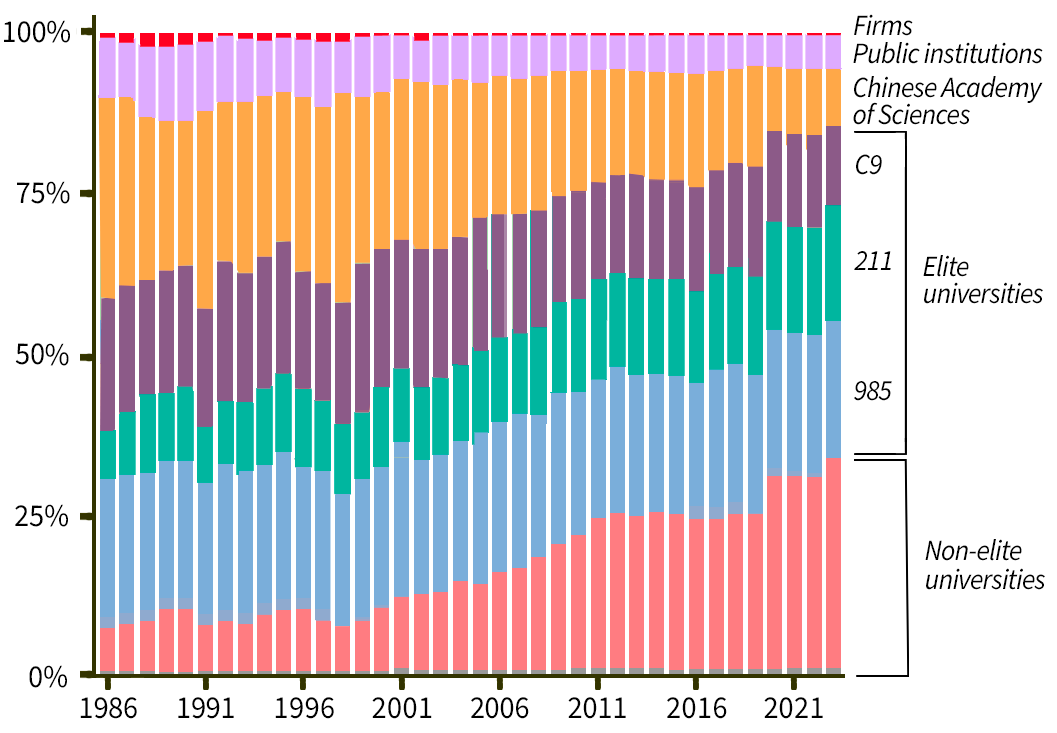
Decentralization is real, but modest. The headline trend in NSFC funding over the past four decades is one of broadening access. Non-elite universities —roughly 96% of China’s 3,000-plus higher education institutions — saw their share of all grants rise from 8% in 1986 to 35% in 2023. Over the same period, the share going to C9 universities fell from 22% to 12%, and the Chinese Academy of Sciences fell from 26% to 12%. Measured by standard concentration indices, overall institutional concentration has declined steadily since the early 2000s.
Share of total basic science funding
Share of Key Programs funding
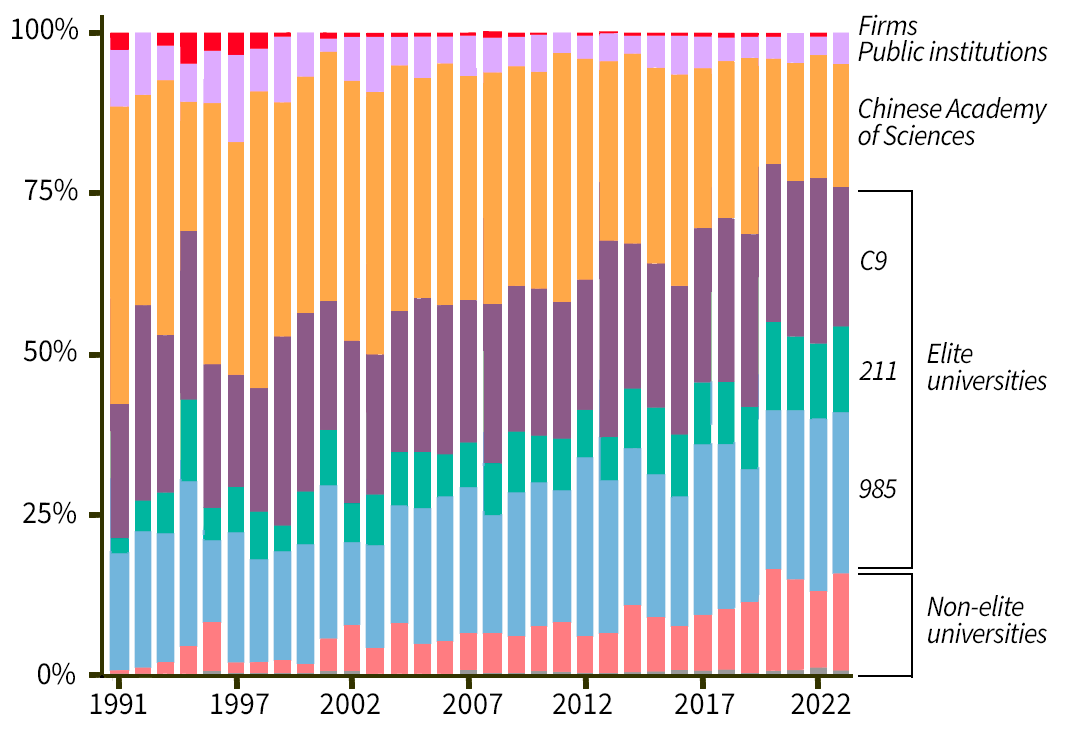
The elite premium survives where it counts most. NSFC funding falls into three categories: standard individual grants, specific regional or policy-targeted programs, and Key Programs — strategically important awards averaging roughly 290,000 RMB per project, about seven times the individual grant average. It is here that elite concentration persists almost unchanged: C9 and Project 985 universities, roughly 40 institutions in total, together capture about half of all Key Program funding despite four decades of reform. Non-elite universities have made almost no inroads, and within the C9 group itself funding is further concentrated among an even smaller subset.
Scientists stay put — or move down. One reason concentration may be self-reinforcing is that scientists rarely move between institutions. Only 4% of NSFC principal investigators (PIs) have ever held grants at more than one institution, compared to 35% of elite U.S. life scientists and 86% of U.S. physicists. When China’s scientists do move, the direction tends to be downward: transitions from elite to non-elite institutions are more common than the reverse.
Annual trends in principal investigators
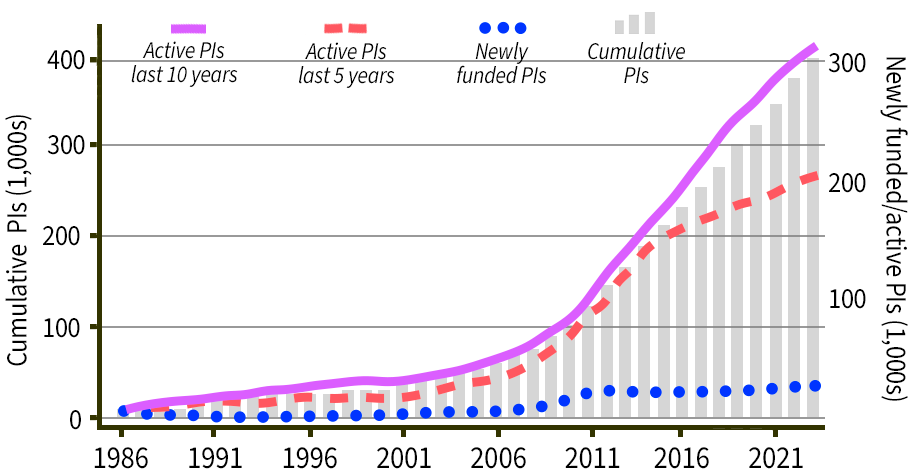
Many PhDs, few grants. The number of newly funded NSFC researchers plateaued in 2011 at 22,000 for most of the following decade. Meanwhile, between 2011 and 2022, STEM doctoral graduates increased by 78%, while newly funded NSFC researchers grew by just 32%. By 2022, China was producing 2.4 new STEM PhDs for every new NSFC-funded researcher. The result is a growing cohort of highly trained researchers who cannot get their own lab or set their own research agenda — and a structural mismatch between China’s training capacity and its funding capacity.
An elite system, quietly entrenched. Taken together, these findings paint a picture of a research system that has broadened in scope without fundamentally redistributing power. In a system where scientists rarely move and elite affiliations determine access to the most valuable grants, the hierarchy tends to reproduce itself — meaning decades of stated policy goals around broadening research capacity may have redistributed small grants without touching the underlying structure of who gets to study what.