
China’s Fertility Decline Is Driven by What Women Want, Not What the Government Permits
China’s Fertility Decline Is Driven by What Women Want, Not What the Government Permits [ 5 min read ]
INSIGHTS
Analysis of nationally representative data reveals China’s 2016 Universal Two-Child (UTC) policy, one of several phased policies lifting birth restrictions, raised births by just 0.025 children per eligible woman — roughly 744,000 additional births per year, or 4.1% of China’s annual total.
The effect was driven entirely by women who already wanted two or more children. Women who desired only one child showed no increase, indicating that low fertility desire — not policy restrictions — is the primary constraint on China’s birth rate.
Childrearing costs dampened the policy’s reach: where housing costs were high, the policy generated far fewer additional births, particularly among women who didn’t own urban property.
Even if every Chinese woman had exactly as many children as she desired, birth rates would continue to decline — both the number of fertile women and their average desired fertility are falling together. Reversing that trend will require making childrearing more affordable, not just removing restrictions.
Source Publication: Hanming Fang, Chang Liu, and Shenghui Yang (2024). Desired Fertility, Actual Fertility and the Effects of China’s Universal Two-Child Policy. University of Chicago working paper.
Read this brief on SUBSTACK
By the early 2010s, facing rapid population aging and a shrinking workforce, China began relaxing policies that it had implemented for decades that were focused on restricting births. Starting in 2011, a “Double-Only” provision allowed couples where both spouses were only children to have a second child. By 2014, a “Single-Only” extension permitted couples where just one spouse was an only child. Neither wave produced the birth surge officials had hoped for. From 2016, all couples were permitted two children under the Universal Two-Child (UTC) policy, followed in 2021 by the removal of all limits. Each liberalization was greeted with underwhelming gains in childbearing. Why?
The data. The study draws on the 2017 China Fertility Survey, which sampled 249,946 women aged 15–60 across 2,737 counties in all 31 provinces. Crucially, the survey collected not just each woman’s pregnancy history but her stated desired fertility — how many children she actually wanted to have. To isolate the policy’s effect, the researchers compared two groups of women who each had one child in late 2015. The first group — the “treatment” group — had been blocked from having a second child under the prior rules but became newly permitted under the UTC. The second group had already been eligible for a second child before the UTC took effect. Since the two groups were otherwise similar, any difference in birth rates after January 2016 can be attributed to the policy change rather than to broader social or economic trends.
Most women in China want 1–2 children, well below the replacement rate of 2.1. Among surveyed women of childbearing age, 32% desired only one child and 55% desired two, and 1.4% desired zero children. About 9% desired three and 2.5% desired four or more, numbers that exceeded the legal birth limits at the time, suggesting women felt free to reveal their true preferences. The average desired fertility ranged between 1.6 and 1.85 across all age groups — already well below the replacement rate of 2.1.
China’s birth rate 2011–2023
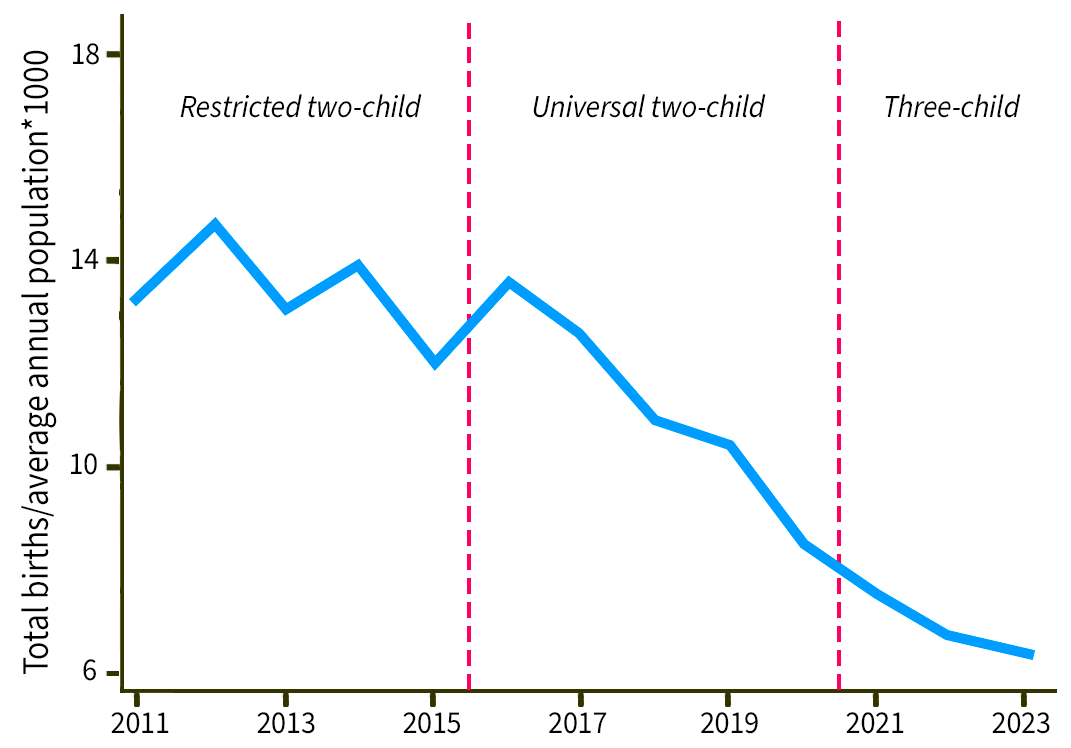
Women in wealthier counties and urban areas expressed lower desired fertility. Housing prices — used in the study as a proxy for childrearing costs — were negatively associated with desired fertility. And in a telling intergenerational phenomenon, women with more siblings desired more children themselves: each additional sibling raised desired fertility by 0.04 children, suggesting the One-Child Policy may have permanently depressed fertility norms across generations.
A modest policy effect. The UTC policy raised births among newly eligible women by just 0.025 children over the two years following its implementation. Scaled to the national population, the researchers estimate approximately 744,000 additional births per year — only 4.1% of China’s average annual births during 2016–2017. The effect was also short-lived. After peaking in 2016–2017, the effect declined rapidly as pent-up demand for additional children was satisfied. In other words, the UTC policy unlocked births that had been waiting to happen — it did not generate new desire for children.
Desire is the binding constraint. Splitting women by fertility preference, the entire policy effect was driven by those who wanted two or more children. Women who desired only one child showed no increase in births at all, suggesting that China’s declining birth rate is not primarily the result of government restrictions preventing willing parents from having children. Rather, the desires themselves have fallen — and they would need to rise substantially to reverse demographic trends.
Even if every woman in China had exactly as many children as she reported to want, the analysis finds births would rise by at most 24% above 2015 levels — and the UTC released only a fraction (16.6%) of that potential. Even the 24% ceiling — the absolute best case — would not be enough to reverse demographic decline, because desired fertility itself is already below replacement level and falling.
No. of fertile women in China and their average fertility desires
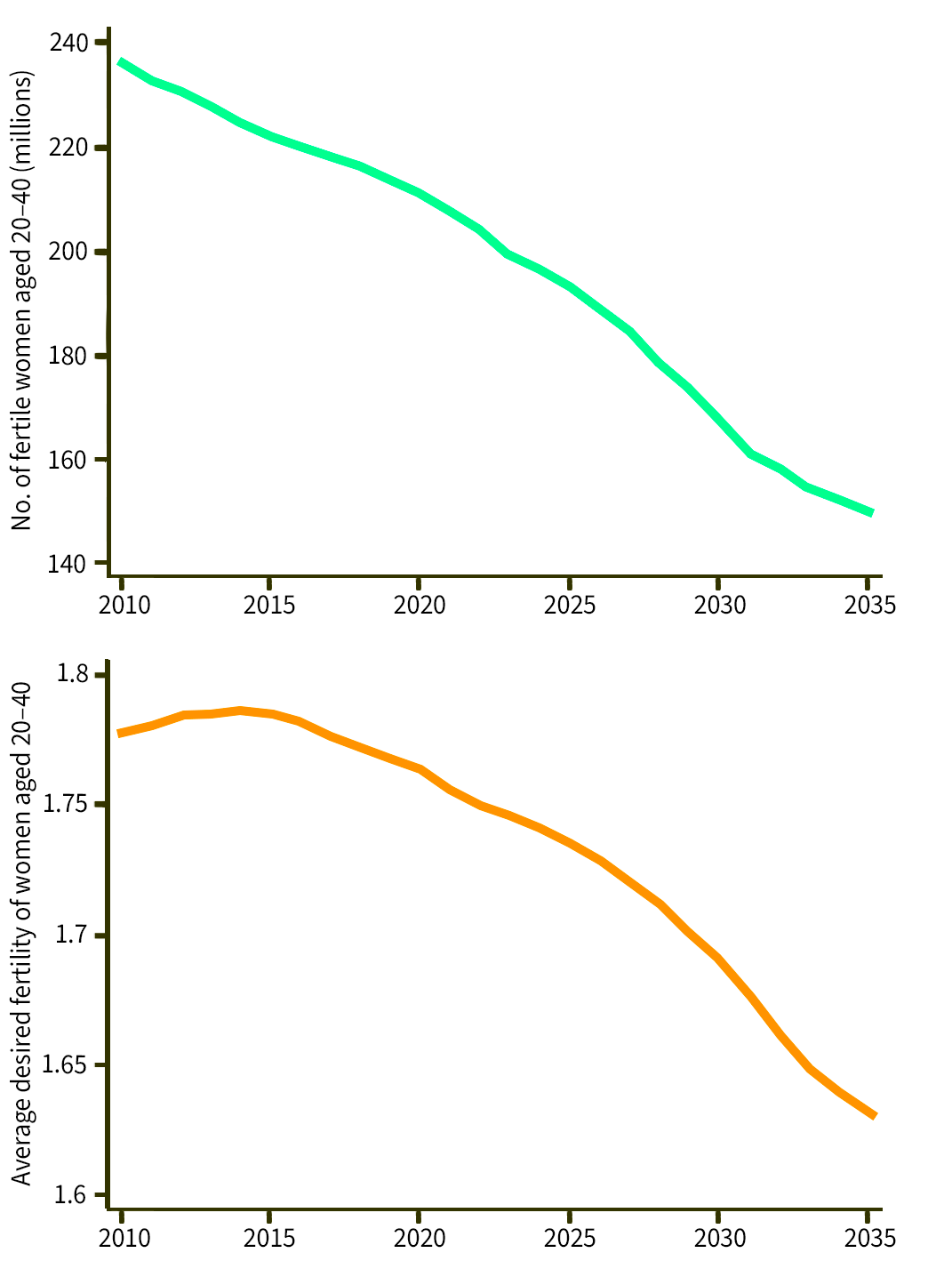
Housing costs as a brake on fertility. Why do so many women in China desire few children? 58.8% of women who were not planning more children cited “the childrearing cost is too high” as the primary reason — far outpacing age (22.6%) or lack of childcare (5.4%). The researchers use county-level housing prices as a proxy for childrearing costs, which correlate strongly with actual medical costs at birth and kindergarten fees. In counties with higher housing costs, the policy generated fewer additional births. This effect was driven entirely by women who did not own urban housing. For homeowners, the relationship was small and statistically insignificant. Renters and those without urban property faced the burden of higher housing costs without any offsetting asset gains, making them more sensitive to housing prices when making childbearing decisions.
The problem isn’t permission. The researchers conclude that removing legal birth restrictions cannot by itself reverse declining birth rates when the underlying desire for children has eroded. The study projects average desired fertility among women aged 20–40 will drop from 1.78 in 2016 to 1.63 by 2035 as lower-desire younger cohorts replace older ones. Reversing that trend will require reducing the economic costs of childrearing — especially housing costs for non-owners — and addressing the deeper normative shifts that have made smaller families the default. While today many provincial and municipal governments now offer financial incentives for childbearing, they tend to be fragmented, locally funded, and modest relative to childrearing costs.