


Stanford researchers partner with local government to bring vision care to rural China
News Type
News
Date
Paragraphs
Hannah Myers
One simple action—placing eyeglasses on a nearsighted child’s face—can help that child to learn almost twice as much in a single school year. Yet only one out of seven children in rural China who needs glasses actually has them. Researchers at Stanford’s Rural Education Action Program (REAP) are now partnering with local government in China to address this problem. Targeting underserved rural primary school students in particular, they have implemented a sustainable pediatric vision care system in two counties. REAP is now preparing to launch a social enterprise based on this model to upscale across the country.
Matthew Boswell, Seeing is Learning’s Project Manager, explains, “We’ve tested our vision care model in the field and know that it’s effective at making care accessible, and makes a big difference in children’s education. By expanding into a social enterprise, we’re hoping to sustainably reach the millions of rural kids in China who need vision care.”
Yang Wenqing is one such child. A fourth grader at Helong Primary School in China’s rural northwestern Shaanxi province, Yang was struggling so much in school that she wanted to drop out. When the REAP team checked Yang’s vision, they found that she could not distinguish the largest letter on an eye chart 20 feet away—the same distance from her desk to the blackboard, where class notes and homework assignments are written. Having never had her vision checked, Yang thought this was normal. When the REAP team fitted Yang with her first pair of glasses, her jaw dropped and she whispered, “Can I keep these?”
At the end of her eye appointment, Yang told the REAP optician that receiving glasses had given her a new outlook on life. When her parents, who are migrant workers, return to visit Yang during the Chinese New Year, she is looking forward to showing them not only a new pair of glasses, but also an improved report card.
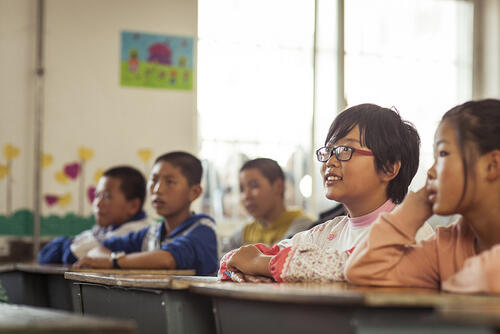 Students whose vision problems were corrected learned almost twice as much in a single academic year as myopic children who did not receive glasses.
Having never had their vision tested, many rural children are unaware that they have poor vision, and that their eyesight is holding them back in school.
She is not alone. Over half of the world’s cases of uncorrected vision occur in China, where the lack of vision care in rural areas is obvious to even the casual observer. In response, REAP researchers launched the Seeing is Learning program in 2012, with the goal of using a simple intervention to transform the education and life opportunities for children like Yang.
The REAP team found that the vast majority of children with vision problems in rural China remain untreated. Furthermore, uncorrected vision is causing these students to fall far behind in school. As a Beijing ophthalmologist told the REAP team, “Eye care is sort of like cars in China. In the cities, people have luxury sedans, and in the countryside many still only have donkeys.” Why is vision care readily available in China’s urban areas, but failing in rural areas—and exacerbating the already substantial rural-urban education gap?
REAP identified both supply- and demand-side obstacles to vision care in rural China. On the demand side, widespread misconceptions hinder uptake of vision care. Rural parents, teachers, school administrators, and even government officials often believe that glasses harm children’s vision. Due to pervasive suspicion of eyeglasses and endorsement of eye exercises, a practice of rubbing around the eyes, rural families often do not seek care.
On the supply side, vision care professionals and eye doctors are located exclusively in the county seat. No clinicians, either public or private, have any incentive to visit rural areas to conduct screening or examinations. Because 7 out of 10 residents in rural areas live a long distance from the county seat, seeking care can be costly.
Since documenting these challenges, REAP has designed practical means to address them. The research team conducted a series of randomized controlled trials and unequivocally found that glasses slow, rather than speed up, the progression of myopia (nearsightedness), and that eye exercises have no measurable impact on vision.
Image
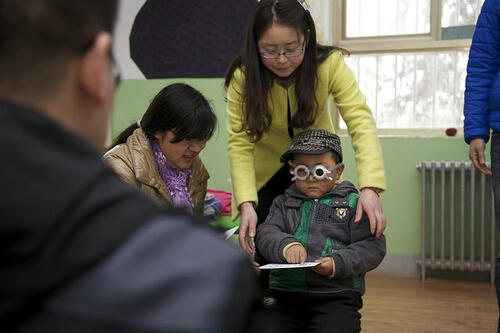
Teachers are generally a trusted source of advice in rural communities. When they buy in to vision care, families often do too.
They also demonstrated that teachers can form a key component in the vision care system. After a half-day training session, teachers in rural schools screened their students for visual acuity with greater than 90 percent accuracy. Teachers can also supervise glasses wear effectively, guaranteeing that the vast majority of nearsighted students wear their glasses in class, where they are most needed.
Finally, the REAP team found that a student’s first pair of glasses must be free (or close to free) for rural households to uptake vision care. When offered free glasses, 8 out of 10 rural families accepted them, even when they had to travel long distances to obtain them. After receiving a voucher for free glasses, the parents of one nearsighted fifth-grade student told the REAP team, “We would travel a thousand miles to restore our daughter’s vision and brighten her future—we just didn't know she had a problem.”
 |
Yongshou, Shaanxi province (Photo Credit: Wikipedia) |
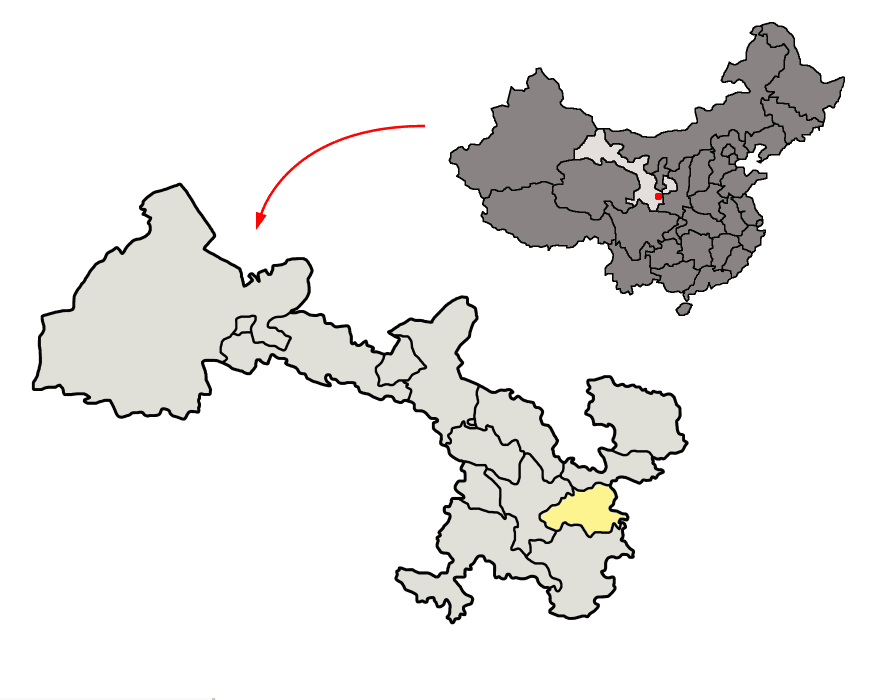 |
Qinan, Gansu province (Photo Credit: Wikipedia) |
With research in hand, in early 2014 REAP partnered with local governments in Yongshou county, Shaanxi province, and Qinan county, Gansu province to implement a new pediatric vision care system. REAP provided donated equipment (including autorefractors and lens edging machines) and high-quality glasses, and helped the hospitals transform space in their outpatient buildings into the vision centers. Four hospital staff were selected to run the clinics, and attended an intensive training program with REAP’s partners at Zhongshan Ophthalmic Center, returning as certified refractionists and opticians. The local Bureaus of Education then trained primary school teachers to screen their students and refer them to the new vision clinics.
This model met with strong success. During the 2014-2015 academic year, 80 percent of children who failed their vision tests went to the clinics in Qinan and Yongshou, where the newly trained optometrists were able to correct 96 percent of vision problems.
“Some students never raised their hands in class because they could not read the blackboard,” explained a primary school teacher in Shaanxi province. “Now that they can see clearly, they are eager to be called on.” Moving forward, these children will likely achieve far more in school, generating greater life opportunities and the ability to participate in China’s fast-changing economy.
REAP is now preparing to launch an innovative social enterprise based on the vision care system they tested in Qinan and Yongshou. The REAP team aims to use this social enterprise, called Learning in Focus, to end China’s rural vision care crisis, and do so sustainably.
As a part of Learning in Focus, REAP will assist county hospitals in building vision centers and provide necessary equipment. REAP will then arrange for four hospital staff members to be trained in ophthalmology and vision center management at Zhongshan Ophthalmic Center, China’s leading ophthalmology hospital. These new optometrists will train local teachers to vision screen their students in a monthly rotation.
Image
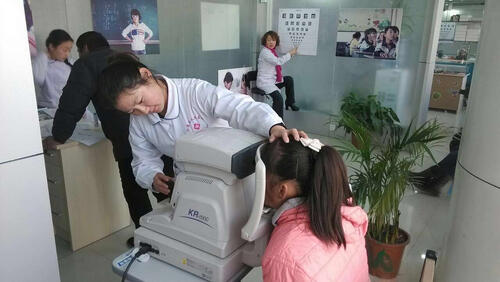
A view inside Seeing is Learning's Yongshou vision clinic: newly certified refractionists and opticians diagnose and treat rural children.
Once Learning in Focus vision centers are up and running, they will give away the first pair of glasses to referred rural primary school students for free, while also providing refraction and eyewear to a fraction of the urban market and junior high students on a fee-for-service basis. This “first pair free” model is not just charity, it also helps build access to the huge and untapped rural market.
The vision centers will repay REAP’s initial investments in monthly installments. After three years, the vision centers will have recouped all start-up costs (equipment, renovation, training, and free glasses), and will begin to earn a profit. Through this market-driven approach, Learning in Focus will rapidly become self-sustaining.
In May, the REAP team met with government officials from 18 counties near Qinan and Yongshou to discuss starting Learning in Focus programs in their localities. County officials were highly interested, as the social enterprise both provides county hospitals with a new revenue stream and helps local governments tackle a key health and education issue. The REAP team is now laying the groundwork to implement Learning in Focus in these areas. In the next several years, they look forward to expanding across rural China, transforming education and opportunities for rural kids like Yang Wenqing in the process.
This Seeing is Learning project is a part of REAP’s broader goal to improve the health, nutrition, and education of China’s rural poor families. Under the direction of Scott Rozelle, the Helen F. Farnsworth Senior Fellow at the Freeman Spogli Institute for International Studies, REAP evaluates the impact and effectiveness of development projects and seeks to upscale programs that work. To learn more about REAP’s diverse projects across rural China, visit their website.
Contacts
Matthew Boswell - Project Manager, Seeing is Learning (boswell@stanford.edu)
Scott Rozelle - REAP Co-Director (rozelle@stanford.edu)
Hero Image

All News button
1
Amita Chudgar on "Who teaches marginalized children, and what may explain these teacher distribution patterns? Analysis of data from Asia, Latin America, and Sub-Saharan Africa"
-
In the final International Education Initiative seminar of the year, Amita Chudgar, Associate Professor of Educational Administration at Michigan State University and Visiting Scholar at the GSE, will present her new study on "Who teaches marginalized children, and what may explain these teacher distribution patterns? Analysis of data from Asia, Latin America, and Sub-Saharan Africa."
Professor Chudgar's study represents the most systematic cross-national analysis of teacher distribution that has been conducted to date. She will also provide insights into policies and practices that may help ensure a more equitable teacher distribution, and address the vicious cycle that can develop—especially in developing countries—when higher-quality teachers are concentrated in the schools and classrooms of wealthier children, while poor and marginalized children find themselves in the classrooms of relatively weaker teachers.
Lunch will be provided. Open to the public.
Encina Hall East Wing, 2nd Floor Conference Room
Seminars
International Education Initiative Workshop
-
The Interantional Education Initiative workshop series creates a forum for graduate students and young researchers to present and discuss their research.
At this workshop, Adi Grief (Department of Political Science) will present on "A Randomized Control Trial on the Source of Gender Threat Stereotype in Rural China" and Minahil Asim (Graduate School of Education) will present on "Can School Council members be informed and mobilized to improve school performance? Evidence from an ICT – based intervention in Pakistan."
Lunch will be served.
Encina Hall East Wing, 5th Floor, Falcon Lounge
Workshops
IEI Seminar: David Baker on "Beyond the Schooled Society, a New Cognitive, Economic, and Demographic Space"
About the Topic: Only 150 years ago, the majority of the world's population was largely illiterate and unschooled. Today, not only do most people have basic reading and writing skills and have attended school, but 20 percent of the world's youth attends some form of higher education. It is clear that the education revolution has transformed postindustrial society in major ways, and that education is a primary rather than a "reactive” institution. What is less clear is what this sea change in exposure to formal education means for the future sustainability of society? Recent research points to a new type of human population with different sets of cognitive abilities, economic interests, and demographic behaviors, all of which will be a major social challenges for the future.
About the Speaker: David P. Baker is Professor of Education and Sociology and a research scientist at the Center for the Study of Higher Education and the Population Research Institute at Pennsylvania State University. His book The Schooled Society is the Winner of the 2015 AERA Outstanding Book Award. He is also coauthor of National Differences, Global Similarities: World Culture and the Future of Schooling (Stanford, 2005) and a frequent contributor to scholarly journals on education.
Lunch will be provided.
Open to the public.
Encina Hall (2nd Floor) Central Conference Room
Seminars
How to better harness big data for international education research
-
International Education Initiative (IEI) Instructional Workshop
IEI is a new cross-campus initiative to increase dialogue and collaboration around international education at Stanford.
About the Topic: There is a wide variety of readily available secondary data sources that can be harnessed to provide rich descriptions and often meaningful causal explanations of interesting educational phenomenon in developing countries. Some of the larger data sources such as TIMSS, PIRLS or PISA are widely known, but in addition to these, many other under-utilized national and cross-national datasets are also available.
In this brief workshop I hope to a) introduce alternative secondary data resources that are useful and relevant for educational research b) discuss some of the advantages and disadvantages of working with such large-scale data.
About the Speaker: Amita Chudgar is an Associate Professor of Educational Administration and Education Policy. As an economist of education, her long-term interest focus is on ensuring that children and adults in resource-constrained environments have equal access to high-quality learning opportunities irrespective of their backgrounds.
Lunch will be served.
Sponsored by: Freeman Spogli Institute for International Studies, Stanford Graduate School of Education, Rural Education Action Program, Center for Education Policy Analysis
Encina Hall East Wing, 5th Floor, Falcon Lounge
Amita Chudgar
Visiting Scholar, Graduate School of Education
Workshops
International Education Initiative (IEI) Workshop
-
The IEI workshop will provide a forum for graduate students and young researchers working in international education to present their research to other graduate students and faculty members.
Brenda Jarillo Rabling from the Program on Poverty and Governance at FSI will present her research on "How the Mexican Drug War Affects Kids and Schools: Evidence of Effects and Mechanisms." Susana Claro from the Center for Education and Policy Analysis will share her work on the "Impact of Teacher Mindset on Student Achievement: Evidence from RCT in Chile."
Lunch will be served.
Open to the public.
Encina Hall East Wing, 5th Floor, Falcon Lounge
Workshops
IEI Workshop
-
We are excited to announce our first International Education Initiative (IEI) events of 2015! As part of our effort to promote greater collaboration around research and policy analysis in international education at Stanford, IEI hosts a speaker series as well as a series of worksops targeted at graduate students and young researchers.
On Friday, January 23rd, we will be holding our first research workshop of the quarter. This workshop will provide a forum for graduate students and young researchers working in international education to present their research to other graduate students and faculty members. The workshop will take place from 1:15pm to 2:30pm in Encina Hall East Wing, 5th Floor, Falcon Lounge. Lunch will be served.
Encina Hall East Wing, 5th Floor, Falcon Lounge
Workshops
