Health and Medicine

FSI’s researchers assess health and medicine through the lenses of economics, nutrition and politics. They’re studying and influencing public health policies of local and national governments and the roles that corporations and nongovernmental organizations play in providing health care around the world. Scholars look at how governance affects citizens’ health, how children’s health care access affects the aging process and how to improve children’s health in Guatemala and rural China. They want to know what it will take for people to cook more safely and breathe more easily in developing countries.

FSI professors investigate how lifestyles affect health. What good does gardening do for older Americans? What are the benefits of eating organic food or growing genetically modified rice in China? They study cost-effectiveness by examining programs like those aimed at preventing the spread of tuberculosis in Russian prisons. Policies that impact obesity and undernutrition are examined; as are the public health implications of limiting salt in processed foods and the role of smoking among men who work in Chinese factories. FSI health research looks at sweeping domestic policies like the Affordable Care Act and the role of foreign aid in affecting the price of HIV drugs in Africa.

Paragraphs

There is little evidence showing whether health information transmitted via text messages can change health and educational outcomes. We conducted a randomized field experiment involving 900 primary students in rural China to study whether a health education campaign conducted via text message could affect caregiver knowledge or student outcomes. When caregivers received both weekly health messages and monthly quiz questions (testing retention of the information conveyed in the weekly messages), caregiver knowledge improved and students experienced gains in both health and academic performance. When caregivers received weekly health messages only, there was no impact on caregiver knowledge or student outcomes.


All Publications button
1
Publication Type
Journal Articles
Publication Date
Journal Publisher
World Development
Authors
Alexis Medina
Scott Rozelle
Authors
News Type
News
Date
Paragraphs

China’s commitment to agricultural development over the last thirty years has dramatically transformed the country’s economy. Rural income per capita has risen an astounding 20 times after 30 prior years of stagnation. Its poverty rate (US$1.25/day) has dropped from 40 percent to less than five, and 350 million rural people between the ages of 18-65 are now working in the industrial or service sector, enjoying rising wages and new economic opportunities.

This rapid transformation is largely the result of three key agricultural policy decisions: putting land in the hands of farmers, market deregulation, and major public investment in the agricultural sector. Although China must now contend with extreme inequality, high levels of pollution, and an aging farming sector there are still lessons to draw from China’s experience that could hasten the transformation of other developing countries.

China expert and agricultural economist Scott Rozelle broke these lessons down at FSE’s fourteenth Global Food Policy and Food Security Symposium Series last week, opening with an underlying theme of the series.

“Growth and development starts with agriculture,” said Rozelle. “Agriculture provides the basis for sound, sustained economic growth needed to build housing, invest in education for kids, start self-employed enterprises, and finance moves off the farm.”

To prove this point he referenced China’s ‘lost decades’ (1950s-1970s) when 80 percent of the population lived in the rural sector and relied on communal, subsistence agriculture. Poor land rights, weak incentives, incomplete markets and inappropriate investments left the average rural farmer poorer at the end of 70s than they were in the 50s with almost no off-farm employment growth.

So what changed? Incentives, market deregulation and strategic investments by the state were key.

Creating the right incentives

In 1978 the Chinese government broke the communes down into small “family farms” such that every rural resident was allocated a small parcel of land. A family of five farmed an area the size of a football field. While they did not own nor could sell the land, they had the right to choose what crops and inputs they used and the right to the income generated from their land.

“Incentives are important, and can be enough in the short run,” said Rozelle. “Hard work led to money in the pockets of farmers and China was off.”

“Every two and half years China added another California in term of agriculture,” said Rozelle.

Between 1979 and 1985 productivity for wheat, maize, and rice went up 50 percent using the same amount of labor, land and inputs. Agriculture across the spectrum has grown at an astounding rate of 5 percent since 1988 (about four times the population growth rate). Livestock and fisheries have grown even faster – accounting for most of the output of the agricultural sector by 2005.

Income growth from farming enabled family members to begin to seek work off the farm. Between 1980 and 2011, off-farm work increased 71 percent with more than 90 percent of households reporting that at least one family member worked off the farm.

Increasing efficiency through liberalization and investment

Another key policy decision was China’s commitment to market liberalization and investment in public goods.

“Markets can be an effective, pro-poor tool of development,” said Rozelle. “A remarkable partnership is formed when you let farmers do production and government do infrastructure…let markets guide decisions.”

The government dismantled state-owned grain trading companies and deregulated trading rules. Prices were set once a week the same day across China to better integrate markets, and eventually prices for major crops closely mirrored those of world prices. Villages began specializing in crops and livestock and incomes of the poor increased. By not providing government input subsidies (e.g, pesticides, fertilizers), traders were incentivized to participate in the market.

“Giving land to farmers and letting the private sector emerge is an easy thing for governments, even without a lot of money, to do,” said Rozelle.

The government provided more indirect market support by publicly investing in better roads, communications, and surface water irrigation. Groundwater was left to the private sector. There were no water or pumping fees nor subsidies for electricity, keeping it completely deregulated. As a result, 50 percent of cultivated land in China is irrigated, compared to 10 percent in the US and only four percent in sub-Saharan Africa.

Finally, China has invested heavily in agricultural research and development (R&D). One percent of China’s agricultural GDP is now invested in agricultural R&D while US investment has fallen over time. US$2 billion alone goes to investments in Chinese biotechnology.

Despite major investment, China only has one major success story to show for so far. The introduction of Bt cotton led to a significant drop in pesticide use (with important health benefits for farmers), and drop in labor and seed price; resulting in a huge 30 percent increase in net income.

“GM technology benefits exist but big policy decisions still need to be made in the face of much resistance both in China and elsewhere in the world on its application,” said Rozelle.

Status of China’s economy

China has largely solved the country’s macro-nutrient food security problem at the household level (>3000 Kcal/day/person) and millions have been lifted out of poverty. Practically all 16-25 years old are now working off the farm.

“This is a real transformation, and one that could not have happened without a major investment in agriculture,” said Rozelle.

While China’s agricultural accomplishments have been major, Rozelle recognizes the system is far from perfect. For starters, there are serious food safety concerns due to lack of traceability. An astounding 98 percent of Beijing consumers think their food is tainted, said Rozelle.

Water is being pumped like crazy and farmers are aging. The younger generation is neither willing nor interested in following in their parents’ farming footsteps. To make up for a labor deficit farmers are applying huge amounts of fertilizer on their land with serious environmental consequences. As a result of changing demographics and an increasing demand for meat, fish, fruits and vegetables, China is likely to be a net importer of food in the long run.

China also faces major urban and rural inequality issues. Even though wages have risen, inequality has not fallen, largely a result of China’s decision not to privatize rural land.

“Rural people have no assets on which to build wealth while urban people were given assets in the form of housing,” said Rozelle. “Housing prices in major cities in China now rival those in the Bay Area!”

The Chinese government fears losing control of the land, but this comes at a price of less individual incentive to invest and inability to build larger farmers. As agricultural growth slows, Rozelle worries high levels of inequality could lead to instability.

Adding fuel to the fire, investment in rural health, nutrition, and education remains far from sufficient. Only 40 percent of the rural poor go to high school resulting in 200 million people who can barely read or write.

“What’s going to happen in 20 years when low skill manufacturing jobs move to other countries?” asked Rozelle. “The rural, uneducated poor are going to become unemployable.”

China’s record leaves room for improvement, but presents a strong case for supporting smallholder agriculture. For those countries emerging out of their own lost decades, smallholder agriculture should remain a primary focus of investment and development.

Hero Image
china rice Sevents
All News button
1
-

The lost decades for China in the 1950s, 1960s and 1970s look remarkably like the lost decades of Africa in the 1980s and 1990s. Poor land rights, weak incentives, incomplete markets and inappropriate investment portfolios. However, China burst out of its stagnation in the 1980s and has enjoyed three decades of remarkable growth. In this talk Rozelle examines the record of the development of China’s food economy and identifies the policies that helped generate the growth and transformation of agriculture. Incentives, markets and strategic investments by the state were key. Equally important, however, is what the state did not do. Policies that worked and those that failed (or those that were ignored) are addressed. Most importantly, Rozelle tries to take an objective, nuanced look at the lessons that might be learned and those that are not relevant for Africa. Many parts of Africa have experienced positive growth during the past decade. Rozelle examines if there are any lessons that might be helpful in turning ten positive years into several more decades of transformation.

Scott Rozelle (main speaker). Scott Rozelle is the Helen F. Farnsworth Senior Fellow and the co-director of the Rural Education Action Program in the Freeman Spogli Institute for International Studies at Stanford University. His research focuses almost exclusively on China and is concerned with: agricultural policy, including the supply, demand, and trade in agricultural projects; the emergence and evolution of markets and other economic institutions in the transition process and their implications for equity and efficiency; and the economics of poverty and inequality, with an emphasis on rural education, health and nutrition.

Alain de Janvry (commentator). Alain de Janvry is an economist working on international economic development, with expertise principally in Latin America, Sub-Saharan Africa, the Middle-East, and the Indian subcontinent. Fields of work include poverty analysis, rural development, quantitative analysis of development policies, impact analysis of social programs, technological innovations in agriculture, and the management of common property resources. He has worked with many international development agencies, including FAO, IFAD, the World Bank, UNDP, ILO, the CGIAR, and the Inter-American Development Bank as well as foundations such as Ford, Rockefeller and Kellogg. His main objective in teaching, research, and work with development agencies is the promotion of human welfare, including understanding the determinants of poverty and analyzing successful approach to improve well-being and promote sustainability in resource use.

Bechtel Conference Center

Encina Hall East, E404
Stanford, CA 94305-6055

0
Faculty Co-director of the Stanford Center on China's Economy and Institutions
Helen F. Farnsworth Endowed Professorship
Senior Fellow at the Freeman Spogli Institute for International Studies
Senior Fellow at the Stanford Institute for Economic Policy Research
scott_rozelle_new_headshot.jpeg PhD

Scott Rozelle is the Helen F. Farnsworth Senior Fellow and the co-director of Stanford Center on China's Economy and Institutions in the Freeman Spogli Institute for International Studies and Stanford Institute for Economic Policy Research at Stanford University. He received his BS from the University of California, Berkeley, and his MS and PhD from Cornell University. Previously, Rozelle was a professor at the University of California, Davis and an assistant professor in Stanford’s Food Research Institute and department of economics. He currently is a member of several organizations, including the American Economics Association, the International Association for Agricultural Economists, and the Association for Asian Studies. Rozelle also serves on the editorial boards of Economic Development and Cultural Change, Agricultural Economics, the Australian Journal of Agricultural and Resource Economics, and the China Economic Review.

His research focuses almost exclusively on China and is concerned with: agricultural policy, including the supply, demand, and trade in agricultural projects; the emergence and evolution of markets and other economic institutions in the transition process and their implications for equity and efficiency; and the economics of poverty and inequality, with an emphasis on rural education, health and nutrition.

Rozelle's papers have been published in top academic journals, including Science, Nature, American Economic Review, and the Journal of Economic Literature. His book, Invisible China: How the Urban-Rural Divide Threatens China’s Rise, was published in 2020 by The University of Chicago Press. He is fluent in Chinese and has established a research program in which he has close working ties with several Chinese collaborators and policymakers. For the past 20 years, Rozelle has been the chair of the International Advisory Board of the Center for Chinese Agricultural Policy; a co-director of the University of California's Agricultural Issues Center; and a member of Stanford's Walter H. Shorenstein Asia-Pacific Research Center and the Center on Food Security and the Environment.

In recognition of his outstanding achievements, Rozelle has received numerous honors and awards, including the Friendship Award in 2008, the highest award given to a non-Chinese by the Premier; and the National Science and Technology Collaboration Award in 2009 for scientific achievement in collaborative research.

Faculty affiliate at the Center on Democracy, Development, and the Rule of Law
Faculty Affiliate at the Walter H. Shorenstein Asia-Pacific Research Center
Date Label
Scott Rozelle Speaker
Alain de Janvry Professor of Agricultural and Resource Economics, Goldman School of Public Policy, UC-Berkeley Speaker
Symposiums
-

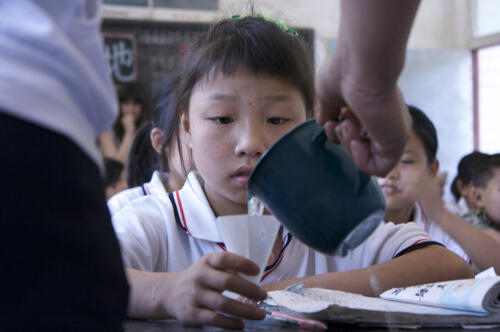
This study seeks to understand whether developing an innovative curriculum kit that will supplement health instruction for 3rd to 6th grade students and teachers in underdeveloped areas of rural China can also be delivered to parents in a set of pilot schools will: improve nutrition and the knowledge of teacher, students and parents about nutrition; reduce the level of anemia; and increase educational performance. The project will also study how to best deliver the message and keep parents accessing the information so they can act on it. The work will entail developing and examining the effectiveness (on the same outcome variables we investigate for the supplemental health class) of ways to use new technologies: mobile phones and postal mailings (for those without mobile phones) to follow up with parents and try to reinforce the message so they put it into action.

Walter P. Falcon Lounge

Encina Hall East, E404
Stanford, CA 94305-6055

0
Faculty Co-director of the Stanford Center on China's Economy and Institutions
Helen F. Farnsworth Endowed Professorship
Senior Fellow at the Freeman Spogli Institute for International Studies
Senior Fellow at the Stanford Institute for Economic Policy Research
scott_rozelle_new_headshot.jpeg PhD

Scott Rozelle is the Helen F. Farnsworth Senior Fellow and the co-director of Stanford Center on China's Economy and Institutions in the Freeman Spogli Institute for International Studies and Stanford Institute for Economic Policy Research at Stanford University. He received his BS from the University of California, Berkeley, and his MS and PhD from Cornell University. Previously, Rozelle was a professor at the University of California, Davis and an assistant professor in Stanford’s Food Research Institute and department of economics. He currently is a member of several organizations, including the American Economics Association, the International Association for Agricultural Economists, and the Association for Asian Studies. Rozelle also serves on the editorial boards of Economic Development and Cultural Change, Agricultural Economics, the Australian Journal of Agricultural and Resource Economics, and the China Economic Review.

His research focuses almost exclusively on China and is concerned with: agricultural policy, including the supply, demand, and trade in agricultural projects; the emergence and evolution of markets and other economic institutions in the transition process and their implications for equity and efficiency; and the economics of poverty and inequality, with an emphasis on rural education, health and nutrition.

Rozelle's papers have been published in top academic journals, including Science, Nature, American Economic Review, and the Journal of Economic Literature. His book, Invisible China: How the Urban-Rural Divide Threatens China’s Rise, was published in 2020 by The University of Chicago Press. He is fluent in Chinese and has established a research program in which he has close working ties with several Chinese collaborators and policymakers. For the past 20 years, Rozelle has been the chair of the International Advisory Board of the Center for Chinese Agricultural Policy; a co-director of the University of California's Agricultural Issues Center; and a member of Stanford's Walter H. Shorenstein Asia-Pacific Research Center and the Center on Food Security and the Environment.

In recognition of his outstanding achievements, Rozelle has received numerous honors and awards, including the Friendship Award in 2008, the highest award given to a non-Chinese by the Premier; and the National Science and Technology Collaboration Award in 2009 for scientific achievement in collaborative research.
Faculty affiliate at the Center on Democracy, Development, and the Rule of Law
Faculty Affiliate at the Walter H. Shorenstein Asia-Pacific Research Center
Date Label
Scott Rozelle Helen F. Farnsworth Senior Fellow, FSI; Affiliated Faculty, CDDRL; and Co-director, REAP Speaker
Dan Schwartz Professor, School of Education, Stanford University Speaker
Seminars
Paragraphs

We conducted a survey of 1707 children in 141 impoverished rural areas of Guizhou and Sichuan Provinces in Southwest China. Kato-Katz smear testing of stool samples elucidated the prevalence of ascariasis, trichuriasis and hookworm infections in pre-school and school aged children. Demographic, hygiene, household and anthropometric data were collected to better understand risks for infection in this population. 21.2 percent of pre-school children and 22.9 percent of school aged children were infected with at least one of the three types of STH. In Guizhou, 33.9 percent of pre-school children were infected, as were 40.1 percent of school aged children. In Sichuan, these numbers were 9.7 percent and 6.6 percent, respectively. Number of siblings, maternal education, consumption of uncooked meat, consumption of unboiled water, and livestock ownership all correlated significantly with STH infection. Through decomposition analysis, we determined that these correlates made up 26.7 percent of the difference in STH infection between the two provinces. Multivariate analysis showed that STH infection is associated with significantly lower weight-for-age and height-for-age z-scores; moreover, older children infected with STHs lag further behind on the international growth scales than younger children.


All Publications button
1
Publication Type
Journal Articles
Publication Date
Journal Publisher
PLoS One
Authors
Alexis Medina
Scott Rozelle
Paragraphs

Background: To study how misaligned supply-side incentives impede health programs in developing countries, we tested the impact of performance pay for anemia reduction in rural China. To the best of our knowledge, our study is the first to evaluate performance pay for actual health improvement.

Methods: We conducted a cluster randomised trial of information, subsidies, and incentives for school principals to reduce anemia among fourth and fifth grade students in 72 randomly-selected rural primary schools across northwest China. Our experiment included a control and three treatment arms: (1) an information arm in which principals received education about anemia; (2) a subsidy arm in which principals received information and unconditional subsidies; and (3) an incentive arm in which principals received information, subsidies, and financial incentives for reducing anemia among students. Students, parents, nursing teams, and survey enumerators were blind to arm assignment. Primary outcomes were student hemoglobin concentrations; secondary outcomes were behavioral responses to the interventions.

Findings: Mean student haemoglobin concentration rose by 1.5 g/L (95% CI –1.1 to 4.1) in information schools, 0.8 g/L (–1.8 to 3.3) in subsidy schools, and 2.4 g/L (0 to 4.9) in incentive schools compared with the control group. This increase in haemoglobin corresponded to a reduction in prevalence of anaemia (Hb <115 g/L) of 24% in incentive schools. Interactions with pre-existing incentives for principals to achieve good academic performance led to substantially larger gains in the information and incentive arms: when combined with incentives for good academic performance, associated effects on student haemoglobin concentration were 9.8 g/L (4.1 to 15.5) larger in information schools and 8.6 g/L (2.1 to 15.1) larger in incentive schools.

Interpretation: Financial incentives for health improvement were modestly effective. Understanding interactions with other motives and pre-existing incentives is critical.

All Publications button
1
Publication Type
Journal Articles
Publication Date
Journal Publisher
BMJ
Authors
Alexis Medina
Scott Rozelle
Paragraphs

Background. Despite growing wealth and a strengthening commitment from the government to provide quality education, a significant share of students across rural China still have inadequate access to micronutrient-rich regular diets. Such poor diets can lead to nutritional problems, such as iron-deficiency anemia, that can adversely affect attention and learning in school.

Objective. The overall goal of this paper is to test whether simple nutritional interventions lower rates of anemia and to assess whether this leads to improved educational performance among students in poor areas of rural China.

Approach: We report on the results of a randomized control trial (RCT) involving over 3600 fourth grade students, mostly aged 9 to 12, from 66 randomly-chosen elementary schools in 8 of the poorest counties in Shaanxi Province in China’s poor northwest region. The design called for random assignment of schools to one of three groups: two different types of treatment/intervention schools; a non-intervention, control group. The two interventions were designed to improve hemoglobin (Hb) levels, which is a measure of iron deficiency. One intervention provided a daily multivitamin with mineral supplements, including 5 milligrams of iron, for 5 months. The other informed the parents of their child’s anemia status and suggested several courses of action (henceforth, the information treatment).

Findings: Some 38.3 percent of the students had Hb levels of below 120 g/L, the World Health Organization’s cutoff for anemia for children 9 to 12 years old. In the schools that received the multivitamins with mineral supplements, Hb levels rose by more than 2 g/L (about 0.2 standard deviations). The standardized math test scores of the students in the schools that received the multivitamin with mineral supplements also improved significantly. In schools that received the information treatment, only students that lived at home (and not the students that lived in boarding schools and took most of their meals at schools) registered positive improvements in their Hb levels. The reductions in anemia rates and improvements in test scores were greater for students that were anemic at the beginning of the study period. Overall, these results should encourage China’s Ministry of Education (MOE) to begin to widen its view of education (beyond teachers, facilities and curriculum) and provide better nutrition and health care for students.

All Publications button
1
Publication Type
Journal Articles
Publication Date
Journal Publisher
Economic Development and Cultural Change
Authors
Scott Rozelle
Paragraphs

Purpose – The purpose of this paper is to explore whether an in-service life teacher training program can improve boarding students’ health, behavior, and academic performance.

Design/methodology/approach – The authors conducted a cluster-randomized controlled trial to measure the effect of life teacher training on student health, behavior, and academic performance among 839 boarding students in ten central primary boarding schools in Shaanxi. And the authors also tried to identify why or why not life teacher training works. Both descriptive and multivariate analysis are used in this paper.

Findings – The authors find significant improvements in health and behavior. Specifically, compared to boarding students in control schools, 15 percent fewer students in treatment schools reported feeling cold while sleeping at night. The results also showed that student tardiness and misbehaviors after class declined significantly by 18 and 78 percent, respectively. However, the in-service life teacher training program had no measurable impact on boarding students’ BMI-for-age Z-score, number of misbehaviors in class, and academic performance. The analysis suggests that improved communication between life teachers and students might be one mechanism behind these results.

Originality/value – This is the first empirical work which explored how to improve the welfare of boarding students via their life teachers. Because of the sudden increase in boarding students in rural China, it is almost certain that school personnel lack experience in managing boarding students. As such, one promising approach to improving student outcomes might be in-service training for life teachers.

All Publications button
1
Publication Type
Journal Articles
Publication Date
Journal Publisher
China Agricultural Economic Review
Authors
Huan Wang
James Chu
Scott Rozelle
Number
3
Paragraphs

The main goal of this paper is to analyze the factors (access, attendance and quality of preschools) that may be affecting the educational readiness of China’s rural children before they enter the formal school system. Using data from a survey of 80 preschools and 500 households in 6 counties in 3 provinces of China, this paper documents the nature of early childhood education (ECE) services and the educational readiness of children aged 4-5 in rural China. We present evidence that ECE services are seriously deficient. Households in many areas of rural China do not have convenient access to preschool facilities. Preschools have poor facilities, inadequate health services, and little concern for the nutrition of their students. Most teachers have little formal training. In part due (perhaps) to the poor quality and low participation in preschool, in this paper we will show that China's rural children score much lower on standardized educational readiness tests. In fact, according to our findings, more than one half of the rural children in our sample are “not ready” for continuing into the next level of formal education. Our analysis implies that it is necessary to improve the facilities and quality of teachers and to increase the probability that children will be sent to ECE institution.

All Publications button
1
Publication Type
Journal Articles
Publication Date
Journal Publisher
Australasian Journal of Early Childhood
Authors
Scott Rozelle
Subscribe to Health and Medicine