
REAP Brief #102:Behind Before They Start
All Publications button
1
Publication Type
Policy Briefs
Publication Date
 FSI researchers consider international development from a variety of angles. They analyze ideas such as how public action and good governance are cornerstones of economic prosperity in Mexico and how investments in high school education will improve China’s economy.
They are looking at novel technological interventions to improve rural livelihoods, like the development implications of solar power-generated crop growing in Northern Benin.
FSI academics also assess which political processes yield better access to public services, particularly in developing countries. With a focus on health care, researchers have studied the political incentives to embrace UNICEF’s child survival efforts and how a well-run anti-alcohol policy in Russia affected mortality rates.
FSI’s work on international development also includes training the next generation of leaders through pre- and post-doctoral fellowships as well as the Draper Hills Summer Fellows Program.
On July 31, 2009, the Education Economic Seminar Series held its first meeting at the Center for Chinese Agricultural Policy (CCAP). Professor Linxiu Zhang moderated the meeting, while Doctor Yingquan Song jumpstarted the series by presenting his research on the "Information and Educational Choices of Junior High Students in Rural China."
The meeting was attended by various professors and graduate students from universities and research institutions in both China and America, including CCAP, Stanford University, The Hong Kong University of Science & Technology, Peking University, Beijing Normal University, and Renmin University. Doctor Song's presentation was followed by a heated and in-depth discussion. Attendees debated and brainstormed ideas for the next step in Song's research.
During the meeting, Professor Linxiu Zhang, the co-director of REAP and the deputy director of CCAP, introduced the idea behind the Seminar Series. Jointly founded by REAP, CCAP, Peking University's China Institute for Educational Finance Research, and Beijing Normal University's School of Economics and Business Administration, the goal of the Seminar Series is to foster creative dialogue among researchers on the development of Education Economics and its role in society. They plan to meet each quarter to discuss fresh ideas and exchange research results. Professor Scott Rozelle from Stanford University, also the co-director of REAP, stresses that once the Seminar Series has started, it needs to continue in order to provide a platform for continuous dialogue among those in the field.

REAP Director Scott Rozelle gave a talk to investment group Dodge and Cox Investments entitled "China’s Shifting Economy, the Plight of Migrant Workers and Shaping the Hope for China’s Recovery/Future Development: China’s Education Challenge."

Wan Gang, China's Minister of Science and Technology, and Bai Chunli, Vice-President of the Chinese Academy of Sciences, presented REAP Director Scott Rozelle with the 2009 Award for Collaboration in Science and Technology in Beijing, China.

A REAP-sponsored workshop lead by REAP affiliate Paul Gewwe (University of Minnesota) designed to target foundation and non-profit managers and executives, researchers and government officials.
Introduction and objectives
Numerous programs are implemented by governments and non-governmental organizations (NGOs), which are intended to change individuals’ economic or social outcomes. Common examples of this include agricultural extension services, public health programs and education programs. An important (and admittedly difficult to answer) question is: How effective are these programs in changing economic or social outcomes? Comparing the relative effectiveness of different programs, as well as comparing these programs’ benefits to their costs is crucial for governments to understand.
Objectives
Institute of Geographic Sciences and Natural Resources Research
No.11 Jia Datun Road
Chaoyang District
Beijing, China
A REAP-sponsored workshop designed to target foundation and non-profit managers and executives, researchers and government officials.
Objectives
Institute of Geographic Sciences and Natural Resources Research
No.11 Jia Datun Road
Chaoyang District
Beijing, China
China has made remarkable progress along the path of economic transformation over the past three decades. To continue its rapid growth in an economy with increasingly higher wages, China’s key challenge is whether it can become competitive in quasi-skilled and skilled industrial sectors so that upscale factories can be induced to establish themselves in China? This study seeks to increase our understanding of high school education in China at a time when the nation is facing challenges in its development path. Using secondary statistics, we have found that educational access at the high school level is quite low—especially in poorer areas of rural China. We argue that the low level of access to high school education in China may be a problem resulting from high tuition and fees. We include empirical evidence about the tuition barrier argument by using a survey of 41 developing and developed countries and a representative survey of 1,177 students from one of China’s poorest provinces. We demonstrate that not only is financing high school a burden for the families of poor students, but also there is little financial aid available. The quality of education of students from poor rural areas prior to entering high school is also a problem. We conclude with a recommendation that in poor rural areas of China high school should be made free, as it is in most of the rest of the world—and efforts should be made to improve rural education in general.
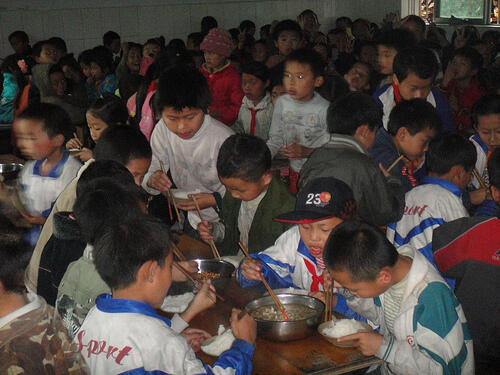
The main goal of this paper is to document the nature of boarding schools and empirically analyze the difference of nutrition intake and malnutrition status between boarding and non-boarding students in western rural China. By using two data sets about boarding schools and boarding students in Shaanxi Province, a representative province in western rural China, this paper finds that dormitory and student canteen facilities in boarding schools are under-equipped and services are poor quality and far below that needed for student development. Poor services in boarding schools and inadequate nutrition intake may be an important cause of low student height-for-age Z-scores (HAZ), as students eating at school have a much lower HAZ on average than that of non-boarding students. Furthermore, girls and students with more siblings have relatively lower HAZ, while the higher the number of parents a student has and the more educated they are exert a positive influence on child nutritional status in terms of HAZ. Finally, our analysis implies that the effective way to decrease the inequality of health, malnutrition and human capital between urban and rural in the long run is to improve the facilities and services of boarding schools in rural China.
 Poor health habits such as not washing hands before eating contribute to wo
 |