Foreign Policy
News Type
Q&As
Date
Paragraphs

For 14 years, Mariano-Florentino Cuéllar has been a tireless Stanford professor who has strengthened the fabric of university’s interdisciplinary nature. Joining the faculty at Stanford Law School in 2001, Cuéllar soon found a second home for himself at the Freeman Spogli for International Studies. He held various leadership roles throughout the institute for several years – including serving as co-director of the Center for International Security and Cooperation. He took the helm of FSI as the institute’s director in 2013, and oversaw a tremendous expansion of faculty, research activity and student engagement. 

An expert in administrative law, criminal law, international law, and executive power and legislation, Cuéllar is now taking on a new role. He leaves Stanford this month to serve as justice of the California Supreme Court and will be succeeded at FSI by Michael McFaul on Jan. 5.

 As the academic quarter comes to a close, Cuéllar took some time to discuss his achievements at FSI and the institute’s role on campus. And his 2014 Annual Letter and Report can be read here.

You’ve had an active 20 months as FSI’s director. But what do you feel are your major accomplishments? 

We started with a superb faculty and made it even stronger. We hired six new faculty members in areas ranging from health and drug policy to nuclear security to governance. We also strengthened our capacity to generate rigorous research on key global issues, including nuclear security, global poverty, cybersecurity, and health policy. Second, we developed our focus on teaching and education. Our new International Policy Implementation Lab brings faculty and students together to work on applied projects, like reducing air pollution in Bangladesh, and improving opportunities for rural schoolchildren in China.  We renewed FSI's focus on the Ford Dorsey Program in International Policy Studies, adding faculty and fellowships, and launched a new Stanford Global Student Fellows program to give Stanford students global experiences through research opportunities.   Third, we bolstered FSI's core infrastructure to support research and education, by improving the Institute's financial position and moving forward with plans to enhance the Encina complex that houses FSI.

Finally, we forged strong partnerships with critical allies across campus. The Graduate School of Business is our partner on a campus-wide Global Development and Poverty Initiative supporting new research to mitigate global poverty.  We've also worked with the Law School and the School of Engineering to help launch the new Stanford Cyber Initiative with $15 million in funding from the Hewlett Foundation. We are engaging more faculty with new health policy working groups launched with the School of Medicine and an international and comparative education venture with the Graduate School of Education. 

Those partnerships speak very strongly to the interdisciplinary nature of Stanford and FSI. How do these relationships reflect FSI's goals?

The genius of Stanford has been its investment in interdisciplinary institutions. FSI is one of the largest. We should be judged not only by what we do within our four walls, but by what activity we catalyze and support across campus. With the business school, we've launched the initiative to support research on global poverty across the university. This is a part of the SEED initiative of the business school and it is very complementary to our priorities on researching and understanding global poverty and how to alleviate. It's brought together researchers from the business school, from FSI, from the medical school, and from the economics department.  

Another example would be our health policy working groups with the School of Medicine. Here, we're leveraging FSI’s Center for Health Policy, which is a great joint venture and allows us to convene people who are interested in the implementation of healthcare reforms and compare the perspective and on why lifesaving interventions are not implemented in developing countries and how we can better manage biosecurity risks. These working groups are a forum for people to understand each other's research agendas, to collaborate on seeking funding and to engage students. 

I could tell a similar story about our Mexico Initiative.  We organize these groups so that they cut across generations of scholars so that they engage people who are experienced researchers but also new fellows, who are developing their own agenda for their careers. Sometimes it takes resources, sometimes it takes the engagement of people, but often what we've found at FSI is that by working together with some of our partners across the university, we have a more lasting impact.

Looking at a growing spectrum of global challenges, where would you like to see FSI increase its attention? 

FSI's faculty, students, staff, and space represent a unique resource to engage Stanford in taking on challenges like global hunger, infectious disease, forced migration, and weak institutions.  The  key breakthrough for FSI has been growing from its roots in international relations, geopolitics, and security to focusing on shared global challenges, of which four are at the core of our work: security, governance, international development, and  health. 

These issues cross borders. They are not the concern of any one country. 

Geopolitics remain important to the institute, and some critical and important work is going on at the Center for International Security and Cooperation to help us manage the threat of nuclear proliferation, for example. But even nuclear proliferation is an example of how the transnational issues cut across the international divide. Norms about law, the capacity of transnational criminal networks, smuggling rings, the use of information technology, cybersecurity threats – all of these factors can affect even a traditional geopolitical issue like nuclear proliferation. 

So I can see a research and education agenda focused on evolving transnational pressures that will affect humanity in years to come. How a child fares when she is growing up in Africa will depend at least as much on these shared global challenges involving hunger and poverty, health, security, the role of information technology and humanity as they will on traditional relations between governments, for instance. 

What are some concrete achievements that demonstrate how FSI has helped create an environment for policy decisions to be better understood and implemented?

We forged a productive collaboration with the U.N. High Commissioner for Refugees through a project on refugee settlements that convened architects, Stanford researchers, students and experienced humanitarian responders to improve the design of settlements that house refugees and are supposed to meet their human needs. That is now an ongoing effort at the UN Refugee Agency, which has also benefited from collaboration with us on data visualization and internship for Stanford students. 

Our faculty and fellows continue the Institute's longstanding research to improve security and educate policymakers. We sometimes play a role in Track II diplomacy on sensitive issues involving global security – including in South Asia and Northeast Asia.  Together with Hoover, We convened a first-ever cyber bootcamp to help legislative staff understand the Internet and its vulnerabilities. We have researchers who are in regular contact with policymakers working on understanding how governance failures can affect the world's ability to meet pressing health challenges, including infectious diseases, such as Ebola.

On issues of economic policy and development, our faculty convened a summit of Japanese prefectural officials work with the private sector to understand strategies to develop the Japanese economy.  

And we continued educating the next generation of leaders on global issues through the Draper Hills summer fellows program and our honors programs in security and in democracy and the rule of law. 

How do you see FSI’s role as one of Stanford’s independent laboratories?

It's important to recognize that FSI's growth comes at particularly interesting time in the history of higher education – where universities are under pressure, where the question of how best to advance human knowledge is a very hotly debated question, where universities are diverging from each other in some ways and where we all have to ask ourselves how best to be faithful to our mission but to innovate. And in that respect, FSI is a laboratory. It is an experimental venture that can help us to understand how a university like Stanford can organize itself to advance the mission of many units, that's the partnership point, but to do so in a somewhat different way with a deep engagement to practicality and to the current challenges facing the world without abandoning a similarly deep commitment to theory, empirical investigation, and rigorous scholarship.

What have you learned from your time at Stanford and as director of FSI that will inform and influence how you approach your role on the state’s highest court?

Universities play an essential role in human wellbeing because they help us advance knowledge and prepare leaders for a difficult world. To do this, universities need to be islands of integrity, they need to be engaged enough with the outside world to understand it but removed enough from it to keep to the special rules that are necessary to advance the university's mission. 

Some of these challenges are also reflected in the role of courts. They also need to be islands of integrity in a tumultuous world, and they require fidelity to high standards to protect the rights of the public and to implement laws fairly and equally.  

This takes constant vigilance, commitment to principle, and a practical understanding of how the world works. It takes a combination of humility and determination. It requires listening carefully, it requires being decisive and it requires understanding that when it's part of a journey that allows for discovery but also requires deep understanding of the past.

Hero Image
tino mug
All News button
1
Authors
News Type
News
Date
Paragraphs

China’s commitment to agricultural development over the last thirty years has dramatically transformed the country’s economy. Rural income per capita has risen an astounding 20 times after 30 prior years of stagnation. Its poverty rate (US$1.25/day) has dropped from 40 percent to less than five, and 350 million rural people between the ages of 18-65 are now working in the industrial or service sector, enjoying rising wages and new economic opportunities.

This rapid transformation is largely the result of three key agricultural policy decisions: putting land in the hands of farmers, market deregulation, and major public investment in the agricultural sector. Although China must now contend with extreme inequality, high levels of pollution, and an aging farming sector there are still lessons to draw from China’s experience that could hasten the transformation of other developing countries.

China expert and agricultural economist Scott Rozelle broke these lessons down at FSE’s fourteenth Global Food Policy and Food Security Symposium Series last week, opening with an underlying theme of the series.

“Growth and development starts with agriculture,” said Rozelle. “Agriculture provides the basis for sound, sustained economic growth needed to build housing, invest in education for kids, start self-employed enterprises, and finance moves off the farm.”

To prove this point he referenced China’s ‘lost decades’ (1950s-1970s) when 80 percent of the population lived in the rural sector and relied on communal, subsistence agriculture. Poor land rights, weak incentives, incomplete markets and inappropriate investments left the average rural farmer poorer at the end of 70s than they were in the 50s with almost no off-farm employment growth.

So what changed? Incentives, market deregulation and strategic investments by the state were key.

Creating the right incentives

In 1978 the Chinese government broke the communes down into small “family farms” such that every rural resident was allocated a small parcel of land. A family of five farmed an area the size of a football field. While they did not own nor could sell the land, they had the right to choose what crops and inputs they used and the right to the income generated from their land.

“Incentives are important, and can be enough in the short run,” said Rozelle. “Hard work led to money in the pockets of farmers and China was off.”

“Every two and half years China added another California in term of agriculture,” said Rozelle.

Between 1979 and 1985 productivity for wheat, maize, and rice went up 50 percent using the same amount of labor, land and inputs. Agriculture across the spectrum has grown at an astounding rate of 5 percent since 1988 (about four times the population growth rate). Livestock and fisheries have grown even faster – accounting for most of the output of the agricultural sector by 2005.

Income growth from farming enabled family members to begin to seek work off the farm. Between 1980 and 2011, off-farm work increased 71 percent with more than 90 percent of households reporting that at least one family member worked off the farm.

Increasing efficiency through liberalization and investment

Another key policy decision was China’s commitment to market liberalization and investment in public goods.

“Markets can be an effective, pro-poor tool of development,” said Rozelle. “A remarkable partnership is formed when you let farmers do production and government do infrastructure…let markets guide decisions.”

The government dismantled state-owned grain trading companies and deregulated trading rules. Prices were set once a week the same day across China to better integrate markets, and eventually prices for major crops closely mirrored those of world prices. Villages began specializing in crops and livestock and incomes of the poor increased. By not providing government input subsidies (e.g, pesticides, fertilizers), traders were incentivized to participate in the market.

“Giving land to farmers and letting the private sector emerge is an easy thing for governments, even without a lot of money, to do,” said Rozelle.

The government provided more indirect market support by publicly investing in better roads, communications, and surface water irrigation. Groundwater was left to the private sector. There were no water or pumping fees nor subsidies for electricity, keeping it completely deregulated. As a result, 50 percent of cultivated land in China is irrigated, compared to 10 percent in the US and only four percent in sub-Saharan Africa.

Finally, China has invested heavily in agricultural research and development (R&D). One percent of China’s agricultural GDP is now invested in agricultural R&D while US investment has fallen over time. US$2 billion alone goes to investments in Chinese biotechnology.

Despite major investment, China only has one major success story to show for so far. The introduction of Bt cotton led to a significant drop in pesticide use (with important health benefits for farmers), and drop in labor and seed price; resulting in a huge 30 percent increase in net income.

“GM technology benefits exist but big policy decisions still need to be made in the face of much resistance both in China and elsewhere in the world on its application,” said Rozelle.

Status of China’s economy

China has largely solved the country’s macro-nutrient food security problem at the household level (>3000 Kcal/day/person) and millions have been lifted out of poverty. Practically all 16-25 years old are now working off the farm.

“This is a real transformation, and one that could not have happened without a major investment in agriculture,” said Rozelle.

While China’s agricultural accomplishments have been major, Rozelle recognizes the system is far from perfect. For starters, there are serious food safety concerns due to lack of traceability. An astounding 98 percent of Beijing consumers think their food is tainted, said Rozelle.

Water is being pumped like crazy and farmers are aging. The younger generation is neither willing nor interested in following in their parents’ farming footsteps. To make up for a labor deficit farmers are applying huge amounts of fertilizer on their land with serious environmental consequences. As a result of changing demographics and an increasing demand for meat, fish, fruits and vegetables, China is likely to be a net importer of food in the long run.

China also faces major urban and rural inequality issues. Even though wages have risen, inequality has not fallen, largely a result of China’s decision not to privatize rural land.

“Rural people have no assets on which to build wealth while urban people were given assets in the form of housing,” said Rozelle. “Housing prices in major cities in China now rival those in the Bay Area!”

The Chinese government fears losing control of the land, but this comes at a price of less individual incentive to invest and inability to build larger farmers. As agricultural growth slows, Rozelle worries high levels of inequality could lead to instability.

Adding fuel to the fire, investment in rural health, nutrition, and education remains far from sufficient. Only 40 percent of the rural poor go to high school resulting in 200 million people who can barely read or write.

“What’s going to happen in 20 years when low skill manufacturing jobs move to other countries?” asked Rozelle. “The rural, uneducated poor are going to become unemployable.”

China’s record leaves room for improvement, but presents a strong case for supporting smallholder agriculture. For those countries emerging out of their own lost decades, smallholder agriculture should remain a primary focus of investment and development.

Hero Image
china rice Sevents
All News button
1
-

The lost decades for China in the 1950s, 1960s and 1970s look remarkably like the lost decades of Africa in the 1980s and 1990s. Poor land rights, weak incentives, incomplete markets and inappropriate investment portfolios. However, China burst out of its stagnation in the 1980s and has enjoyed three decades of remarkable growth. In this talk Rozelle examines the record of the development of China’s food economy and identifies the policies that helped generate the growth and transformation of agriculture. Incentives, markets and strategic investments by the state were key. Equally important, however, is what the state did not do. Policies that worked and those that failed (or those that were ignored) are addressed. Most importantly, Rozelle tries to take an objective, nuanced look at the lessons that might be learned and those that are not relevant for Africa. Many parts of Africa have experienced positive growth during the past decade. Rozelle examines if there are any lessons that might be helpful in turning ten positive years into several more decades of transformation.

Scott Rozelle (main speaker). Scott Rozelle is the Helen F. Farnsworth Senior Fellow and the co-director of the Rural Education Action Program in the Freeman Spogli Institute for International Studies at Stanford University. His research focuses almost exclusively on China and is concerned with: agricultural policy, including the supply, demand, and trade in agricultural projects; the emergence and evolution of markets and other economic institutions in the transition process and their implications for equity and efficiency; and the economics of poverty and inequality, with an emphasis on rural education, health and nutrition.

Alain de Janvry (commentator). Alain de Janvry is an economist working on international economic development, with expertise principally in Latin America, Sub-Saharan Africa, the Middle-East, and the Indian subcontinent. Fields of work include poverty analysis, rural development, quantitative analysis of development policies, impact analysis of social programs, technological innovations in agriculture, and the management of common property resources. He has worked with many international development agencies, including FAO, IFAD, the World Bank, UNDP, ILO, the CGIAR, and the Inter-American Development Bank as well as foundations such as Ford, Rockefeller and Kellogg. His main objective in teaching, research, and work with development agencies is the promotion of human welfare, including understanding the determinants of poverty and analyzing successful approach to improve well-being and promote sustainability in resource use.

Bechtel Conference Center

Encina Hall East, E404
Stanford, CA 94305-6055

0
Faculty Co-director of the Stanford Center on China's Economy and Institutions
Helen F. Farnsworth Endowed Professorship
Senior Fellow at the Freeman Spogli Institute for International Studies
Senior Fellow at the Stanford Institute for Economic Policy Research
scott_rozelle_new_headshot.jpeg PhD

Scott Rozelle is the Helen F. Farnsworth Senior Fellow and the co-director of Stanford Center on China's Economy and Institutions in the Freeman Spogli Institute for International Studies and Stanford Institute for Economic Policy Research at Stanford University. He received his BS from the University of California, Berkeley, and his MS and PhD from Cornell University. Previously, Rozelle was a professor at the University of California, Davis and an assistant professor in Stanford’s Food Research Institute and department of economics. He currently is a member of several organizations, including the American Economics Association, the International Association for Agricultural Economists, and the Association for Asian Studies. Rozelle also serves on the editorial boards of Economic Development and Cultural Change, Agricultural Economics, the Australian Journal of Agricultural and Resource Economics, and the China Economic Review.

His research focuses almost exclusively on China and is concerned with: agricultural policy, including the supply, demand, and trade in agricultural projects; the emergence and evolution of markets and other economic institutions in the transition process and their implications for equity and efficiency; and the economics of poverty and inequality, with an emphasis on rural education, health and nutrition.

Rozelle's papers have been published in top academic journals, including Science, Nature, American Economic Review, and the Journal of Economic Literature. His book, Invisible China: How the Urban-Rural Divide Threatens China’s Rise, was published in 2020 by The University of Chicago Press. He is fluent in Chinese and has established a research program in which he has close working ties with several Chinese collaborators and policymakers. For the past 20 years, Rozelle has been the chair of the International Advisory Board of the Center for Chinese Agricultural Policy; a co-director of the University of California's Agricultural Issues Center; and a member of Stanford's Walter H. Shorenstein Asia-Pacific Research Center and the Center on Food Security and the Environment.

In recognition of his outstanding achievements, Rozelle has received numerous honors and awards, including the Friendship Award in 2008, the highest award given to a non-Chinese by the Premier; and the National Science and Technology Collaboration Award in 2009 for scientific achievement in collaborative research.

Faculty affiliate at the Center on Democracy, Development, and the Rule of Law
Faculty Affiliate at the Walter H. Shorenstein Asia-Pacific Research Center
Date Label
Scott Rozelle Speaker
Alain de Janvry Professor of Agricultural and Resource Economics, Goldman School of Public Policy, UC-Berkeley Speaker
Symposiums
Authors
News Type
News
Date
Paragraphs

Stanford opened a research and education center at China’s Peking University, strengthening an already close academic bond and building a stronger tie to one of the world’s fastest-growing countries.

“Globalization is the defining characteristic of the 21st Century,” Stanford President John Hennessy said during an opening ceremony on March 21 that drew hundreds of academics, donors and government officials to the opening of the Stanford Center at Peking University.

“It is increasingly important for our students to understand what it means to be citizens of the world, to bring a more international perspective, to be able to communicate with others from different backgrounds or with different expertise,” he said. “Both Peking University and Stanford are stepping up to that challenge and moving to become more global institutions to address the challenges of this century. This new center exemplifies that.”

"It is increasingly important for our students to understand what it means to be citizens of the world, to bring a more international perspective, to be able to communicate with others from different backgrounds or with different expertise," Stanford President John Hennessy said at the opening of SCPKU.
Designed as a resource for the entire Stanford community and administered by the university’s Freeman Spogli Institute for International Studies, 10 programs and departments – including the School of Medicine’s Asian Liver Center, the Bing Overseas Studies Program and the Rural Education Action Project – will locate operations at SCPKU.

FSI faculty already doing research in China showcased their work during conferences held in conjunction with the opening of the center.

The new building is available to the several hundred Stanford scholars studying, researching and conducting university activities in China each year. It also offers the opportunity for Stanford faculty to work with academics from Peking University and other universities throughout China.

“Stanford is one of the most valued partners of Peking University,” PKU President Zhou Qifeng said. “The center will create more opportunities through collaborative research, student and faculty exchange programs, joint teaching and other activities.”

The center makes Stanford the first American university to construct a building for its use on a major Chinese university campus. SCPKU will allow current educational programs to expand, but will not grant Stanford degrees.

The center’s distinctiveness is reflected in the building that houses it – a 36,000-square-foot structure that combines Chinese and Western architecture. The courtyard building was constructed with interlocking mortise-and-tenon joinery – a classic Chinese technique that eliminates the need for nails or glue.

Hand-painted scenes depicting typical Chinese landscapes and views from Stanford’s campus are featured on the building beams. At the point where beams and columns meet, artists added Chinese symbols for teaching, learning and scholarship.

State-of-the-art classrooms, conference rooms and meeting spaces fill out the two floors below the courtyard. Skylights, interior gardens and a reflecting pool invoke a natural setting.

The melding of styles brings as much substance as symbolism.

The SCPKU opening drew hundreds of academics, donors and government officials.
SCPKU “marks a new era of collaboration between two outstanding universities,” Gary Locke, the U.S. ambassador to China, said during the opening ceremony. “It also represents a new bridge of understanding between our nations – and most importantly – our peoples.

“There are virtually no problems in the world today that cannot be solved if the people – the scientists and engineers, and the business people – of the United States and China join together,” Locke said. “And this center will help make that happen.”

Stanford’s relationship with China dates to the late 1970s, when the university began accepting Chinese graduate students. Students from China have accounted for the largest number of Stanford’s foreign graduate students for the past decade, with about 600 enrolled last year.

Those scholars are part of the 160,000 Chinese students studying in American colleges and universities every year, a number that eclipses the 16,000 American students taking classes in China, Locke said.

“We have to know much more about each other’s cultures, customs, traditions, values and languages so we can build a mutual trust and understanding that will allow us to face all of the challenges we face,” he said. “The way to build that trust starts with building people-to-people interactions. It starts with more student exchanges…and it most certainly starts with the Stanford center here at Peking University.”

Over the last 30 years, Stanford’s bond with Peking University has grown from an initial collaboration between the schools’ Asian language departments to a wide range of joint research and academic exchanges.

In 2004, Stanford’s undergraduate study abroad and internship programs began at Peking University. The study abroad program continues to be managed by the Bing Overseas Studies Program, which hosts roughly 60 undergraduates every year on the Peking University campus.  The internship programs are coordinated by the International, Comparative, and Area Studies Program.

The overseas studies program offers a broad curriculum taught by a Stanford faculty-in-residence who spends a 10-week quarter with the students in Beijing.  A range of topical and language courses are taught by Peking University faculty.

“The new center at PKU allows us to continue this dynamic program in a new environment designed to encourage interaction across disciplines and with graduate students and faculty from both universities,” said Irene Kennedy, the program’s executive director. “We also plan to continue supporting and developing interactions between Stanford and PKU students through language partnering and by including Chinese students in classes taught by Stanford faculty and associated field trips.”

Jean Oi and Andrew Walder – both senior fellows at the Freeman Spogli Institute – began building on that relationship in 2006 by envisioning a way to bolster Stanford research, teaching, training and outreach activities in China. Their ideas led to the creation of SCPKU and several new academic programs, including a law school exchange program.

The $7 million project is funded entirely from gifts made to the Stanford International Initiative. The lead donor was the charitable foundation of the family of Chien Lee, a Hong Kong-based private investor and Stanford emeritus trustee who received his bachelor's and master's degrees from the university in 1975 and his MBA from the Graduate School of Business four years later.

The SCPKU building is named for his father, the late Lee Jung Sen, who attended Peking University in the mid-1930s when it was Yenching University. Lee’s mother, Leatrice Lowe Lee, graduated from Stanford in 1945.

A bust of Lee Jung Sen sits in SCPKU’s courtyard, one level above the modern facility and surrounded by the more familiar, traditional Chinese architecture.

Hero Image
SCPKU SQUARE
All News button
1
Authors
Scott Rozelle
News Type
News
Date
Paragraphs

Full text available at YaleGlobal.

Children of China's Future – Part II

 
Aging population and poverty require stronger investment in China’s rural youth
Karen Eggleston, Jean Oi, Scott Rozelle, Ang Sun, Xueguang Zhou
YaleGlobal, 14 March 2012
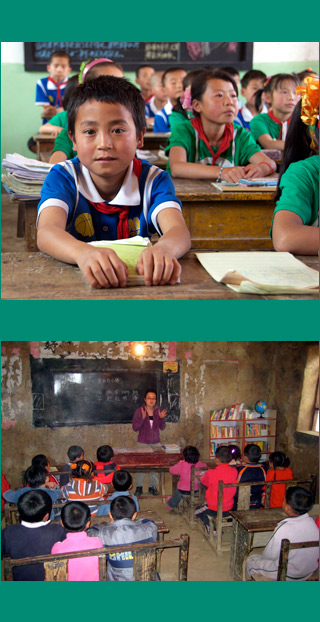
Poor education mortgaging the future? Students in a Gansu province school, where many are anemic (top); another class room in Loess Plateau. (Top Photo: Adam Gorlick)

DINGXI PREFECTURE: Wang Hongli, 8 years old, lives in a remote rural village on the Loess Plateau in one of China’s poorest and most agricultural provinces, Gansu. His prospects for living the good life are as bleak as the landscape. He is not on track to become part of China’s emerging middle class, the free-spending, computer-savvy, person-of-the-world often featured in the western media.

Hongli is a pseudonym. His parents work in a faraway industrial zone, coming home for only three weeks at Chinese New Year. His grandmother takes care of him and his siblings on the weekends, and during the week he lives in a dorm, three to a bed with 36 other students in an unheated room 4 by 4 meters.

Hongli suffers from iron-deficient anemia, but neither his family nor his teacher knows he is sick. Even if his anemia is discovered and treated by the researchers who have documented 30 percent anemia among children in poor rural areas, it likely will recur after he finishes the study, with furnished dietary supplements. Despite educational pamphlets, he’ll likely revert to a diet of staple grains and bits of pickled vegetables.

Unsurprisingly, Hongli’s grades are not good. In China’s competitive school system, he has only a slight chance of attending high school, much less college. In China’s future high-wage economy, all Hongli can hope for is a menial job in the provincial capital, Lanzhou, or as a temporary migrant elsewhere. Without urban permanent residency, hukou, he will have limited access to urban social services. He may suffer chronic unemployment, or resort to the gray economy or crime. He also may never marry – one of the millions of “forced bachelors” created by China’s large gender imbalance.

In China’s future high-wage economy, 
all the rural poor can hope for is menial jobs in a provincial capital.

Hongli is not alone. In fact, he’s one of 50 million school-age youth in China’s vast poor rural hinterlands. Recent studies by Stanford and Chinese collaborators show that 39 percent of fourth-grade students in Shaanxi Province are anemic, with similarly high rates elsewhere in the northwest; up to 40 percent of rural children in the poor southwest regions, e.g., Guizhou, are infected with intestinal worms. Millions of poor rural students throughout China are nearsighted, but do not wear glasses.

Because China’s urbanites have fewer children, poor rural kids like Hongli represent almost a third of China’s school-aged children, a large share of the future labor force. These young people must be healthy, educated and productive if China is to have any chance of increasing labor productivity to offset the shrinking size of its aging workforce.

Many observers presume that China’s growth will continue unabated, drawing upon a vast reservoir of rural labor to staff manufacturing plants for the world. In fact, to a considerable extent, China’s rural areas have already been emptied out, leaving many villages with only the old and the very young. The growth of wages for unskilled workers exceeds GDP growth.

Better pay should be good news for poverty alleviation. However, rising wages push up the opportunity cost of staying in school – especially since high school fees, even at rural public schools, are among the highest in the world.

It’s myopic to allow rural students to drop out of junior high and high school – mitigating the current labor shortage, but mortgaging their futures. Recent studies demonstrate that eliminating high school tuition – or reducing the financial burden on poor households – improves junior high achievement and significantly increases continuation on to high school. Yet unlike many other developing countries, China does not use incentives to keep children in school, such as conditional cash transfers. The public health and educational bureaucracies also do not proactively cooperate to remedy nutritional and medical problems – including mental health – that school-based interventions could address cost effectively.

Less than half of youth in China’s poor rural areas go to academic high school; less than 10 percent head to college.

The educational system, based on rote memory and drill, doesn’t teach children how to learn. The vocational education system is ineffective. Instead, China’s schools tend to focus resources on elite students. Tracking starts early, and test scores are often the sole criterion for success. A recent comparative study documents that China’s digital divide, with lower access to computers in poor rural areas, is among the widest in the world.

China’s government is increasing expenditures for school facilities and raising teacher salaries. However, these steps are far from adequate. During South Korea’s high growth, almost all Korean students finished high school. Today, less than half of youth in China’s poor rural areas go to academic high school, and the percent going to college remains in the single digits.

Greater investment in public health and education for the young people in China’s poor rural areas is urgent. If the government waits 10 years, it may be too late to avert risks for China’s stability and sustained economic growth.

Surely China could easily address this problem? A third of Chinese were illiterate in the early 1960s; now, fewer than 5 percent are. By 2010, about 120 million Chinese had completed a college degree. Chinese also enjoy a relatively long life expectancy compared to India and many other developing countries, and basic health insurance coverage is almost universal.

But the pace of change and citizens’ expectations are higher as well. Most Chinese assume that basic nutritional problems and intestinal worms were eradicated in the Mao era. China’s mortality halved in the 1950s; fertility halved in the 1970s. As a result, China will get old before it gets rich. Population aging, rapid urbanization and a large gender imbalance represent intertwined demographic challenges to social and economic governance. The policy options are complicated, the constraints significant, the risks of missteps real and ever-present.

China’s prosperity depends on youth mastering skills to thrive in a technology-driven world.

Timely policy response is complicated by competition for resources – pensions, long-term care, medical care for the elderly and more – as well as significant governance challenges arising from a countryside drained of young people. The well-intentioned programs for what government regards a “harmonious society” create large unfunded mandates for local authorities. Attempts to relocate rural residents to new, denser communities provoke anger at being uprooted and skepticism that local authorities simply want to expropriate land for development.

Millions of migrant workers – like Wang Hongli’s parents – return to their rural homes during economic downturns. Urbanization weakens this capacity to absorb future economic fluctuations. Government efforts at “social management” – strengthening regulatory control of informal social groups and strategies for diffusing social tensions – expand the bureaucratic state, a central target of popular discontent.

Premier Wen Jiabao’s announcement of a 7.5 percent growth target – the lowest in two decades – has been expected. Future economic growth will moderate partly because of demographics, but mostly because productivity gains slow as an economy runs out of surplus rural labor and converges on the technological frontier. Costly upgrading of industrial structure will squeeze the government’s ability to deliver on its promise of a better future for all, stoking social tensions.

China’s stability and prosperity, and that of the region and the globe, depends on how well today’s youth master the knowledge and skills that enable them to thrive in the technology-driven globalized world of the mid-21st century. Resilient public and private sector leaders of the future must be able to think creatively. Therefore, China’s government should respond to population aging by acting now to invest more in the health and education of youth, especially the rural poor.


Hero Image
5734696609 a3b10b4c8f z
All News button
1
Subscribe to Foreign Policy