International Relations

FSI researchers strive to understand how countries relate to one another, and what policies are needed to achieve global stability and prosperity. International relations experts focus on the challenging U.S.-Russian relationship, the alliance between the U.S. and Japan and the limitations of America’s counterinsurgency strategy in Afghanistan.

Foreign aid is also examined by scholars trying to understand whether money earmarked for health improvements reaches those who need it most. And FSI’s Walter H. Shorenstein Asia-Pacific Research Center has published on the need for strong South Korean leadership in dealing with its northern neighbor.

FSI researchers also look at the citizens who drive international relations, studying the effects of migration and how borders shape people’s lives. Meanwhile FSI students are very much involved in this area, working with the United Nations in Ethiopia to rethink refugee communities.

Trade is also a key component of international relations, with FSI approaching the topic from a slew of angles and states. The economy of trade is rife for study, with an APARC event on the implications of more open trade policies in Japan, and FSI researchers making sense of who would benefit from a free trade zone between the European Union and the United States.

-

This event will take place on Zoom. Registration is required: http://bit.ly/Invisible_China
Image
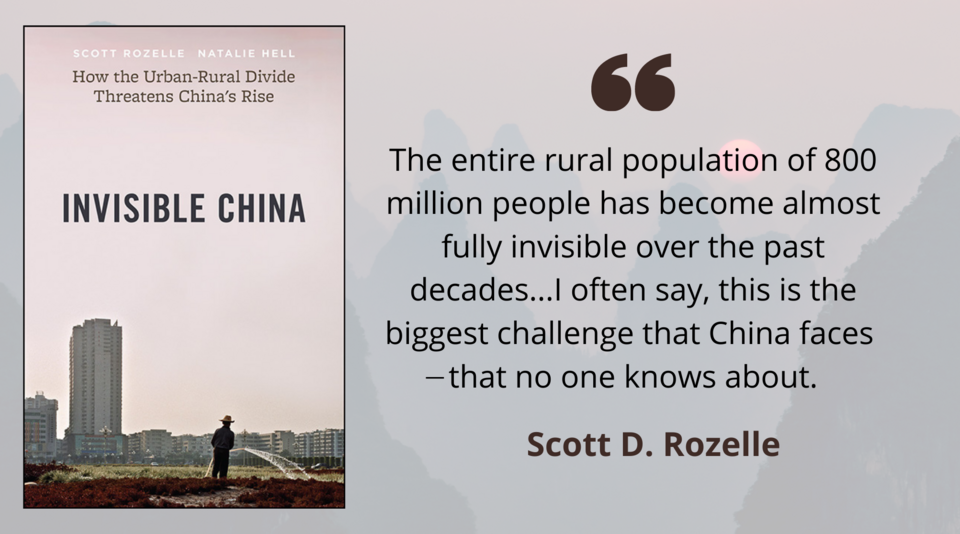
Book cover for "Invisible China: How the Urban-Rural Divide Threatens China's Rise" and a quote from Scott Rozelle, "The entire population of 800 million people has become almost fully invisible over the past decades..."

As the glittering skyline in Shanghai seemingly attests, China has quickly transformed itself from a place of stark poverty into a modern, urban, technologically savvy economic powerhouse. But as FSI Senior Fellow Scott Rozelle and Natalie Hell show in their new book Invisible China, the truth is much more complicated and might be a serious cause for concern.

Drawing on extensive surveys on the ground in China, Rozelle and Hell reveal that while China may be the second-largest economy in the world, its labor force has one of the lowest levels of education of any comparable country. The low levels of basic education of such a large share of workers may leave many unable to find work in the formal workplace as China’s economy changes and manufacturing jobs move elsewhere.

In this book talk event, Rozelle, who is also the director of FSI’s Rural Education Action Program, will be joined by Hongbin Li, a senior fellow at the Stanford Institute for Economic Policy Research and director of the China Program at the Stanford King Center on Global Development, who will moderate a discussion about the major themes of the book. A question and answer session with the audience will follow the discussion.


Image
scott rozelle new headshot

Scott Rozelle holds the Helen Farnsworth Endowed Professorship at Stanford University and is Senior Fellow in the Food Security and Environment Program and the Shorenstein Asia-Pacific Research Center, Freeman Spogli Institute (FSI) for International Studies. For the past 30 years, he has worked on the economics of poverty reduction. Currently, his work on poverty has its full focus on human capital, including issues of rural health, nutrition and education. For the past 20 year, Rozelle has been the chair of the International Advisory Board of the Center for Chinese Agricultural Policy, Chinese Academy of Sciences (CAS). In recent years Rozelle spends most of his time co-directing the Rural Education Action Project (REAP). In recognition of this work, Dr. Rozelle has received numerous honors and awards. Among them, he became a Yangtse Scholar (Changjiang Xuezhe) in Renmin University of China in 2008. In 2008 he also was awarded the Friendship Award by Premiere Wen Jiabao, the highest honor that can be bestowed on a foreigner. 
Image
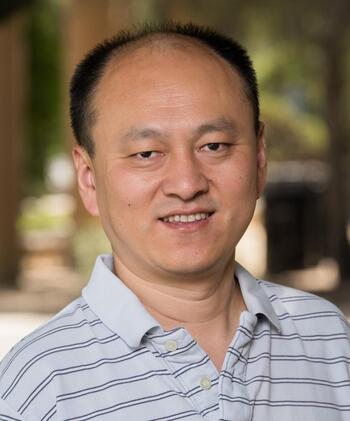
hongbin li headshot


Hongbin Li is the James Liang Director of the China Program at the Stanford King Center on Global Development, and a Senior Fellow of Stanford Institute for Economic Policy Research (SIEPR). Hongbin’s research has been focused on the transition and development of the Chinese economy, and the evidence-based research results have been both widely covered by media outlets and well read by policy makers around the world. He is currently the co-editor of the Journal of Comparative Economics.


 

Seminars
Paragraphs

When seeking to build high quality and cost-effective infrastructure in rural villages, a fundamental question is: Who is better at doing so? Should the village leadership or a government agency above the village finance and/or manage the construction of the infrastructure project? To answer this question, we surveyed all rural road projects in 101 villages in rural China between 2003 and 2007 and measured the quality and per kilometer cost of each road. According to our analysis, road quality was higher when more of the project funds came from the government agency above. Moreover, projects had lower cost per kilometer when the village leaders managed the road construction. Overall, our findings suggest that to build high quality and cost-effective rural roads village leaders and government agencies should collaborate and each specialize in a specific project role.

All Publications button
1
Publication Type
Journal Articles
Publication Date
Journal Publisher
Journal of Development Economics
Authors
Scott Rozelle
News Type
Q&As
Date
Paragraphs

"What do I do about the chickens?"

When assistant professor of medicine Eran Bendavid began a study on livestock in African households to determine impact on childhood health, he'd already anticipated common field problems like poorly captured or intentionally misreported data, difficulty getting to work sites, or problems with training local volunteers.

But he'd never gotten that particular question from a fieldworker before. It didn't occur to him that participating families, in reporting their livestock holdings, would completely omit the chickens running around at their feet, thereby skewing the data.

"They didn't consider chickens to be livestock," recalled Bendavid. Along with Scott Rozelle, the Helen F. Farnsworth Senior Fellow at FSI, and associate professor of political science and FSI senior fellow Beatriz Magaloni, Bendavid spoke to a full house last week on lessons learned from fieldwork gone awry. The return engagement of FSI's popular seminar, "Everything that can go wrong in a field experiment” was introduced by Jesper Sørensen, executive director of Stanford Seed, and moderated by Katherine Casey, assistant professor of political economy at the GSB. The seminar is a product of FSI and Seed’s joint Global Development and Poverty (GDP) Initiative, which to date has awarded nearly $7 million in faculty research funding to promote research on poverty alleviation and economic development worldwide.

Rozelle, co-director of the Rural Education Action Program, spoke of the obstacles to accurate data gathering, especially in rural areas where record-keeping is inaccurate and participants' trust is low. Arriving in a Chinese village to carry out child nutrition studies, said Rozelle, "we found Grandma running out the back door with the baby." The researchers had worked with the local family planning council to find the names of children to study, but the families thought the authorities were coming to penalize them for violation of the one-child policy.

Cultural differences make for entertaining and illuminating (if frustrating) lessons, but Beatriz Magaloni, director of FSI's Program on Poverty and Governance at the Center on Democracy, Development and the Rule of Law had a different story to tell. Over the course of three years, her GDP-funded work to investigate and reduce police violence in Brazil - a phenomenon resulting in more than 22,000 deaths since 2005 - has encountered obstacle after obstacle. Her work to pilot body-worn cameras on police in Rio has faced a change in police leadership, setting back cooperation; a yearlong struggle to decouple a study of TASER International’s body worn cameras from its electrical weapons in the same population; a work site initially lacking electricity to charge the cameras or Internet to view the feeds; and noncompliance among the officers. "It's discouraging at times," admitted Magaloni, who has finally gotten the cameras onto the officers' uniforms and must now experiment with ways to incentivize their use. "We are learning a lot about how institutional behavior becomes so entrenched and why it's so hard to change."

Experimentation is a powerful tool to understand cause and effect, said Casey, but a tool only works if it's implemented properly. Learning from failure makes for an interesting panel discussion. The speakers' hope is that it also makes for better research in the future.

The Global Development and Poverty Initiative is a University-wide initiative of the Stanford Institute for Innovation in Developing Economies (Seed) in partnership with the Freeman Spogli Institute (FSI). GDP was established in 2013 to stimulate transformative research ideas and new approaches to economic development and poverty alleviation worldwide. GDP supports groundbreaking research at the intersection of traditional academic disciplines and practical application. GDP uses a venture-funding model to pursue compelling interdisciplinary research on the causes and consequences of global poverty. Initial funding allows GDP awardees to conduct high-quality research in developing countries where there is a lack of data and infrastructure.


Hero Image
scott in field
All News button
1
-

About the Topic: Despite massive research and public policy efforts aimed at diversification, gender segregation of science, technology, engineering and mathematics remains extreme in affluent democracies. More surprising is evidence that women’s representation in many “STEM” fields is weaker in advanced industrial societies than in poorer, reputably gender traditional ones. The most obvious explanation is that broad-based existential security frees more women to realize aspirations for (less lucrative) non-STEM pursuits. I will discuss another piece of the puzzle by focusing on the aspirations themselves and how these vary with societal affluence. Over-time data on eighth-grade boys and girls in 32 countries provide strong evidence that the gender gap in aspirations for mathematically-related jobs increases with societal affluence, controlling for traits of individual students (parental education, affinity for school, mathematics test scores). This affluence effect is not attributable to cross-national differences in the gender-labeling of science, Internet access, or women’s educational or economic integration. Results are consistent with arguments suggesting that gender beliefs more strongly influence career aspirations in affluent, “postmaterialist” societies.


Maria Charles

About the Speaker:  Maria Charles is Professor and Chair of Sociology, Area Director for Sex and Gender Research, and an Affiliate Professor of Feminist Studies at U.S. Santa Barbara. She specializes in the international comparative study of social inequalities, particularly cross-national differences in women's economic, educational, and family roles. She has published extensively on gender segregation, most recently on the ideological and organizational factors that contribute to woman's underrepresentation in science, technology, engineering, and mathematics ("STEM") fields around the world. She has a Ph.D. in Sociology from Stanford University, and Bachelor’s degrees from UCSB in Environmental Studies and Political Science.

Philippines Conference Room

Encina Hall Central, 3rd floor

616 Serra St.

Stanford, CA 94305

Maria Charles Professor and Chair of Sociology, Area Director for Sex and Gender Research, Affiliate Professor of Feminist Studies U.C. Santa Barbara
Seminars
News Type
News
Date
Paragraphs

The Wall Street Journal quotes REAP's director Scott Rozelle, on the differences between President Hu and President Xi's approach to China's rural economy. To read the original article, click here.


After Mr. Hu retired in late 2012, and China deemphasized his push for a “harmonious society,” less happened with the foreign run rural banks. 

Citigroup Inc. says its network of Citi Credit outlets remains at four – including two in Hubei province – the same it reported in 2011. Spokesmen for both Standard Chartered Plc and Australia and New Zealand Banking Group Ltd. each say their push into village banking stopped at one outlet.

The “three nong” issues remain important to Xi Jinping’s administration, according to the conclusion of a seminar on the subject held last September and covered in state-run media. (Mr. Xi didn’t attend the event.)

Not everyone agrees. The former Chinese leaders, Mr. Hu and Premier Wen Jiabao, “for all their indecisiveness in other parts of the economy did a tremendous amount for rural policy,” said Scott Rozelle, an expert on the sector at Stanford University. Mr. Rozelle added that during Mr. Xi’s administration “there’s been almost no effort and even some backtracking on the rural economy.”

Hero Image
3 nong picture
China's top leadership has deemphasized rural economic policy, halting the spread of foreign banks.
The Wall Street Journal / James T. Areddy
All News button
1
Date Label
-
9:30-12:00 Session 1: Inequality of Human Capital and Labor Market Outcomes
Location: Goldman Conference Room, Encina Hall East (4th floor)
 
The Health and Nutrition Roots of China's Human Capital Crisis
Speaker:Scott Rozelle, Stanford University, US
 
Trade Liberalization, Social Policy Development and Labour Market Outcomes of
Chinese Women and Men in the Decade after China’s Accession to the World Trade
Organization
Speaker:Xiaoyuan Dong, The University of Winnipeg, Canada
 
Mismatch of the Boston Mechanism: Evidence from Chinese College Admission
Speaker:Binzhen Wu, Tsinghua University, China
 
12:00-1:00 Lunch
Location: Philippines Conference Room, Encina Hall (3rd Floor)
 
1:00-3:00 Session 2: Determinants for Labor Market Outcomes
Location: Philippines Conference Room, Encina Hall (3rd Floor)
 
Does Informal Employment Push college graduates into Low Income Trap?
Speaker:Xiaoying Li, Sun Yat-sen University, China
Cognitive Skills, Noncognitive Skills, and School-to-Work Transitions in Rural China
Speaker:Qiuqiong Huang, University of Arkansas, US
Institutional Labor Market Segmentation and Public Sector Reform in China
Speaker:Xiaohua Li, Chinese Academy of Personnel Science, China

Goldman Conference Room
Encina Hall East (4th Floor)

Workshops
-

The Global Development and Poverty Initiative (GDP) seminar series returns with a reprise of its most popular seminar last year. Join us for a stimulating discussion on the opportunities, obstacles, and unforeseen events encountered while conducting field research in the developing world.

The panelists will share stories of challenges and successes from their own experiences and will offer insights on conducting effective research in the field.

Read more about last year's seminar here.

Image
screen shot 2016 02 05 at 2 31 21 pm

This seminar is located in the Knight Management Center's Class of 1968 Building. Click Here for a map.

Eran Bendavid Assistant Professor, Medicine Panelist
Beatriz Magaloni Associate Professor, Political Science and Senior Fellow, FSI Panelist

Encina Hall East, E404
Stanford, CA 94305-6055

0
Faculty Co-director of the Stanford Center on China's Economy and Institutions
Helen F. Farnsworth Endowed Professorship
Senior Fellow at the Freeman Spogli Institute for International Studies
Senior Fellow at the Stanford Institute for Economic Policy Research
scott_rozelle_new_headshot.jpeg PhD

Scott Rozelle is the Helen F. Farnsworth Senior Fellow and the co-director of Stanford Center on China's Economy and Institutions in the Freeman Spogli Institute for International Studies and Stanford Institute for Economic Policy Research at Stanford University. He received his BS from the University of California, Berkeley, and his MS and PhD from Cornell University. Previously, Rozelle was a professor at the University of California, Davis and an assistant professor in Stanford’s Food Research Institute and department of economics. He currently is a member of several organizations, including the American Economics Association, the International Association for Agricultural Economists, and the Association for Asian Studies. Rozelle also serves on the editorial boards of Economic Development and Cultural Change, Agricultural Economics, the Australian Journal of Agricultural and Resource Economics, and the China Economic Review.

His research focuses almost exclusively on China and is concerned with: agricultural policy, including the supply, demand, and trade in agricultural projects; the emergence and evolution of markets and other economic institutions in the transition process and their implications for equity and efficiency; and the economics of poverty and inequality, with an emphasis on rural education, health and nutrition.

Rozelle's papers have been published in top academic journals, including Science, Nature, American Economic Review, and the Journal of Economic Literature. His book, Invisible China: How the Urban-Rural Divide Threatens China’s Rise, was published in 2020 by The University of Chicago Press. He is fluent in Chinese and has established a research program in which he has close working ties with several Chinese collaborators and policymakers. For the past 20 years, Rozelle has been the chair of the International Advisory Board of the Center for Chinese Agricultural Policy; a co-director of the University of California's Agricultural Issues Center; and a member of Stanford's Walter H. Shorenstein Asia-Pacific Research Center and the Center on Food Security and the Environment.

In recognition of his outstanding achievements, Rozelle has received numerous honors and awards, including the Friendship Award in 2008, the highest award given to a non-Chinese by the Premier; and the National Science and Technology Collaboration Award in 2009 for scientific achievement in collaborative research.

Faculty affiliate at the Center on Democracy, Development, and the Rule of Law
Faculty Affiliate at the Walter H. Shorenstein Asia-Pacific Research Center
Date Label
Scott Rozelle Senior Fellow, FSI Panelist
Katherine Casey Assistant Professor, Political Economy Moderator
Panel Discussions
-

In 2006, the Chinese Government introduced a massive block grant program for rural compulsory education, similar to that of Title I grant in the United States. Central government provided block grants with add-on requirement to provincial governments based on total number of pupils, average per pupil spending in that province, and a cost-sharing plan that favors the economically backward provinces. Provincial governments then distributed the grants along with its own share to county government using a similar formula to cover school operating expenditures, free tuitions, and conditional cash transfers for boarding students.


While there have been plenty research on whether the program has buttressed the financing of rural education or crowded out local financing, little is known about its effects on the enrollment and education attainment of rural children after a decade  (Shi, 2012; Chyi & Zhou, 2014; Lü, 2014). This paper fills this glaring gap by using matched household survey data and county school expenditure data between 2000-2011 that were made available to researchers for the first time.


Our identification strategies are composed of three parts. First, we take advantage of the exogenous variation in the rates of cost-sharing in the two-step allocation process of the block grants to estimate “Intention to Treatment” effects of the whole program. Secondly, we compare counties receiving different proportion of subsidies from central government in a difference-in-difference framework. Thirdly, we use the IV-DID strategy that instruments the county-level education spending with the exogenous variation in the planned allocation of the grants.


Dr. Wei HA is currently Research Professor in Education Policy and Leadership at the Graduate School of Education and a faculty associate at the Institute of Education Economics at Peking University. Prior to joining the Peking University, he worked as policy specialists at UNICEF and UNDP for seven years in the United States and Africa. During his doctoral study at the Harvard University, he also served as a consultant at the World Bank. He has conducted research in a wide-range of fields including education economics, public health, migration, and development economics. His current research focuses on the impact evaluation of key national education policies in China such as the Rural Compulsory Education Finance Reform, and China’s efforts to build “World Class Universities” through the 211 and 985 Projects. He also examines the interaction between education and major social transformations in China such as the massive labor retrenchments at State-Owned Enterprises in the late 1990s and rising housing prices in urban China. Dr. Ha received a dual BA in Economics and Political Science and MA in Education Economics from Peking University and his PhD in Public Policy from Harvard University.


This event is cosponsored by the Rural Education Action Program (REAP).

Does Money Matter? The Effects of Block Grants on Education Enrollment and Attainment in Rural China
Wei HA Education Policy and Leadership at the Graduate School of Education and Institute of Education Economics at Peking University
Seminars
-

Please join us for a seminar on the assessment of student learning in higher education. We will hear from internationally renowned experts in the field of higher education assessment and present preliminary results from a pathbreaking new study comparing university learning between the U.S., Russia and China.


Lydia Liu

Director of Research, Higher Education
Educational Testing Service


Olga Zlatkin-Troitschanskaia

Professor of Business Education
Johannes Gutenberg University


Prashant Loyalka

Center Fellow (FSI)

Assistant Professor, Teaching (FSE)

Stanford University

Central Conference Room

Encina Hall, second floor
616 Serra St.
Stanford, CA 94305-6055

Lydia Liu Director of Research, Higher Education Educational Testing Service (ETS)
Olga Zlatkin- Troitschanskaia Professor of Business Education Johannes Gutenberg University
Prashant Loyalka Center Fellow, FSI/GSE Stanford University
Seminars
Subscribe to International Relations