Public Health
News Type
News
Date
Paragraphs

Matt Sheehan
China Correspondent, The WorldPost
October 12th, 2015

This article was reprinted with permission from the Huffington Post. To read the original piece, click here. 

Simply giving nearsighted children glasses can dramatically boost their school performance. Convincing teachers and parents is harder.

This article is the second in a What’s Working series that looks at innovative policy solutions pioneered by the Rural Education Action Program. REAP brings together researchers from Stanford University and China to devise new ways to improve rural education and alleviate poverty. You can read the first article in the series here.  

QIN'AN COUNTY, China -- Wei Wentai can barely be heard over the crescendo of cackles coming from the hallway. Fourth graders everywhere cane be boisterousness, but today the presence of two foreigners, an exotic breed in the rugged hills of western China, has driven these kids into a frenzy.

You could try to reason with the children: tell them they need to quiet down because Dr. Wei is here to train their teachers in how to perform vision tests. Those tests will give some kids free glasses so they can see the blackboard, dramatically improving their grades and chances of graduating high school.

But yeah, that’d be about as effective here in rural Gansu, in China's northwest, as it would be in Alabama, and it takes the lunch bell to drag the mob away from the classroom window. 

With relative peace restored, Wei continues to tutor the 12 village schoolteachers in the basics of eyesight and education. Having grown up nearby, he knows what superstitions to dispel (“No, glasses do not make your eyes worse”) and what points to drive home (“Yes, glasses dramatically improve grades for nearsighted students”). Despite receiving his medical training in Shanghai, Wei returned home after graduating and always speaks in the local dialect when training the teachers to perform this basic eye exam and write referrals.

Image
5616cce41400002b003c7d01

Teachers in Weng Yao village practice administering eye exams. Photo credit: Matt Sheehan

It’s a simple presentation tailored to this county, but one predicated on years of trust building and scientific trials by researchers on both sides of the Pacific Ocean.

Driving the project, called Seeing is Learning, are researchers from Stanford University’s Rural Education Action Plan (REAP) and Shaanxi Normal University’s Center for Experimental Economics in Education (CEEE). These groups operate in an emerging field of development economics that prizes rigorous experimentation over theory. Concrete interventions, randomized controlled trials and impact analysis are what drive their research and policy recommendations. Randomized controlled trials compare a randomly assigned group of participants receiving a particular treatment being studied with one not receiving the treatments. These trials are often called the gold standard of scientific research. 

REAP and CEEE have spent almost five years accruing the political capital and research results that they hope will overcome one of the biggest obstacles standing between rural Chinese kids and a high school diploma: most of them can’t even see the writing on the blackboard. 

Like many of their peers around East Asia, rural Chinese children suffer high rates of myopia. Around 57 percent are nearsighted by middle school, according to one REAP study. Unlike schoolchildren in Singapore or in China’s cities, most kids growing up in the Chinese countryside are ignorant of and isolated from vision care. 

Image
5616cd8d1400002200c79819

Students line up for a vision screening organized by REAP and CEEE.

In hundreds of visits to rural Chinese classrooms, REAP program director Matt Boswell has rarely seen a bespectacled face. A patchy and inadequate rural medical system, the high cost of glasses and cultural preferences for eye exercises over glasses (what one researcher calls “voodoo health”) mean that most children growing up in townships and villages never take a vision test. 

“There is no eye care at the township level in China,” said Boswell. “Period.”

That void has a huge impact on education. In a study published in the British Medical Journal, REAP and Chinese researchers showed that giving myopic kids free glasses improved their math test scores by about as much as reducing class sizes. Those improvements came despite the fact that only 41 percent of students who were prescribed glasses actually wore them regularly. According to Boswell, when results were limited to the students who actually wore the glasses they were given, the impact proved enormous: it roughly halved the achievement gap between these rural students and their urban peers in just nine months.

Image
5616ca171400002b003c7cf8

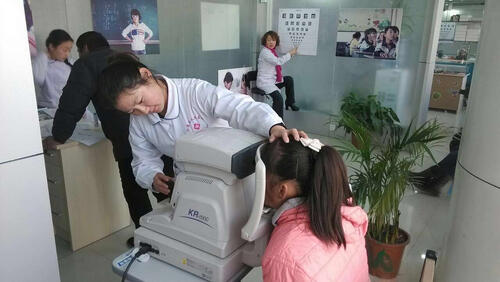
A girl tries on her first pair of glasses at the Qi'nan County Hospital. Photo credit: Matt Sheehan

Improvements of that size represent some of the juiciest low-hanging fruit in Chinese education. Sixty percent of children in the countryside will drop out before high school, many due to failed grades and entrance exams. These tens of millions of dropouts threaten to throw a wrench in the Chinese government's plan to transition to a service- and innovation-based economy.

But when dealing with China’s bureaucracies, having a simple solution to a vexing problem isn’t enough to start harvesting that low-hanging fruit. The real art and science of the project came in aligning bureaucratic interests to get it off the ground.

“Every issue has its own little ecosystem,” Boswell said. 

For Seeing is Learning, that ecosystem involved education officials committed to the eye exercise regime, schools that closely guard access to their students, families who are deeply suspicious of the effect of eyeglasses and hospitals that saw no reason to screen rural kids.

Image
5616cf8b1400002b003c7d07

Students hurry to lunch at a school in Weng Yao village. Photo credit: Matt Sheehan

To break the impasse, the researchers had to first get local education bureaucrats on board. Randomized controlled trials proved the effectiveness of glasses and debunked the myth of eye exercises. They caught the eye of a powerful official in the nearby city of Tianshui, whose backing opened the doors to local schools. With REAP’s pledge to subsidize glasses, the hospitals suddenly saw large new markets materialize.

As a kicker, one trial found that when teachers were offered an iPad if their students were wearing glasses during random inspections, usage rates jumped from 9 to 80 percent.

“Hospitals love it because they get in the schools. Principals love it because of the impact on scores,” said Boswell. “We love it because the kids are learning.”

Turning that newfound excitement into a working program required the creation of two “Model Vision Counties” in which nurses and doctors like Wei Wentai receive accelerated optometry training.  In order to expand that reach from the county seat down to the village,  REAP ran another trial to see if teachers could conduct accurate eye exams after just a half-day training (answer: yes). So the newly trained doctors now rotate through the village schools, training teachers who then refer students to the hospital vision centers for proper prescriptions.

Image
5616d0d01400002b003c7d08

An elementary school teacher practices administering an eye exam during training. Photo credit: Matt Sheehan

Now the researchers are looking to scale up the program to six counties and at the same time turn the vision centers into sustainable social enterprises. Using their privileged access to schools, the vision centers can sell glasses to urban children with the resources to pay. Those profits then subsidize the first pair of glasses for rural kids, and repay REAP's initial loan, which REAP can then reinvest in creating further Model Vision Counties.

It’s a new model for REAP and one that prompts many new research questions. Can the vision centers earn enough revenue to both subsidize glasses and keep the hospitals happy? Will teachers enforce wearing eyeglasses if given a simple mandate rather than an iPad? Will the impact of the first pair of glasses convince rural parents to purchase the second pair?

Those questions will be investigated and answered when the project scales up. But as this van winds its way back down from the village to the county hospital, Wei Wentai reflects on the work they’ve done.

“I really feel like this is meaningful work,” he said. “When I hear the thank you’s from the parents, it’s really moving.”
 
Image
5616c8dd12000026007e4b39

A child takes an eye exam administered by REAP and CEEE.
 
Hero Image
5616cc1914000024003c7cfe
All News button
1
News Type
News
Date
Paragraphs

A REAP project takes on the challenge of teaching parents in rural China that playing with their children is as important as feeding them.

Once every week for six months, a special team of family planning workers fanned out across the remote towns of Shaanxi Province or journeyed to isolated villages in the Qinling Mountains, the cradle of China’s civilization and habitat of the world’s remaining wild pandas. Determined to make a difference, the workers braved downpours in the dead of winter and long, treacherous roads to conduct weekly visits to families living in the region’s rural corners.  

The little children who were their inspiration were often too shy to even make eye contact during the initial family sessions, but the government workers – part of a pilot group of parenting trainers – persevered. Eventually, the children welcomed the trainers with smiles, open arms and confident curiosity.

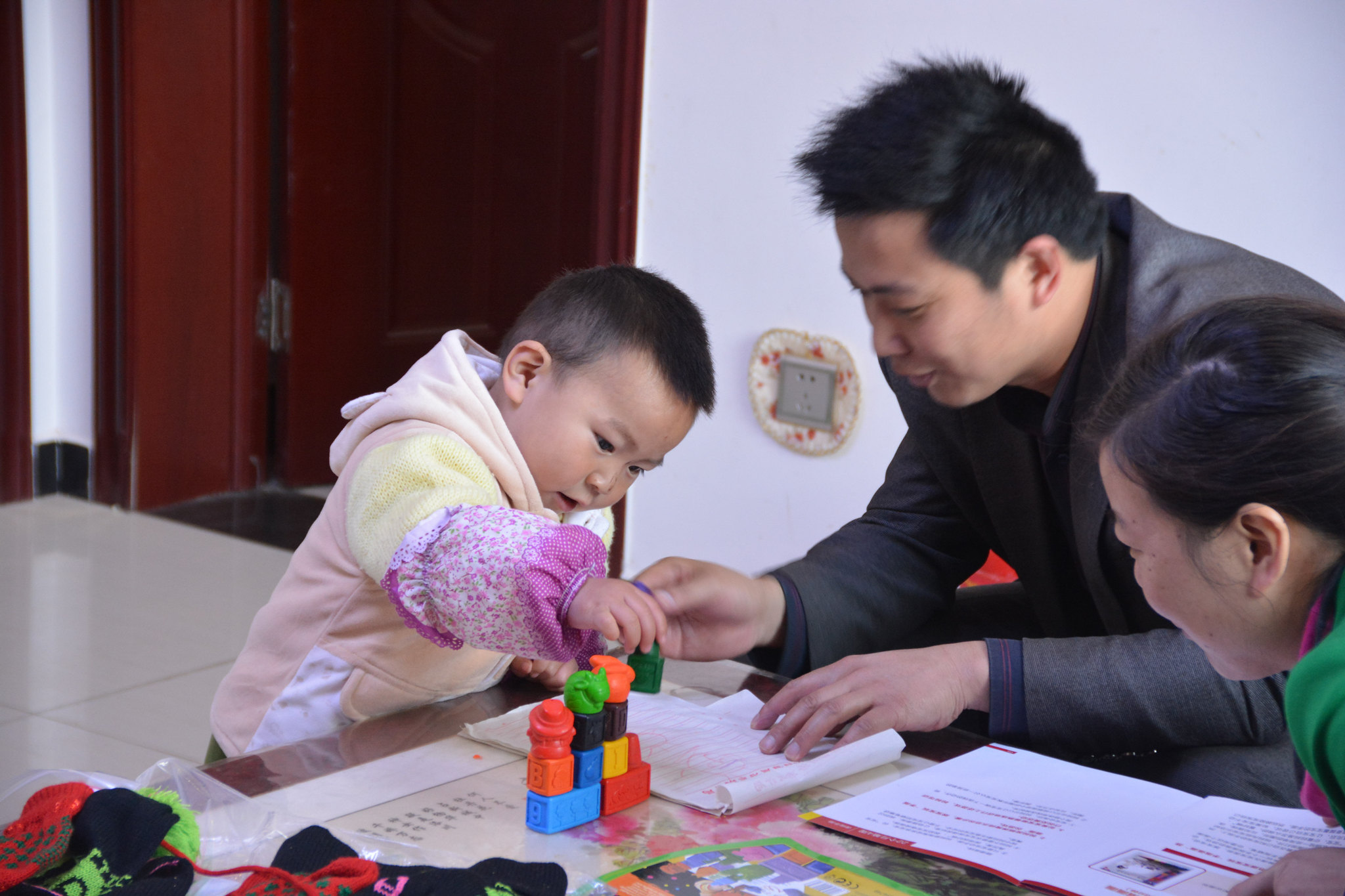
The parenting trainers brought toys to play with the toddlers, but not just for fun. The act of playing had a higher purpose.

Toddlers in rural China lag far behind their urban cohorts in developmental benchmarks, and Stanford’s Rural Education Action Program launched its Perfecting Parenting Project to tackle a key underlying cause: only a small fraction of rural parents interact with their young children.

“We want to get parents to improve their interactions with their toddlers,” said Alexis Medina, project manager of REAP’s health, nutrition and education initiatives.

That’s because the period between birth and age 3 is a critical developmental window, and interactive playing and verbal stimulation are important components of a child’s growth. REAP researchers know this, but a majority of parents in rural China do not.

For many parents or grandparents who are primary caregivers, the concept of actively engaging with their offspring is foreign. Research surveys revealed that less than 5 percent of parents in rural China regularly read to their babies and toddlers, and only 32 percent of them sing songs or use toys to play together. From their fieldwork, REAP researchers witnessed a pervasive view among parents: their young children are clothed and fed, isn’t that all they need?

In launching the 6-month pilot program in November 2014, researchers designed a week-by-week parenting curriculum – complete with books, balls and building blocks – to target key child development milestones.

“Before, the role of the family planning worker was to manage the quantity of the population,” said He Miao, one of the 70 parenting trainers recruited under the REAP project. “But from now on, our role is to improve the population’s quality.” 

3-baby3-5

Little Cheng Junya transformed from shy and withdrawn to outgoing and engaged in just two months of parenting visits.

As researchers work to gather project findings, REAP hopes Chinese officials will decide to expand the parenting training program. 

Those at the frontlines are already convinced.

“My child never used to be so comfortable around strangers; I can’t believe she is now so outgoing,” the mother of little Cheng Junya remarked just two months into the program. “This is all because of the visits from such excellent teachers.”

Echoing his fellow parenting trainers, family planning worker Qin Yulu said, "In all the years I’ve been in this position, this is the most meaningful work I have ever done.”

REAP researcher Xueyang Liu summed up her view of the project’s success. “Each family planning worker manages different children and faces different challenges: sometimes the roads are difficult, sometimes the parents are unappreciative, and sometimes the children are unresponsive,” she said. But, she continued, “the parent trainers are united both by their willingness to overcome difficulty and by a passion for their work, and this has earned them the respect and love of the parents.”

For a closer view of the challenges and promise of the Perfecting Parenting Project, take a look at the following stories by REAP researchers who shadowed China’s first crew of parenting trainers.


DSC_2958

Modern Parenting 101 
REAP researcher Xinrui Gao joins parent trainer Liu Xianju on several weekly sessions during the six-month pilot program and describes here a caretaker’s dramatic shift in attitude toward modern parenting.


3-baby1-1

Little Activities Go A Long Way 
REAP researcher Xi Zhiqi witnesses how the parenting program’s activities help to enhance a toddler’s verbal and social-emotional skills. This is her story of Little Wei.


DSC_3085

A Mother’s Realization 
REAP researcher Xueyang Liu describes here how a mother literally and metaphorically tramples on the project’s guidance materials before she comes to embrace the methods of active parenting.


3-baby4 These parenting trainers are propelled by thoughts of the children's recognition and trust when enduring tough travel conditions to reach their homes.

Trainers: A Santa Qin and Honorary Godmother  
The following two accounts by REAP researchers Wang Xiaohong and Jia Fang illustrate the immense dedication of two family planning workers from Shanyang County. 


DSC_3121

No Easy Road 
REAP researcher Zhang Nianrui describes a-day-in-the-life of a pair of parenting trainers as she joins them on a rough journey to the remote village homes of the families under their charge for the pilot project.


Hero Image
18176792366 22405f107b o
All News button
1
News Type
News
Date
Paragraphs

Hannah Myers

One simple action—placing eyeglasses on a nearsighted child’s face—can help that child to learn almost twice as much in a single school year. Yet only one out of seven children in rural China who needs glasses actually has them. Researchers at Stanford’s Rural Education Action Program (REAP) are now partnering with local government in China to address this problem. Targeting underserved rural primary school students in particular, they have implemented a sustainable pediatric vision care system in two counties. REAP is now preparing to launch a social enterprise based on this model to upscale across the country.
 
Matthew Boswell, Seeing is Learning’s Project Manager, explains, “We’ve tested our vision care model in the field and know that it’s effective at making care accessible, and makes a big difference in children’s education. By expanding into a social enterprise, we’re hoping to sustainably reach the millions of rural kids in China who need vision care.”
 
Yang Wenqing is one such child. A fourth grader at Helong Primary School in China’s rural northwestern Shaanxi province, Yang was struggling so much in school that she wanted to drop out. When the REAP team checked Yang’s vision, they found that she could not distinguish the largest letter on an eye chart 20 feet away—the same distance from her desk to the blackboard, where class notes and homework assignments are written. Having never had her vision checked, Yang thought this was normal. When the REAP team fitted Yang with her first pair of glasses, her jaw dropped and she whispered, “Can I keep these?”
 
At the end of her eye appointment, Yang told the REAP optician that receiving glasses had given her a new outlook on life. When her parents, who are migrant workers, return to visit Yang during the Chinese New Year, she is looking forward to showing them not only a new pair of glasses, but also an improved report card.
 
11059332616 c231f4a625 z Students whose vision problems were corrected learned almost twice as much in a single academic year as myopic children who did not receive glasses.
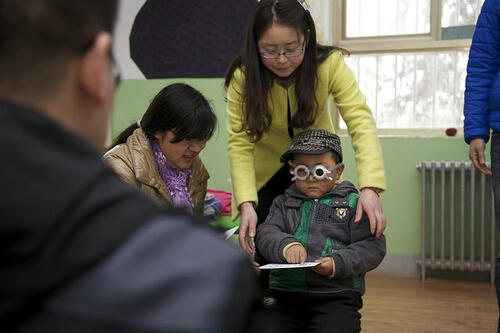

Having never had their vision tested, many rural children are unaware that they have poor vision, and that their eyesight is holding them back in school.

 
She is not alone. Over half of the world’s cases of uncorrected vision occur in China, where the lack of vision care in rural areas is obvious to even the casual observer. In response, REAP researchers launched the Seeing is Learning program in 2012, with the goal of using a simple intervention to transform the education and life opportunities for children like Yang.
 
The REAP team found that the vast majority of children with vision problems in rural China remain untreated. Furthermore, uncorrected vision is causing these students to fall far behind in school. As a Beijing ophthalmologist told the REAP team, “Eye care is sort of like cars in China. In the cities, people have luxury sedans, and in the countryside many still only have donkeys.” Why is vision care readily available in China’s urban areas, but failing in rural areas—and exacerbating the already substantial rural-urban education gap?
 
REAP identified both supply- and demand-side obstacles to vision care in rural China. On the demand side, widespread misconceptions hinder uptake of vision care. Rural parents, teachers, school administrators, and even government officials often believe that glasses harm children’s vision. Due to pervasive suspicion of eyeglasses and endorsement of eye exercises, a practice of rubbing around the eyes, rural families often do not seek care.
 
On the supply side, vision care professionals and eye doctors are located exclusively in the county seat. No clinicians, either public or private, have any incentive to visit rural areas to conduct screening or examinations. Because 7 out of 10 residents in rural areas live a long distance from the county seat, seeking care can be costly.
 
Since documenting these challenges, REAP has designed practical means to address them. The research team conducted a series of randomized controlled trials and unequivocally found that glasses slow, rather than speed up, the progression of myopia (nearsightedness), and that eye exercises have no measurable impact on vision.
 
Image
16436591941 2de1560300 z


Teachers are generally a trusted source of advice in rural communities. When they buy in to vision care, families often do too.

 
They also demonstrated that teachers can form a key component in the vision care system. After a half-day training session, teachers in rural schools screened their students for visual acuity with greater than 90 percent accuracy. Teachers can also supervise glasses wear effectively, guaranteeing that the vast majority of nearsighted students wear their glasses in class, where they are most needed.
 
Finally, the REAP team found that a student’s first pair of glasses must be free (or close to free) for rural households to uptake vision care. When offered free glasses, 8 out of 10 rural families accepted them, even when they had to travel long distances to obtain them. After receiving a voucher for free glasses, the parents of one nearsighted fifth-grade student told the REAP team, “We would travel a thousand miles to restore our daughter’s vision and brighten her future—we just didn't know she had a problem.”
 
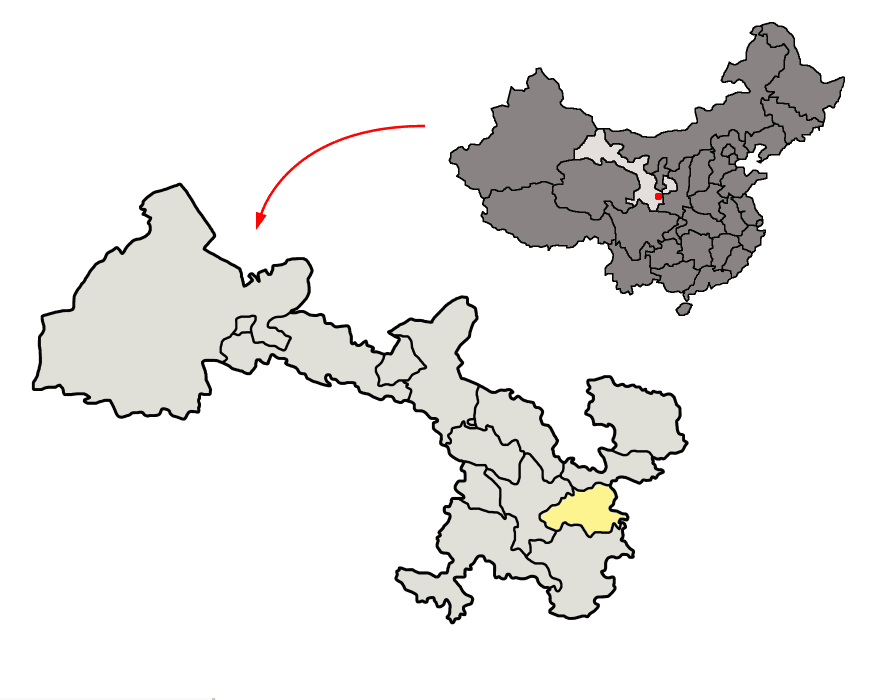
Location_of_Xianyang_Prefecture_within_Shaanxi_(China)

Yongshou, Shaanxi province (Photo Credit: Wikipedia)

Tianshui

Qinan, Gansu province (Photo Credit: Wikipedia)

With research in hand, in early 2014 REAP partnered with local governments in Yongshou county, Shaanxi province, and Qinan county, Gansu province to implement a new pediatric vision care system. REAP provided donated equipment (including autorefractors and lens edging machines) and high-quality glasses, and helped the hospitals transform space in their outpatient buildings into the vision centers. Four hospital staff were selected to run the clinics, and attended an intensive training program with REAP’s partners at Zhongshan Ophthalmic Center, returning as certified refractionists and opticians. The local Bureaus of Education then trained primary school teachers to screen their students and refer them to the new vision clinics.
 
This model met with strong success. During the 2014-2015 academic year, 80 percent of children who failed their vision tests went to the clinics in Qinan and Yongshou, where the newly trained optometrists were able to correct 96 percent of vision problems.
 
“Some students never raised their hands in class because they could not read the blackboard,” explained a primary school teacher in Shaanxi province. “Now that they can see clearly, they are eager to be called on.” Moving forward, these children will likely achieve far more in school, generating greater life opportunities and the ability to participate in China’s fast-changing economy.
 
REAP is now preparing to launch an innovative social enterprise based on the vision care system they tested in Qinan and Yongshou. The REAP team aims to use this social enterprise, called Learning in Focus, to end China’s rural vision care crisis, and do so sustainably.
 
As a part of Learning in Focus, REAP will assist county hospitals in building vision centers and provide necessary equipment. REAP will then arrange for four hospital staff members to be trained in ophthalmology and vision center management at Zhongshan Ophthalmic Center, China’s leading ophthalmology hospital. These new optometrists will train local teachers to vision screen their students in a monthly rotation.
 
Image
16252456337 b7854955cf b 1


A view inside Seeing is Learning's Yongshou vision clinic: newly certified refractionists and opticians diagnose and treat rural children.

 
Once Learning in Focus vision centers are up and running, they will give away the first pair of glasses to referred rural primary school students for free, while also providing refraction and eyewear to a fraction of the urban market and junior high students on a fee-for-service basis. This “first pair free” model is not just charity, it also helps build access to the huge and untapped rural market.
 
The vision centers will repay REAP’s initial investments in monthly installments. After three years, the vision centers will have recouped all start-up costs (equipment, renovation, training, and free glasses), and will begin to earn a profit. Through this market-driven approach, Learning in Focus will rapidly become self-sustaining.
 
In May, the REAP team met with government officials from 18 counties near Qinan and Yongshou to discuss starting Learning in Focus programs in their localities. County officials were highly interested, as the social enterprise both provides county hospitals with a new revenue stream and helps local governments tackle a key health and education issue. The REAP team is now laying the groundwork to implement Learning in Focus in these areas. In the next several years, they look forward to expanding across rural China, transforming education and opportunities for rural kids like Yang Wenqing in the process.
 
This Seeing is Learning project is a part of REAP’s broader goal to improve the health, nutrition, and education of China’s rural poor families. Under the direction of Scott Rozelle, the Helen F. Farnsworth Senior Fellow at the Freeman Spogli Institute for International Studies, REAP evaluates the impact and effectiveness of development projects and seeks to upscale programs that work. To learn more about REAP’s diverse projects across rural China, visit their website.
 
 
Contacts
 
Matthew Boswell - Project Manager, Seeing is Learning (boswell@stanford.edu)
Scott Rozelle - REAP Co-Director (rozelle@stanford.edu)
 
 
Hero Image
11059432544 63bef89ec8 o
All News button
1
0
Professor, Queen's University Belfast
Research Affiliate, Rural Education Action Program
nathan_congdon_wideshot.jpg MD, MPH

Dr Nathan Congdon received an AB degree from Princeton University and an MPhil from Cambridge, both in Oriental languages and literature. His medical and public health education were received at Johns Hopkins University, where he pursued an ophthalmology residency at the Wilmer Eye Institute. Dr Congdon’s career has focused on public health research as a tool to improve the quality of blindness prevention programs in rural Asia. He has worked at the nexus between academia and program delivery. His research has resulted in the publication of over 100 peer-reviewed articles, and has been supported by the NIH, World Bank, RPB and the governments of China and Hong Kong. Dr Congdon moved with his family to China five years ago, where he is a Professor of Preventive Ophthalmology at Zhongshan Ophthalmic Center, the largest eye hospital in China. He regularly collaborates on blindness prevention programs in Asia and elsewhere with NGOs including Helen Keller International, ORBIS International and the Fred Hollows Foundation. In addition to providing medical and surgical care to adults and children with glaucoma, a major focus of Dr Congdon’s work has been the training of the next generation of eye doctors in China. He has received the Wilmer Resident Teaching Award, the Outstanding Service Award and Holmes Lecture Award from the APAO, and has recently been awarded a Thousand Man Prize by the Chinese government.

News Type
Q&As
Date
Paragraphs

For 14 years, Mariano-Florentino Cuéllar has been a tireless Stanford professor who has strengthened the fabric of university’s interdisciplinary nature. Joining the faculty at Stanford Law School in 2001, Cuéllar soon found a second home for himself at the Freeman Spogli for International Studies. He held various leadership roles throughout the institute for several years – including serving as co-director of the Center for International Security and Cooperation. He took the helm of FSI as the institute’s director in 2013, and oversaw a tremendous expansion of faculty, research activity and student engagement. 

An expert in administrative law, criminal law, international law, and executive power and legislation, Cuéllar is now taking on a new role. He leaves Stanford this month to serve as justice of the California Supreme Court and will be succeeded at FSI by Michael McFaul on Jan. 5.

 As the academic quarter comes to a close, Cuéllar took some time to discuss his achievements at FSI and the institute’s role on campus. And his 2014 Annual Letter and Report can be read here.

You’ve had an active 20 months as FSI’s director. But what do you feel are your major accomplishments? 

We started with a superb faculty and made it even stronger. We hired six new faculty members in areas ranging from health and drug policy to nuclear security to governance. We also strengthened our capacity to generate rigorous research on key global issues, including nuclear security, global poverty, cybersecurity, and health policy. Second, we developed our focus on teaching and education. Our new International Policy Implementation Lab brings faculty and students together to work on applied projects, like reducing air pollution in Bangladesh, and improving opportunities for rural schoolchildren in China.  We renewed FSI's focus on the Ford Dorsey Program in International Policy Studies, adding faculty and fellowships, and launched a new Stanford Global Student Fellows program to give Stanford students global experiences through research opportunities.   Third, we bolstered FSI's core infrastructure to support research and education, by improving the Institute's financial position and moving forward with plans to enhance the Encina complex that houses FSI.

Finally, we forged strong partnerships with critical allies across campus. The Graduate School of Business is our partner on a campus-wide Global Development and Poverty Initiative supporting new research to mitigate global poverty.  We've also worked with the Law School and the School of Engineering to help launch the new Stanford Cyber Initiative with $15 million in funding from the Hewlett Foundation. We are engaging more faculty with new health policy working groups launched with the School of Medicine and an international and comparative education venture with the Graduate School of Education. 

Those partnerships speak very strongly to the interdisciplinary nature of Stanford and FSI. How do these relationships reflect FSI's goals?

The genius of Stanford has been its investment in interdisciplinary institutions. FSI is one of the largest. We should be judged not only by what we do within our four walls, but by what activity we catalyze and support across campus. With the business school, we've launched the initiative to support research on global poverty across the university. This is a part of the SEED initiative of the business school and it is very complementary to our priorities on researching and understanding global poverty and how to alleviate. It's brought together researchers from the business school, from FSI, from the medical school, and from the economics department.  

Another example would be our health policy working groups with the School of Medicine. Here, we're leveraging FSI’s Center for Health Policy, which is a great joint venture and allows us to convene people who are interested in the implementation of healthcare reforms and compare the perspective and on why lifesaving interventions are not implemented in developing countries and how we can better manage biosecurity risks. These working groups are a forum for people to understand each other's research agendas, to collaborate on seeking funding and to engage students. 

I could tell a similar story about our Mexico Initiative.  We organize these groups so that they cut across generations of scholars so that they engage people who are experienced researchers but also new fellows, who are developing their own agenda for their careers. Sometimes it takes resources, sometimes it takes the engagement of people, but often what we've found at FSI is that by working together with some of our partners across the university, we have a more lasting impact.

Looking at a growing spectrum of global challenges, where would you like to see FSI increase its attention? 

FSI's faculty, students, staff, and space represent a unique resource to engage Stanford in taking on challenges like global hunger, infectious disease, forced migration, and weak institutions.  The  key breakthrough for FSI has been growing from its roots in international relations, geopolitics, and security to focusing on shared global challenges, of which four are at the core of our work: security, governance, international development, and  health. 

These issues cross borders. They are not the concern of any one country. 

Geopolitics remain important to the institute, and some critical and important work is going on at the Center for International Security and Cooperation to help us manage the threat of nuclear proliferation, for example. But even nuclear proliferation is an example of how the transnational issues cut across the international divide. Norms about law, the capacity of transnational criminal networks, smuggling rings, the use of information technology, cybersecurity threats – all of these factors can affect even a traditional geopolitical issue like nuclear proliferation. 

So I can see a research and education agenda focused on evolving transnational pressures that will affect humanity in years to come. How a child fares when she is growing up in Africa will depend at least as much on these shared global challenges involving hunger and poverty, health, security, the role of information technology and humanity as they will on traditional relations between governments, for instance. 

What are some concrete achievements that demonstrate how FSI has helped create an environment for policy decisions to be better understood and implemented?

We forged a productive collaboration with the U.N. High Commissioner for Refugees through a project on refugee settlements that convened architects, Stanford researchers, students and experienced humanitarian responders to improve the design of settlements that house refugees and are supposed to meet their human needs. That is now an ongoing effort at the UN Refugee Agency, which has also benefited from collaboration with us on data visualization and internship for Stanford students. 

Our faculty and fellows continue the Institute's longstanding research to improve security and educate policymakers. We sometimes play a role in Track II diplomacy on sensitive issues involving global security – including in South Asia and Northeast Asia.  Together with Hoover, We convened a first-ever cyber bootcamp to help legislative staff understand the Internet and its vulnerabilities. We have researchers who are in regular contact with policymakers working on understanding how governance failures can affect the world's ability to meet pressing health challenges, including infectious diseases, such as Ebola.

On issues of economic policy and development, our faculty convened a summit of Japanese prefectural officials work with the private sector to understand strategies to develop the Japanese economy.  

And we continued educating the next generation of leaders on global issues through the Draper Hills summer fellows program and our honors programs in security and in democracy and the rule of law. 

How do you see FSI’s role as one of Stanford’s independent laboratories?

It's important to recognize that FSI's growth comes at particularly interesting time in the history of higher education – where universities are under pressure, where the question of how best to advance human knowledge is a very hotly debated question, where universities are diverging from each other in some ways and where we all have to ask ourselves how best to be faithful to our mission but to innovate. And in that respect, FSI is a laboratory. It is an experimental venture that can help us to understand how a university like Stanford can organize itself to advance the mission of many units, that's the partnership point, but to do so in a somewhat different way with a deep engagement to practicality and to the current challenges facing the world without abandoning a similarly deep commitment to theory, empirical investigation, and rigorous scholarship.

What have you learned from your time at Stanford and as director of FSI that will inform and influence how you approach your role on the state’s highest court?

Universities play an essential role in human wellbeing because they help us advance knowledge and prepare leaders for a difficult world. To do this, universities need to be islands of integrity, they need to be engaged enough with the outside world to understand it but removed enough from it to keep to the special rules that are necessary to advance the university's mission. 

Some of these challenges are also reflected in the role of courts. They also need to be islands of integrity in a tumultuous world, and they require fidelity to high standards to protect the rights of the public and to implement laws fairly and equally.  

This takes constant vigilance, commitment to principle, and a practical understanding of how the world works. It takes a combination of humility and determination. It requires listening carefully, it requires being decisive and it requires understanding that when it's part of a journey that allows for discovery but also requires deep understanding of the past.

Hero Image
tino mug
All News button
1
Paragraphs

Empirical evidence suggests that the prevalence of soil-transmitted helminth (STH) infections in remote and poor rural areas is still high among children, the most vulnerable to infection. There is concern that STH infections may detrimentally affect children’s healthy development, including their cognitive ability, nutritional status, and school performance. Medical studies have not yet identified the exact nature of the impact STH infections have on children. The objective of this study is to examine the relationship between STH infections and developmental outcomes in 2,180 school-aged children in seven nationally-designated poverty counties in rural China. We conducted a large-scale survey in Guizhou province in southwest China in May, 2013. Overall, 42 percent of elementary school-aged children were infected with one or more of the three types of STH—Ascarislumbricoides (ascaris), Trichuris trichuria (whipworm) and the hookworms Ancylostoma duodenaleor Necator americanus. After controlling for socioeconomic status, we observed that children infected with one or more STHs have worse cognitive ability, worse nutritional status, and worse school performance than their uninfected peers.

All Publications button
1
Publication Type
Working Papers
Publication Date
Authors
Alexis Medina
Scott Rozelle
Subscribe to Public Health