Governance

FSI's research on the origins, character and consequences of government institutions spans continents and academic disciplines. The institute’s senior fellows and their colleagues across Stanford examine the principles of public administration and implementation. Their work focuses on how maternal health care is delivered in rural China, how public action can create wealth and eliminate poverty, and why U.S. immigration reform keeps stalling. 

FSI’s work includes comparative studies of how institutions help resolve policy and societal issues. Scholars aim to clearly define and make sense of the rule of law, examining how it is invoked and applied around the world. 

FSI researchers also investigate government services – trying to understand and measure how they work, whom they serve and how good they are. They assess energy services aimed at helping the poorest people around the world and explore public opinion on torture policies. The Children in Crisis project addresses how child health interventions interact with political reform. Specific research on governance, organizations and security capitalizes on FSI's longstanding interests and looks at how governance and organizational issues affect a nation’s ability to address security and international cooperation.

-

Education is critical to economic and social development. There has been substantial progress in improving education in developing countries, but there are still considerable challenges ahead. In recent years, improvements in enrollment worldwide have slowed down, increasing by only two per cent between 2004 and 2009. Moreover, it is important for children not only to enroll in schools but to also complete their schooling. Although the international community has focused predominately on getting children into school, it is just as important to ensure that children are able to learn and acquire new skills when they do enter classrooms. What works in getting children into school in developing countries, keeping them there, and ensuring that they learn whilst there? Drawing on systematic review evidence, Howard White shows that most interventions intended to get children into school do work, as do those to improve learning outcomes. Some, of course, work better than others.


Howard White leads the International Initiative for Impact Evaluation (3ie),which funds impact evaluations and systematic reviews that generate evidence on what works in development programs and why. He is Managing Editor of the Journal of Development Studies and the Journal of Development Effectiveness.


This seminar is part of the new INTERNATIONAL EDUCATION INITIATIVE, a project co-sponsored by the Freeman Spogli Institute, the Rural Education Action Project, the Stanford Graduate School of Education, and the Center for Education Policy Analysis

CISAC Conference Room

Howard White Speaker
Seminars
-

The lost decades for China in the 1950s, 1960s and 1970s look remarkably like the lost decades of Africa in the 1980s and 1990s. Poor land rights, weak incentives, incomplete markets and inappropriate investment portfolios. However, China burst out of its stagnation in the 1980s and has enjoyed three decades of remarkable growth. In this talk Rozelle examines the record of the development of China’s food economy and identifies the policies that helped generate the growth and transformation of agriculture. Incentives, markets and strategic investments by the state were key. Equally important, however, is what the state did not do. Policies that worked and those that failed (or those that were ignored) are addressed. Most importantly, Rozelle tries to take an objective, nuanced look at the lessons that might be learned and those that are not relevant for Africa. Many parts of Africa have experienced positive growth during the past decade. Rozelle examines if there are any lessons that might be helpful in turning ten positive years into several more decades of transformation.

Scott Rozelle (main speaker). Scott Rozelle is the Helen F. Farnsworth Senior Fellow and the co-director of the Rural Education Action Program in the Freeman Spogli Institute for International Studies at Stanford University. His research focuses almost exclusively on China and is concerned with: agricultural policy, including the supply, demand, and trade in agricultural projects; the emergence and evolution of markets and other economic institutions in the transition process and their implications for equity and efficiency; and the economics of poverty and inequality, with an emphasis on rural education, health and nutrition.

Alain de Janvry (commentator). Alain de Janvry is an economist working on international economic development, with expertise principally in Latin America, Sub-Saharan Africa, the Middle-East, and the Indian subcontinent. Fields of work include poverty analysis, rural development, quantitative analysis of development policies, impact analysis of social programs, technological innovations in agriculture, and the management of common property resources. He has worked with many international development agencies, including FAO, IFAD, the World Bank, UNDP, ILO, the CGIAR, and the Inter-American Development Bank as well as foundations such as Ford, Rockefeller and Kellogg. His main objective in teaching, research, and work with development agencies is the promotion of human welfare, including understanding the determinants of poverty and analyzing successful approach to improve well-being and promote sustainability in resource use.

Bechtel Conference Center

Encina Hall East, E404
Stanford, CA 94305-6055

0
Faculty Co-director of the Stanford Center on China's Economy and Institutions
Helen F. Farnsworth Endowed Professorship
Senior Fellow at the Freeman Spogli Institute for International Studies
Senior Fellow at the Stanford Institute for Economic Policy Research
scott_rozelle_new_headshot.jpeg PhD

Scott Rozelle is the Helen F. Farnsworth Senior Fellow and the co-director of Stanford Center on China's Economy and Institutions in the Freeman Spogli Institute for International Studies and Stanford Institute for Economic Policy Research at Stanford University. He received his BS from the University of California, Berkeley, and his MS and PhD from Cornell University. Previously, Rozelle was a professor at the University of California, Davis and an assistant professor in Stanford’s Food Research Institute and department of economics. He currently is a member of several organizations, including the American Economics Association, the International Association for Agricultural Economists, and the Association for Asian Studies. Rozelle also serves on the editorial boards of Economic Development and Cultural Change, Agricultural Economics, the Australian Journal of Agricultural and Resource Economics, and the China Economic Review.

His research focuses almost exclusively on China and is concerned with: agricultural policy, including the supply, demand, and trade in agricultural projects; the emergence and evolution of markets and other economic institutions in the transition process and their implications for equity and efficiency; and the economics of poverty and inequality, with an emphasis on rural education, health and nutrition.

Rozelle's papers have been published in top academic journals, including Science, Nature, American Economic Review, and the Journal of Economic Literature. His book, Invisible China: How the Urban-Rural Divide Threatens China’s Rise, was published in 2020 by The University of Chicago Press. He is fluent in Chinese and has established a research program in which he has close working ties with several Chinese collaborators and policymakers. For the past 20 years, Rozelle has been the chair of the International Advisory Board of the Center for Chinese Agricultural Policy; a co-director of the University of California's Agricultural Issues Center; and a member of Stanford's Walter H. Shorenstein Asia-Pacific Research Center and the Center on Food Security and the Environment.

In recognition of his outstanding achievements, Rozelle has received numerous honors and awards, including the Friendship Award in 2008, the highest award given to a non-Chinese by the Premier; and the National Science and Technology Collaboration Award in 2009 for scientific achievement in collaborative research.

Faculty affiliate at the Center on Democracy, Development, and the Rule of Law
Faculty Affiliate at the Walter H. Shorenstein Asia-Pacific Research Center
Date Label
Scott Rozelle Speaker
Alain de Janvry Professor of Agricultural and Resource Economics, Goldman School of Public Policy, UC-Berkeley Speaker
Symposiums
Authors
James Chu
News Type
News
Date
Paragraphs

Original article at: http://www.3ieimpact.org/news.html?id=106

16 year old Kou Yaokang’s family are poor subsistence farmers. They cannot afford to pay for Kou's high school education. Instead of ending his formal education after middle school, Kou Yaokang enrolled in a vocational school. This seemed like a good idea at the time. “The government was providing subsidies for vocational schools, and I thought I could learn new skills to get a good job,” Kou Yaokang told a team from the Rural Education Action Project in December 2011.

Vocational schools are increasingly viewed as an appealing alternative to academic high schools in rural China. In recent years, the Chinese government—at both the local and national levels—has been encouraging students like Kou Yaokang to attend vocational schools. Shaanxi Province has invested US$ 80 million in vocational education in 2010.The central government gives a subsidy of US$ 250 per year for each student enrolled in a vocational school.

So what is behind this recent expansion of vocational schooling? The drive seems to be aimed at addressing the perceived failures of the country’s traditional schooling system. There is now a feeling that China’s higher education system, which has seen a 30-fold expansion over the past two decades, has sacrificed quality of education for quantity of diplomas. Each year the system churns out thousands and thousands of graduates with high expectations but few practical skills. These graduates then enter an economy that still relies heavily on low wage exports.  At the same time, the upper secondary school system has not found a way of providing quality education to the large number of students from underserved rural areas. These students enter China’s extremely competitive higher education system without the skills to excel in the nation’s rigid, test-centered curriculum.

China’s policymakers believe that the expansion of vocational schooling can help redress these failures in two ways. On one hand it would reduce the pressure on the higher education system by drawing children to vocational schools. On the other hand it would also impart “useful” skills to young people who want to directly enter the workforce. The government’s goal is to have an equal number of students in academic and vocational high schools.

What is the quality of vocational education?

At REAP, we were concerned. Was the expansion of vocational education really good for students? There was little evidence on the quality of vocational education in China. No standardized evaluations of student performance had been conducted in Chinese vocational schools. Most of the available evidence was either anecdotal or based on scant data. From our preliminary assessment, it seemed like these vocational schools were hiring ill-qualified teachers. The facilities in these schools were poor and teachers were not able to maintain student discipline.

Unfortunately, Kou Yaokang’s story does not have a happy ending. He dropped out of the subsidized vocational school after just one semester, citing the poor quality of teachers, inability to gain practical experience at school, and lack of discipline in the school. “People would wrestle in class and the teacher would do nothing! How was I supposed to learn in this environment?” said Kou.

Were the other 12 million students in Chinese vocational schools also experiencing the same problems? Encouraging them to attend poor quality schools would have negative effects and their families. At REAP, we felt the need to assess whether students were actually learning in these vocational schools. However, a solid evaluation of vocational education alone would not have been enough to change or support policy. We also needed strategic partners who would help us communicate to the top leaders in China. REAP could not work alone.

Building Partnerships

Before we began any evaluation work, we contacted our long-time partners at the Chinese Academy of Sciences, the Chinese Institute for Education Finance Research (at Peking University), and Northwest University of Xi’an- three prestigious research groups.

Our partners were well positioned to translate our results to policy change. For example, the Chinese Academy of Sciences has a long track record in influencing national policy. They have published 12 policy briefs that have been read by top policymakers including Premier Wen Jiabao and State Councilor Liu Yandong. Our partners at Peking University were also part of an education finance research team, with previous work directly overseen by the Ministry of Finance.

Even though we had partners, we also wanted to directly collaborate with policymakers at all levels: local, provincial, and national. The Ministry of Finance and Ministry of Education were interested in this study as soon as we presented it to them. They pledged to provide access to any data they had and offered to write letters of introduction to provincial officials on our behalf.

At the provincial level, the Zhejiang Department of Education officially commissioned us to evaluate their vocational schools. The Shaanxi Department of Education also wrote a letter supporting our efforts and pledging to be a stakeholder in the final report. We even contacted individuals at the local level. These were people who were part of district education bureaus we had worked with before or bureaus we thought would be interested in our work.

Aiming for Policy Change

With the support of the government and our partners, and financial backing from 3ie, in the autumn of 2011, REAP began the first ever large-scale study to evaluate the impact of vocational schooling on student learning in China. Using standardized tests developed by our partners at Peking University, we conducted a baseline survey in Zhejiang and Shaanxi provinces covering over 120 randomly selected schools and 12,000 vocational school students. We also surveyed academic high schools that enrolled students with similar test scores and family backgrounds as our vocational school students.

Although our study is ongoing, preliminary results suggest that vocational schools are indeed not all that they promise to be. They do not offer much practical training, suffer from serious disciplinary problems, and lack well-qualified teachers. Of course, we still need to analyze our final results to see the “proof in the pudding”. Before the summer of 2012, we will return to each of these schools to conduct a second survey. It is only then that we will be able to compare the gains in standardized test scores between vocational and academic high school students.

Although our evaluation is still underway, we continue to communicate preliminary results to policymakers. Apart from our usual policy briefs and publications, we also periodically visit policymakers to inform them of our progress. In fact, because we took the lead in collaborating with them before undertaking the study, there are times when the policymakers themselves contact us, asking about our results.

We also periodically bring local and provincial policymakers to Beijing to attend policy relevant conferences. For example, we hosted a conference in March that brought together policymakers, students, school principals, academics and representatives from not-for-profit organizations, and foundations.

Ultimately, all of our efforts - building partnerships, conducting rigorous evaluations, and communicating results - are geared towards policy change. Conducting evaluations of new policies can sometimes be the best way to help students like Kou Yaokang stay in school. The results of the evaluation can help in designing programmes that achieve their intended goals and benefit the poor students of rural China. The fact that policymakers at all levels have been involved from the outset greatly increases the chances that our recommendations will be incorporated and lives will be changed.


Hero Image
4905882946 ba38deed87 z
All News button
1
Authors
Scott Rozelle
News Type
News
Date
Paragraphs

Full text available at YaleGlobal.

Children of China's Future – Part II

 
Aging population and poverty require stronger investment in China’s rural youth
Karen Eggleston, Jean Oi, Scott Rozelle, Ang Sun, Xueguang Zhou
YaleGlobal, 14 March 2012
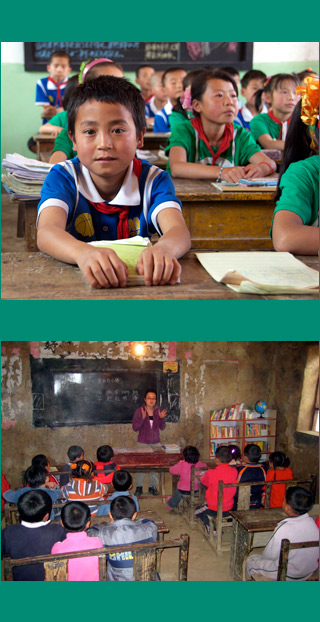
Poor education mortgaging the future? Students in a Gansu province school, where many are anemic (top); another class room in Loess Plateau. (Top Photo: Adam Gorlick)

DINGXI PREFECTURE: Wang Hongli, 8 years old, lives in a remote rural village on the Loess Plateau in one of China’s poorest and most agricultural provinces, Gansu. His prospects for living the good life are as bleak as the landscape. He is not on track to become part of China’s emerging middle class, the free-spending, computer-savvy, person-of-the-world often featured in the western media.

Hongli is a pseudonym. His parents work in a faraway industrial zone, coming home for only three weeks at Chinese New Year. His grandmother takes care of him and his siblings on the weekends, and during the week he lives in a dorm, three to a bed with 36 other students in an unheated room 4 by 4 meters.

Hongli suffers from iron-deficient anemia, but neither his family nor his teacher knows he is sick. Even if his anemia is discovered and treated by the researchers who have documented 30 percent anemia among children in poor rural areas, it likely will recur after he finishes the study, with furnished dietary supplements. Despite educational pamphlets, he’ll likely revert to a diet of staple grains and bits of pickled vegetables.

Unsurprisingly, Hongli’s grades are not good. In China’s competitive school system, he has only a slight chance of attending high school, much less college. In China’s future high-wage economy, all Hongli can hope for is a menial job in the provincial capital, Lanzhou, or as a temporary migrant elsewhere. Without urban permanent residency, hukou, he will have limited access to urban social services. He may suffer chronic unemployment, or resort to the gray economy or crime. He also may never marry – one of the millions of “forced bachelors” created by China’s large gender imbalance.

In China’s future high-wage economy, 
all the rural poor can hope for is menial jobs in a provincial capital.

Hongli is not alone. In fact, he’s one of 50 million school-age youth in China’s vast poor rural hinterlands. Recent studies by Stanford and Chinese collaborators show that 39 percent of fourth-grade students in Shaanxi Province are anemic, with similarly high rates elsewhere in the northwest; up to 40 percent of rural children in the poor southwest regions, e.g., Guizhou, are infected with intestinal worms. Millions of poor rural students throughout China are nearsighted, but do not wear glasses.

Because China’s urbanites have fewer children, poor rural kids like Hongli represent almost a third of China’s school-aged children, a large share of the future labor force. These young people must be healthy, educated and productive if China is to have any chance of increasing labor productivity to offset the shrinking size of its aging workforce.

Many observers presume that China’s growth will continue unabated, drawing upon a vast reservoir of rural labor to staff manufacturing plants for the world. In fact, to a considerable extent, China’s rural areas have already been emptied out, leaving many villages with only the old and the very young. The growth of wages for unskilled workers exceeds GDP growth.

Better pay should be good news for poverty alleviation. However, rising wages push up the opportunity cost of staying in school – especially since high school fees, even at rural public schools, are among the highest in the world.

It’s myopic to allow rural students to drop out of junior high and high school – mitigating the current labor shortage, but mortgaging their futures. Recent studies demonstrate that eliminating high school tuition – or reducing the financial burden on poor households – improves junior high achievement and significantly increases continuation on to high school. Yet unlike many other developing countries, China does not use incentives to keep children in school, such as conditional cash transfers. The public health and educational bureaucracies also do not proactively cooperate to remedy nutritional and medical problems – including mental health – that school-based interventions could address cost effectively.

Less than half of youth in China’s poor rural areas go to academic high school; less than 10 percent head to college.

The educational system, based on rote memory and drill, doesn’t teach children how to learn. The vocational education system is ineffective. Instead, China’s schools tend to focus resources on elite students. Tracking starts early, and test scores are often the sole criterion for success. A recent comparative study documents that China’s digital divide, with lower access to computers in poor rural areas, is among the widest in the world.

China’s government is increasing expenditures for school facilities and raising teacher salaries. However, these steps are far from adequate. During South Korea’s high growth, almost all Korean students finished high school. Today, less than half of youth in China’s poor rural areas go to academic high school, and the percent going to college remains in the single digits.

Greater investment in public health and education for the young people in China’s poor rural areas is urgent. If the government waits 10 years, it may be too late to avert risks for China’s stability and sustained economic growth.

Surely China could easily address this problem? A third of Chinese were illiterate in the early 1960s; now, fewer than 5 percent are. By 2010, about 120 million Chinese had completed a college degree. Chinese also enjoy a relatively long life expectancy compared to India and many other developing countries, and basic health insurance coverage is almost universal.

But the pace of change and citizens’ expectations are higher as well. Most Chinese assume that basic nutritional problems and intestinal worms were eradicated in the Mao era. China’s mortality halved in the 1950s; fertility halved in the 1970s. As a result, China will get old before it gets rich. Population aging, rapid urbanization and a large gender imbalance represent intertwined demographic challenges to social and economic governance. The policy options are complicated, the constraints significant, the risks of missteps real and ever-present.

China’s prosperity depends on youth mastering skills to thrive in a technology-driven world.

Timely policy response is complicated by competition for resources – pensions, long-term care, medical care for the elderly and more – as well as significant governance challenges arising from a countryside drained of young people. The well-intentioned programs for what government regards a “harmonious society” create large unfunded mandates for local authorities. Attempts to relocate rural residents to new, denser communities provoke anger at being uprooted and skepticism that local authorities simply want to expropriate land for development.

Millions of migrant workers – like Wang Hongli’s parents – return to their rural homes during economic downturns. Urbanization weakens this capacity to absorb future economic fluctuations. Government efforts at “social management” – strengthening regulatory control of informal social groups and strategies for diffusing social tensions – expand the bureaucratic state, a central target of popular discontent.

Premier Wen Jiabao’s announcement of a 7.5 percent growth target – the lowest in two decades – has been expected. Future economic growth will moderate partly because of demographics, but mostly because productivity gains slow as an economy runs out of surplus rural labor and converges on the technological frontier. Costly upgrading of industrial structure will squeeze the government’s ability to deliver on its promise of a better future for all, stoking social tensions.

China’s stability and prosperity, and that of the region and the globe, depends on how well today’s youth master the knowledge and skills that enable them to thrive in the technology-driven globalized world of the mid-21st century. Resilient public and private sector leaders of the future must be able to think creatively. Therefore, China’s government should respond to population aging by acting now to invest more in the health and education of youth, especially the rural poor.


Hero Image
5734696609 a3b10b4c8f z
All News button
1
Subscribe to Governance