FSI researchers consider international development from a variety of angles. They analyze ideas such as how public action and good governance are cornerstones of economic prosperity in Mexico and how investments in high school education will improve China’s economy.
They are looking at novel technological interventions to improve rural livelihoods, like the development implications of solar power-generated crop growing in Northern Benin.
FSI academics also assess which political processes yield better access to public services, particularly in developing countries. With a focus on health care, researchers have studied the political incentives to embrace UNICEF’s child survival efforts and how a well-run anti-alcohol policy in Russia affected mortality rates.
FSI’s work on international development also includes training the next generation of leaders through pre- and post-doctoral fellowships as well as the Draper Hills Summer Fellows Program.
The Relationship Between Birth Season and Early Childhood Development: Evidence from Northwest Rural China
Trajectories of Child Cognitive Development During Ages 0-3 in Rural Western China: Prevalence, Risk Factors and Links to Preschool-Age Cognition
Foreign Policy: China Will Run Out of Growth if it Doesn't Fix its Rural Crisis
No country with China’s vast education and public health problems has ever broken out of the ranks of middle-income countries.
"At a time when every other major economy is shrinking, China announced in late January that its GDP grew 2.3 percent in 2020. Beneath that impressive achievement, however, lies a very unbalanced recovery: As in the past, Beijing relied heavily on state investment and a state-led push for higher industrial production, while private investment and consumer spending remained weak. Easy credit to fuel growth has likely formed even more so-called zombie companies with little prospect of future profitability and filled the books of Chinese banks with even more bad loans.
That much is familiar to many who have taken a closer look at China’s skewed model for economic growth. What’s much less well known is the disproportionate burden of the COVID-19-induced downturn that has fallen on rural Chinese, including the 290 million migrant workers with rural hukou (household registrations) who work in cities throughout China. Lockdowns forced by the pandemic paralyzed economic sectors where many migrants work, such as services and retail. According to one estimate, Chinese migrant workers lost about $100 billion in wages that they are unlikely ever to recover.
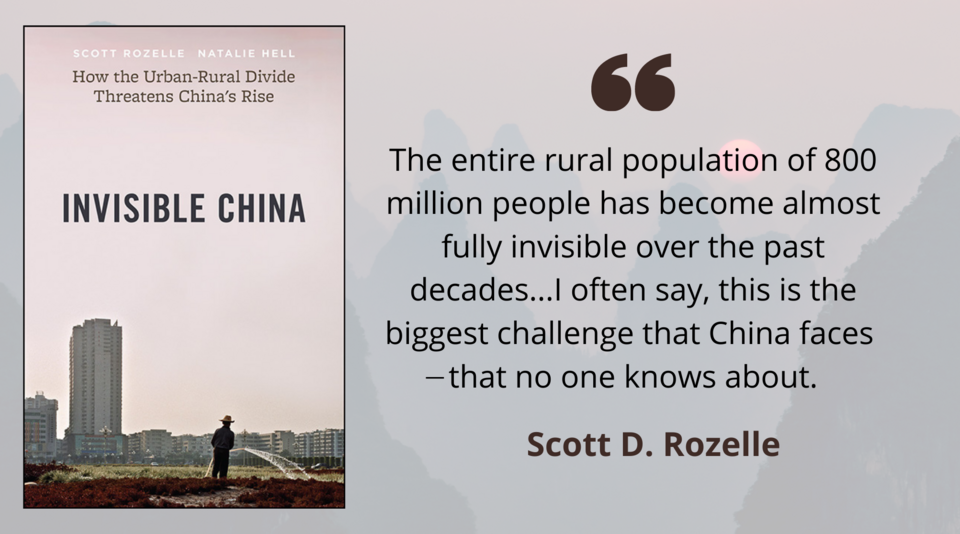
Among migrant workers and the underdeveloped rural communities that depend on the wages they send home, a quiet crisis is taking place—with potentially dramatic consequences for China’s future growth. Despite what the GDP number suggests about the country’s successful handling of the pandemic, China’s longer-term economic risks have only grown—and are a direct result of the crisis in rural China. As Stanford University researchers Scott Rozelle and Natalie Hell document in their meticulously researched book, Invisible China: How the Urban-Rural Divide Threatens China’s Rise, hundreds of millions of rural Chinese face a dangerous lack of human capital and suffer from pervasive health problems, including widespread iron-deficiency anemia, uncorrected myopia, and parasitic intestinal worms. Exacerbated by the pandemic, China’s rural crisis remains largely invisible to outside observers, and even to many Chinese."
Read the full article from Foreign Policy.
Chorzempa & Huang write on China's rural human capital crisis stating that "no country with China's vast education and public health problems has ever broken out of the ranks of middle-income countries." The article references FSI Senior Fellow and SCCEI Director Scott Rozelle's book "Invisible China: How the Urban-Rural Divide Threatens China’s Rise" throughout.
Cognitive Ability and Academic Performance Among Left-Behind Children: Evidence from Rural China
Little attention has been paid to the role that low levels of cognitive development (or IQ) play among both left-behind children (LBCs) and children living with parents (CLPs) in the context of poor educational attainment in rural China. In this paper, we examine how general cognitive abilities contribute to the academic achievement gains of both LBCs and CLPs in poor areas of rural China. We measure the general cognitive ability of the 4,780 sample students using the Raven’s Standard Progressive Matrices (Raven IQ) and assess academic achievement using a curriculum-based mathematics exam. We find that IQ and left-behind status predict achievement gains for the average student. Among low-IQ students, however, left-behind status does not correlate with a change in achievement, suggesting that the migration of parents does not immediately/automatically translate into a loss of academic achievement for students with delays in their general cognitive ability.
The Concept of Public Goods, the State, and Higher Education Finance: A View from the BRICs
Because higher education serves both public and private interests, the way it is conceived and financed is contested politically, appearing in different forms in different societies. What is public and private in education is a political–social construct, subject to various political forces, primarily interpreted through the prism of the state. Mediated through the state, this construct can change over time as the economic and social context of higher education changes. In this paper, we analyze through the state’s financing of higher education how it changes as a public/private good and the forces that impinge on states to influence such changes. To illustrate our arguments, we discuss trends in higher education financing in the BRIC countries—Brazil, Russia, India, and China. We show that in addition to increased privatization of higher education financing, BRIC states are increasingly differentiating the financing of elite and non-elite institutions.
Assessing College Critical Thinking: Preliminary Results from the Chinese HEIghten® Critical Thinking Assessment
Assessing student learning outcomes has become a global trend in higher education. In this paper, we report on the validation of the Chinese HEIghten® Critical Thinking assessment with a nationally representative sample of Electrical Engineering and Computer Science students from 35 institutions in China. Key findings suggest that there was a test delivery mode effect favoring the paper tests over the online tests. In general, the psychometric quality of the items was satisfactory for low-stakes, group-level uses but there were a few items with low discrimination that awaits further investigation. The relationships between test scores and various external variables such as college entrance examination scores, university elite status and student perceptions of the test were as expected. We conclude with speculations on the key findings and discussion of directions for future research.
Invisible China: How the Urban-Rural Divide Threatens China’s Rise — Book Launch Event
This event will take place on Zoom. Registration is required: http://bit.ly/Invisible_China
As the glittering skyline in Shanghai seemingly attests, China has quickly transformed itself from a place of stark poverty into a modern, urban, technologically savvy economic powerhouse. But as FSI Senior Fellow Scott Rozelle and Natalie Hell show in their new book Invisible China, the truth is much more complicated and might be a serious cause for concern.
Drawing on extensive surveys on the ground in China, Rozelle and Hell reveal that while China may be the second-largest economy in the world, its labor force has one of the lowest levels of education of any comparable country. The low levels of basic education of such a large share of workers may leave many unable to find work in the formal workplace as China’s economy changes and manufacturing jobs move elsewhere.
In this book talk event, Rozelle, who is also the director of FSI’s Rural Education Action Program, will be joined by Hongbin Li, a senior fellow at the Stanford Institute for Economic Policy Research and director of the China Program at the Stanford King Center on Global Development, who will moderate a discussion about the major themes of the book. A question and answer session with the audience will follow the discussion.
Scott Rozelle holds the Helen Farnsworth Endowed Professorship at Stanford University and is Senior Fellow in the Food Security and Environment Program and the Shorenstein Asia-Pacific Research Center, Freeman Spogli Institute (FSI) for International Studies. For the past 30 years, he has worked on the economics of poverty reduction. Currently, his work on poverty has its full focus on human capital, including issues of rural health, nutrition and education. For the past 20 year, Rozelle has been the chair of the International Advisory Board of the Center for Chinese Agricultural Policy, Chinese Academy of Sciences (CAS). In recent years Rozelle spends most of his time co-directing the Rural Education Action Project (REAP). In recognition of this work, Dr. Rozelle has received numerous honors and awards. Among them, he became a Yangtse Scholar (Changjiang Xuezhe) in Renmin University of China in 2008. In 2008 he also was awarded the Friendship Award by Premiere Wen Jiabao, the highest honor that can be bestowed on a foreigner.
Hongbin Li is the James Liang Director of the China Program at the Stanford King Center on Global Development, and a Senior Fellow of Stanford Institute for Economic Policy Research (SIEPR). Hongbin’s research has been focused on the transition and development of the Chinese economy, and the evidence-based research results have been both widely covered by media outlets and well read by policy makers around the world. He is currently the co-editor of the Journal of Comparative Economics.
Order Your Copy
Invisible China: How the Urban-Rural Divide Threatens China’s Rise
Book Synopsis:
As the glittering skyline in Shanghai seemingly attests, China has quickly transformed itself from a place of stark poverty into a modern, urban, technologically savvy economic powerhouse. But as Scott Rozelle and Natalie Hell show in Invisible China, the truth is much more complicated and might be a serious cause for concern.
China’s growth has relied heavily on unskilled labor. Most of the workers who have fueled the country’s rise come from rural villages and have never been to high school. While this national growth strategy has been effective for three decades, the unskilled wage rate is finally rising, inducing companies inside China to automate at an unprecedented rate and triggering an exodus of companies seeking cheaper labor in other countries. Ten years ago, almost every product for sale in an American Walmart was made in China. Today, that is no longer the case. With the changing demand for labor, China seems to have no good back-up plan. For all of its investment in physical infrastructure, for decades China failed to invest enough in its people. Recent progress may come too late. Drawing on extensive surveys on the ground in China, Rozelle and Hell reveal that while China may be the second-largest economy in the world, its labor force has one of the lowest levels of education of any comparable country. Over half of China’s population—as well as a vast majority of its children—are from rural areas. Their low levels of basic education may leave many unable to find work in the formal workplace as China’s economy changes and manufacturing jobs move elsewhere.
In Invisible China, Rozelle and Hell speak not only to an urgent humanitarian concern but also a potential economic crisis that could upend economies and foreign relations around the globe. If too many are left structurally unemployable, the implications both inside and outside of China could be serious. Understanding the situation in China today is essential if we are to avoid a potential crisis of international proportions. This book is an urgent and timely call to action that should be read by economists, policymakers, the business community, and general readers alike.
Meet the Authors:
Order Your Copy
Correlates of Participation in Community-Based Interventions: Evidence from a Parenting Program in Rural China
A growing body of literature has documented that community-based early childhood development (ECD) interventions can improve child developmental outcomes in vulnerable communities. One critical element of effective community-based programs is consistent program participation. However, little is known about participation in community-based ECD interventions or factors that may affect participation. This paper examines factors linked to program participation within a community-based ECD program serving 819 infants and their caregivers in 50 rural villages in northwestern China. The results find that more than half of families did not regularly attend the ECD program. Both village-level social ties within the program and proximity to the program significantly predict program participation. Increased distance from the program site is linked with decreased individual program participation, while the number of social ties is positively correlated with participation. The average program participation rates among a family’s social ties is also positively correlated with individual participation, indicating strong peer effects. Taken together, our findings suggest that attention should be given to promoting social interactions and reducing geographic barriers among households in order to raise participation in community-based ECD programs.