Nutrition
Paragraphs

Background. Despite growing wealth and a strengthening commitment from the government to provide quality education, a significant share of students across rural China still have inadequate access to micronutrient-rich regular diets. Such poor diets can lead to nutritional problems, such as iron-deficiency anemia, that can adversely affect attention and learning in school.

Objective. The overall goal of this paper is to test whether simple nutritional interventions lower rates of anemia and to assess whether this leads to improved educational performance among students in poor areas of rural China.

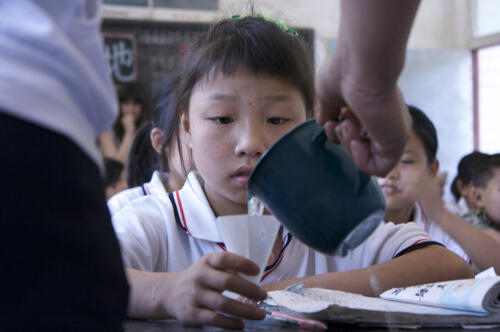
Approach: We report on the results of a randomized control trial (RCT) involving over 3600 fourth grade students, mostly aged 9 to 12, from 66 randomly-chosen elementary schools in 8 of the poorest counties in Shaanxi Province in China’s poor northwest region. The design called for random assignment of schools to one of three groups: two different types of treatment/intervention schools; a non-intervention, control group. The two interventions were designed to improve hemoglobin (Hb) levels, which is a measure of iron deficiency. One intervention provided a daily multivitamin with mineral supplements, including 5 milligrams of iron, for 5 months. The other informed the parents of their child’s anemia status and suggested several courses of action (henceforth, the information treatment).

Findings: Some 38.3 percent of the students had Hb levels of below 120 g/L, the World Health Organization’s cutoff for anemia for children 9 to 12 years old. In the schools that received the multivitamins with mineral supplements, Hb levels rose by more than 2 g/L (about 0.2 standard deviations). The standardized math test scores of the students in the schools that received the multivitamin with mineral supplements also improved significantly. In schools that received the information treatment, only students that lived at home (and not the students that lived in boarding schools and took most of their meals at schools) registered positive improvements in their Hb levels. The reductions in anemia rates and improvements in test scores were greater for students that were anemic at the beginning of the study period. Overall, these results should encourage China’s Ministry of Education (MOE) to begin to widen its view of education (beyond teachers, facilities and curriculum) and provide better nutrition and health care for students.

All Publications button
1
Publication Type
Journal Articles
Publication Date
Journal Publisher
Economic Development and Cultural Change
Authors
Scott Rozelle
Paragraphs

In this paper we present new evidence on the impact of health and nutrition information on anemia rates from three large-scale randomized controlled trials (RCTs) in rural China. Each RCT studies a different type of health education campaign designed in partnership with the Chinese government to reduce the prevalence of iron-deficiency anemia among rural primary school students. These campaigns include single and multiple face-to-face education sessions for parents at their children’s schools as well as dissemination of written health education materials. Across all three studies, we find little evidence of changes in blood hemoglobin concentration or anemia status. In contrast, in our two studies that also examined a multivitamin supplementation intervention, we find meaningful reductions in anemia.

All Publications button
1
Publication Type
Journal Articles
Publication Date
Journal Publisher
CESifo Economic Studies
Authors
Alexis Medina
Scott Rozelle
Paragraphs

The main goal of this paper is to analyze the factors (access, attendance and quality of preschools) that may be affecting the educational readiness of China’s rural children before they enter the formal school system. Using data from a survey of 80 preschools and 500 households in 6 counties in 3 provinces of China, this paper documents the nature of early childhood education (ECE) services and the educational readiness of children aged 4-5 in rural China. We present evidence that ECE services are seriously deficient. Households in many areas of rural China do not have convenient access to preschool facilities. Preschools have poor facilities, inadequate health services, and little concern for the nutrition of their students. Most teachers have little formal training. In part due (perhaps) to the poor quality and low participation in preschool, in this paper we will show that China's rural children score much lower on standardized educational readiness tests. In fact, according to our findings, more than one half of the rural children in our sample are “not ready” for continuing into the next level of formal education. Our analysis implies that it is necessary to improve the facilities and quality of teachers and to increase the probability that children will be sent to ECE institution.

All Publications button
1
Publication Type
Journal Articles
Publication Date
Journal Publisher
Australasian Journal of Early Childhood
Authors
Scott Rozelle
Paragraphs

Despite rapid growth in China, it is unclear whether the poor have benefited in terms of nutrition. This paper’s goal is to understand the prevalence of anemia among school children in western China.We report on results from seven cross-sectional surveys involving 12,768 age 8-12 students. Sample students were selected randomly from 283 primary schools in 41 poor counties of Ningxia, Qinghai, Shaanxi and Sichuan provinces. Data were collected through questionnaires and hemoglobin tests. The dataset represents 7 million age 8-12 children in poor western counties. The anemia prevalence was 34% using the WHO’s hemoglobin cutoff of < 120g/L. Students who boarded at school and girls were more likely to be anemic. Assuming the sample population is representative of poorregions in western China, nearly2.5 million 8-12 year old school children in the region may be anemic and many more iron deficient. Given China’s growth, such high prevalence of anemia is surprising and illustrative of the large health disparities in the country. Iron deficiency remains a significant nutrition issue, though there appears to be no effort to address this issue.

All Publications button
1
Publication Type
Journal Articles
Publication Date
Journal Publisher
Southeast Asian Journal of Tropical Medicine and Public Health
Authors
Scott Rozelle
Paragraphs

Opportunities to go to college and earn a degree have risen dramatically in China. Government investment into the college systems has skyrocketed and the size of universities has increased by more than five times over the past decade. With the rise in the opportunity to go to college, several questions naturally arise: Are the rural poor—perhaps those that would most benefit individually as well as provide spillovers to their home communities—being systematically excluded? If they are, what are the barriers that are keeping them from having access to higher education?

The overall goal of this paper is to answer these questions. To do so, we combine two sets of our own primary survey data. One survey covers a group of randomly selected high school students from the poor parts of Shaanxi province, one of China’s poorest provinces. The other survey is a census of all freshman entering into four universities in three poor provinces. With these data we seek to identify if China’s rural poor are being systematically excluded from the university system, and if so, why.

In the first part of the results section of the paper, we show that the participation rate of the poor accessing to college education is substantially lower than the students from nonpoor families. Clearly, there are barriers that are keeping the rural poor out. In the rest of the paper, we examine two general categories of barriers. First, according to our data from Shaanxi province, it does not appear that any real barriers appear at the period of time between the final year of high school and the first year of college. We find no empirical evidence that the College Entrance Exam (CEE) is biased against the poor; the exam scores of poor students are virtually the same as the exam scores of nonpoor students, holding all other factors constant. There is some evidence that the nature of the CEE process—particularly that the timing of when students find out about financial aid—distorts the decisions of poorer students regarding what college to attend and what major to pursue. At the same time, however, we observe that the admission rates between poor and nonpoor are statistically the same when poor students are admitted to university. Contrary to commonly held beliefs, we find that virtually every student who passes the entrance exam (poor and nonpoor alike) is able to find a way to pay the fees and tuition charges that are demanded upon matriculation and is able to enter college, despite the high costs.

Therefore, the paper concludes that if the real barriers are not at the time of admissions to college, there must be a second, remaining set of systematic barriers that prevent poor children from ever making it to the point where they take the CEE. In fact, a close reading of the literature and some of our own data demonstrate that the rural education system—in general—is putting rural children at a severe disadvantage at almost every point of the educational process (low rates of enrollment into early childhood education; low quality elementary schools; poor nutrition and low quality boarding facilities; high levels of high school tuition; a migrant schooling system that is outside of the public education system).

The paper concludes that the real barriers keeping the rural poor from pursuing a college education are being erected early in their educational experience—as early as preschool and elementary school—and are present throughout the entire schooling system.

All Publications button
1
Publication Type
Journal Articles
Publication Date
Journal Publisher
China Agricultural Economic Review
Authors
Scott Rozelle
Paragraphs

Although the past few decades have seen incomes rise and increased government commitment to helping the poor, there is concern that a large fraction of children in rural China still lack regular access to micronutrient-rich regular diets. Insufficient diets and poor knowledge of nutrition among low income populations can result in nutritional problems, including iron deficiency anemia, which adversely affect attention and learning in school. Surprisingly, there has been little research in China trying to document the prevalence of nutritional problems among certain vulnerable populations, such as school-aged children in rural areas. The absence of programs to combat iron deficiency anemia among students might be interpreted as a sign that the government does not recognize the severity of this problem. The goal of this paper is to increase our understanding of the extent of anemia among school-aged children in poor regions of Qinghai and Ningxia, and to identify structural correlates of anemia in this region. We report on the results of a cross-sectional survey involving over 4000 fourth grade students, from 76 randomly selected elementary schools in 10 poor counties in Qinghai Province and Ningxia Hui Autonomous Region, in China’s poor northwest region. Data were collected through structured questionnaires and standardized tests. Trained professional nurses administered hemoglobin (Hb) tests (using Hemocue finger prick kits) and anthropomorphic measurements using high quality equipment. Our baseline data shows that the overall anemia rate is 34.5% (23.0%) using the World Health Organization’s blood Hb cutoff of 120g/L (115g/L). We find that students who live and eat at school have higher rates of anemia. Children with less-educated parents are more likely to be anemic. Higher anemia rates are associated with students with parents working on farms and away from home. Anemia rates are correlated with adverse physical (lower body mass index (BMI) z-scores and higher incidences of stunting), cognitive and psychological impacts among students. Such findings are consistent with recent findings of other studies in other poor areas in China’s Northwest.

All Publications button
1
Publication Type
Journal Articles
Publication Date
Journal Publisher
Journal of Health, Population and Nutrition
Authors
Scott Rozelle
Alexis Medina
Subscribe to Nutrition