
China’s Share of U.S. Imports Has Plunged, but Its Value Added Has Proven Stickier
China’s Share of U.S. Imports Has Plunged, but Its Value Added Has Proven Stickier [ 5 min read ]
INSIGHTS
- U.S. imports have shifted sharply away from China, but not from the world. China’s share of U.S. imports fell from 21% in 2017 to 8% by late 2025, while total imports continued to grow and the U.S. external deficit remained around 3–4% of GDP.
- Dependence on China has proven stickier than direct trade. From 2017 to 2022, China’s direct share of U.S. imports fell from 21% to 16%, while its share of value added in U.S. imports edged down only from 15.7% to 15.3%. U.S. dependence also persists in key upstream materials, including rare earths and pharmaceutical ingredients.
- The shift has favored established U.S. trading partners. By 2024, Vietnam and Mexico had each gained just over 2 percentage points of U.S. import share, while the collective share of countries outside the top 20 remained largely unchanged.
- The shift away from China continues to deepen. By 2021–2024, it had spread to products for which switching suppliers is difficult and costly, and accelerated further after the April 2025 Liberation Day tariff announcements.
Source Publication: Laura Alfaro and Davin Chor (2026). An Anatomy of the Great Reallocation in U.S. Supply Chain Trade. NBER working paper.
Read this brief on SUBSTACK
Beginning in 2018, the U.S. imposed a series of tariffs on Chinese goods that raised the average U.S. tariff on imports from China by roughly 20 percentage points. The measures were followed by a broader push to reduce U.S. dependence on China through “friendshoring,” “nearshoring,” and reshoring supply chains. New research examines how U.S. sourcing actually changed in response, including after the second Trump administration’s April 2025 “Liberation Day” tariff announcements. Using detailed trade data through 2025, the researchers find a major reallocation of U.S. imports away from China and toward other countries, but little evidence that the U.S. is retreating from global trade overall.
The data. The researchers use U.S. Census Bureau data on imports at the detailed six-digit product level from 2013 through 2025. They track changes in both the value and market share of imports from China and other trading partners, and examine whether those shifts reflect increased purchases of products already imported from a country or the addition of new products. They also compare changes across products with different characteristics, including skill intensity, and how difficult established buyer-supplier relationships are to replace.
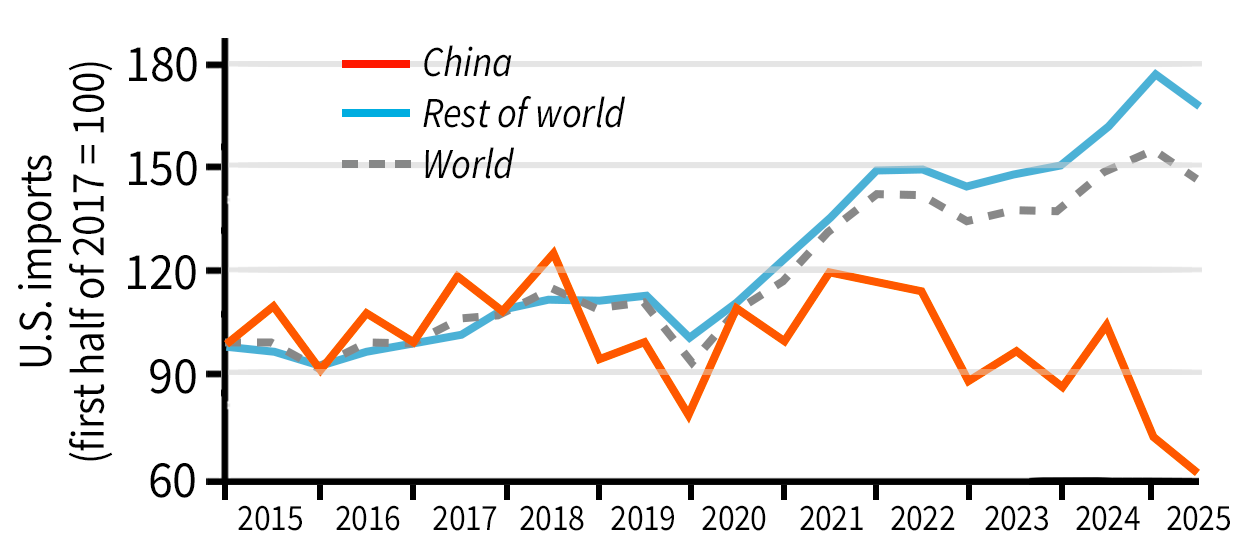
Decoupling from China, but not the world. The scale of the shift has been dramatic. Direct U.S. imports from China fell 40% cumulatively between 2017 and 2025, while China’s share of U.S. imports dropped from about 21% to just 8% by the fourth quarter of 2025. That put China’s share roughly back where it stood when the country joined the World Trade Organization in 2001. Yet total U.S. imports grew by an average of 5.7% per year over the same period, as increased imports from the rest of the world more than offset the decline from China. For the U.S., the reallocation has therefore been a decoupling from China, not from global trade.
Changes in U.S. imports by major trade partners (2015–2025)
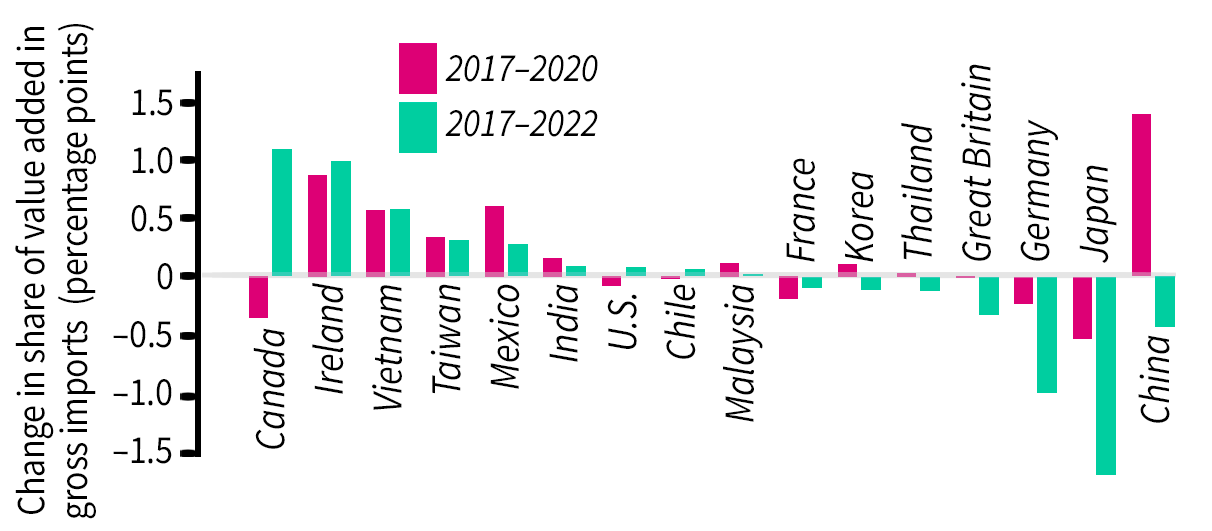
Dependence on China has proven harder to unwind. The decline in direct imports has not been matched by an equivalent decline in the Chinese value embedded in U.S. imports. From 2017 to 2022, China’s direct import share fell from about 21% to 16%, while its share of the value added embodied in U.S. imports edged down only from 15.7% to 15.3%. Countries gaining U.S. market share, including Vietnam and Mexico, continue to import significant volumes of intermediate goods from China that they assemble and sell to the U.S. Dependence also persists further upstream. Even as China lost U.S. market share in finished goods, such as apparel, footwear, and toys, its share actually increased in several upstream categories containing rare earths, base metals, and pharmaceutical ingredients.
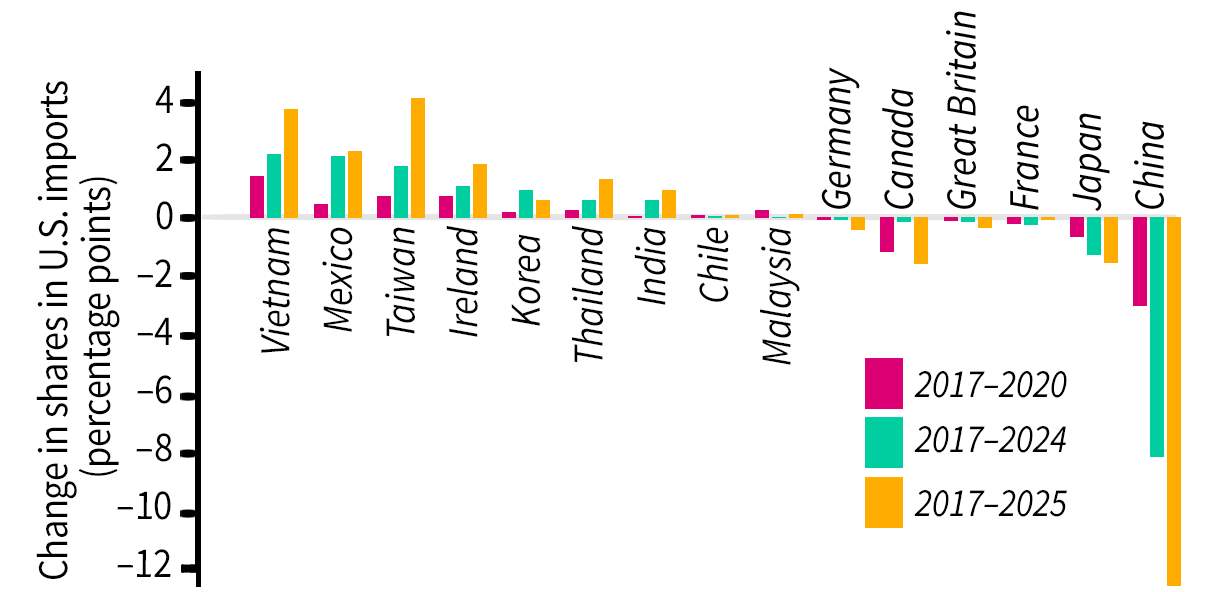
Trade shifted toward established partners. Vietnam and Mexico have been the largest beneficiaries of the U.S. reducing imports from China, each gaining slightly more than 2 percentage points of U.S. import share by 2024, followed by countries including Taiwan. Taiwan’s gains were overwhelmingly concentrated in computers and semiconductors, coinciding with surging U.S. demand for AI-related capital investment. But no new bilateral import relationship has approached the scale of the U.S.-China relationship at its peak: even Mexico, now the largest source of U.S. merchandise imports, held a markedly smaller share in late 2025 than China’s 21% before the trade war. Moreover, almost all the diversification has occurred among the U.S.’s existing top 20 suppliers. Between 2017 and 2025, only one country, the Netherlands, entered that group.
Changes in U.S. import shares across trade partners since 2017
Changes in value added import share in the U.S.
across trade partners since 2017
Even harder-to-move supply chains are shifting. Initially, the move away from China was concentrated in products for which changing suppliers was relatively easier. By 2021–2024, however, it had spread even to products for which switching suppliers is difficult and costly, suggesting that firms became increasingly willing to absorb the costs of reorganizing established supply chains as it became clear that U.S. tariffs on China would persist. The reallocation accelerated again following the April 2025 Liberation Day tariff announcements: U.S. imports shifted away from countries facing higher additional tariffs and toward countries facing lower tariffs and geographically closer supply networks. The speed of the response suggests that years of trade tensions had already pushed firms to develop alternative suppliers, production sites, and logistics plans that could be activated quickly. The researchers describe the post-Liberation Day response as a sharp acceleration of a reallocation already years in the making.
A structural shift, but not a clean break. The U.S.-China direct trade relationship has undergone an extraordinary unwinding, but what replaced it is not a clean break with China or a radically more dispersed global supply chain. U.S. imports moved primarily toward established partners; some of those partners remain tied to Chinese inputs; and key raw-material dependencies persist. The researchers conclude that the Great Reallocation represents a structural, rather than temporary, transformation in U.S. trade, but one that has brought relatively few new countries into U.S. value chains. They also find that the shift has not produced a dramatic reduction in the U.S. external deficit or substantially diminished China’s position as the world’s largest exporter. Whether America’s selective decoupling from China can coexist with continued economic interdependence with the rest of the world may help determine the next phase of globalization.